WASSCE Commerce · Marketing and Advertising
Marketing: concept, functions and the marketing mix
By the WASSCE Tutor team
Updated 12 November 2026 · 7 min read · Prepared against the WASSCE syllabus.
A good product does not sell itself. Someone must find out what customers want, set a price they will pay, get the product to where they shop and tell them it exists. That whole process is marketing. It begins before production and continues after the sale.
Learning objectives
By the end of this lesson you should be able to:
- define marketing and explain the marketing concept
- explain the functions of marketing
- describe the marketing mix (the four Ps)
- explain market research and market segmentation
- explain the product life cycle and pricing methods
Meaning of marketing
Marketing is the process of finding out what customers want and satisfying those wants at a profit. It covers market research, product design, pricing, distribution, promotion and after-sales service.
Marketing is wider than selling. Selling is persuading people to buy what has already been produced; marketing starts by asking what people want and then produces it.
| Approach | Focus |
|---|---|
| Production concept | Make goods cheaply and in large quantities; customers will buy |
| Selling concept | Push what has been made through strong selling and advertising |
| Marketing concept | Find out customer needs first, then produce to satisfy them |
| Societal marketing concept | Satisfy customers in a way that also protects society and the environment |
Functions of marketing
- Market research: finding out what customers want, at what price, and what competitors do.
- Product planning and development: designing products to meet wants.
- Buying and assembling: collecting goods or produce from many producers.
- Selling: transferring ownership to buyers.
- Standardisation and grading: sorting goods by quality and size so buyers know what they get.
- Packaging and branding: protecting and identifying the product.
- Pricing: setting prices that customers will pay and that cover costs.
- Transport and storage: getting goods to where and when they are wanted.
- Promotion: advertising, sales promotion and public relations.
- Financing: giving credit to buyers and paying producers.
- Risk-bearing: price changes, damage and unsold stock.
- After-sales service: repairs, guarantees and handling complaints.
Market research
Market research is the systematic collection and analysis of information about customers, markets and competitors.
| Method | Example |
|---|---|
| Questionnaires and surveys | Asking 200 students in Bo which snack they prefer |
| Interviews | Talking to shop owners about sales of a new drink |
| Observation | Watching which products customers pick up first |
| Test marketing | Selling a new product in one town before the whole country |
| Desk research | Using existing data: government statistics, trade reports, sales records |
Market segmentation divides the market into groups with similar needs: by age (children, youths), income, location (urban, rural), gender, occupation or lifestyle. A firm can then target each segment with a suitable product and message.
The marketing mix
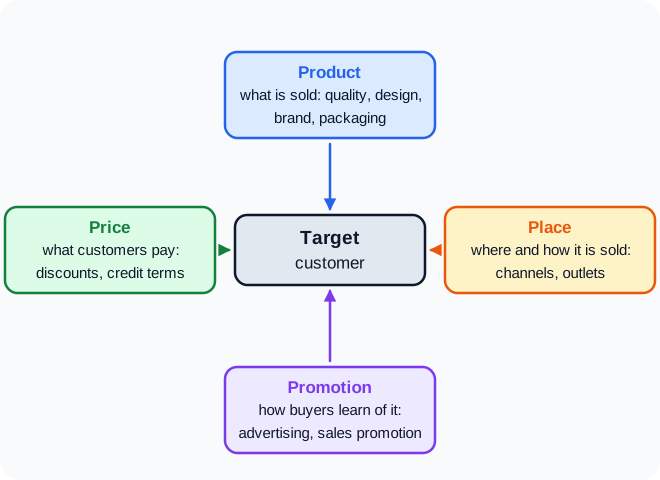
Figure 1. The marketing mix: the four Ps around the target customer. WASSCE Tutor diagram.
| P | Decisions |
|---|---|
| Product | Quality, design, features, brand name, packaging, sizes, guarantee |
| Price | Price level, discounts, credit terms, pricing method |
| Place | Channels of distribution, outlets, location, transport, stock levels |
| Promotion | Advertising, sales promotion, personal selling, public relations |
The four Ps must fit together. A cheap product sold through a luxury shop with expensive TV adverts will confuse customers.
Pricing methods
| Method | How it works | Example |
|---|---|---|
| Cost-plus | Add a fixed mark-up to cost | Cost NLe 40 + 25% = NLe 50 |
| Competitive pricing | Price at or near competitors' prices | Soft drinks of similar size |
| Penetration pricing | Low price to win market share, raised later | A new mobile network's cheap data bundles |
| Price skimming | High price at launch, lowered later | A new phone model |
| Psychological pricing | Prices just below a round figure | NLe 9.99 instead of NLe 10 |
| Price discrimination | Different prices for different groups | Student and adult fares |
The product life cycle
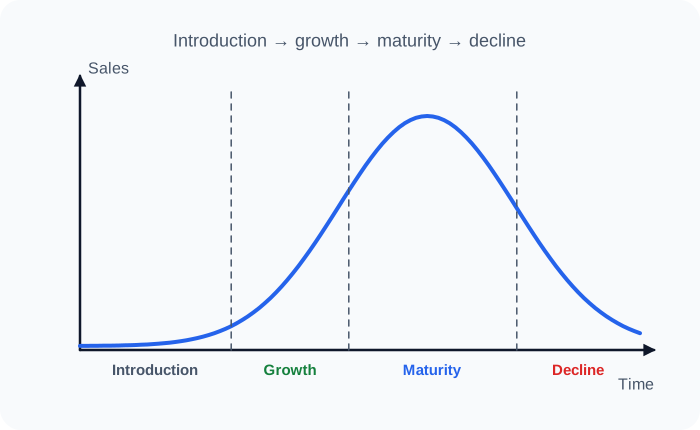
Figure 2. The stages of the product life cycle. WASSCE Tutor diagram.
| Stage | Sales and profit | Marketing action |
|---|---|---|
| Introduction | Sales low; losses likely (high launch costs) | Heavy advertising to create awareness; free samples |
| Growth | Sales rise fast; profit appears | Expand distribution; build brand loyalty |
| Maturity | Sales level off; competition strongest | Competitive pricing; new packaging or features |
| Decline | Sales and profit fall | Cut costs, cut price, or withdraw the product |
Firms try to extend a product's life with extension strategies: new flavours, new sizes, new packaging, new uses or new markets.
Think of mobile phone services in Sierra Leone. A new network launches with penetration pricing (cheap calls and data) and heavy advertising (introduction). As subscribers grow it extends coverage (growth). When most people have a phone, networks compete with bundles and promotions (maturity). Older services, such as fixed lines and fax, have entered decline.
Marketing is not the same as selling or advertising. Selling and advertising are only parts of marketing, which also includes research, product design, pricing and distribution.
Key points
- Marketing finds out customer wants and satisfies them at a profit; it is wider than selling.
- Functions include research, product planning, buying, selling, grading, packaging, pricing, transport, storage, promotion, financing and risk-bearing.
- Marketing mix: product, price, place and promotion.
- Product life cycle: introduction, growth, maturity, decline; extension strategies prolong it.
WASSCE examination focus
Expect to define marketing, to state the functions of marketing, to explain the four Ps of the marketing mix, and to explain the stages of the product life cycle (sometimes with a sketch). Distinguish marketing from selling when asked.
Quick check
- Distinguish marketing from selling.
- Name the four Ps of the marketing mix.
- At which stage of the product life cycle is competition strongest?
- What is penetration pricing?
Answers: 1. Marketing finds out what customers want and produces to satisfy them; selling persuades customers to buy what has already been produced. 2. Product, price, place and promotion. 3. Maturity. 4. Setting a low price for a new product to win market share quickly, then raising it later.
Keep going with marketing and advertising
This is one of 2 lessons in Marketing and Advertising. Start free with the first lesson of every topic, then unlock them all, plus exam-style practice marked instantly and guided learning tools, from 25 NLe.
- Free account, no card needed
- Everything from 25 NLe
- No automatic renewal
More lessons in Marketing and Advertising
- Advertising, sales promotion and public relations🔒