WASSCE syllabus · Main subject in Science
Biology
Every topic in the WASSCE Biology syllabus, grouped the way you will study it, with lessons written for Sierra Leone students.
- syllabus topics
- 41
- lessons
- 98
- of study
- 19 h 12 min
The first lesson of every topic is free. No card needed.
Course outline
Biology syllabus, section by section
Lessons published for 25 of 41 topics
01Foundations of Life7 topics · 54 lessons · 8 h 45 min
- 01Introduction to BiologyWhat biology is, branches of biology, and the importance of biology in everyday life.1What is biology and why study itFree2The branches of biology9 min 8 lessons 1 h 16 min+6 more
- 02Characteristics of Living ThingsThe seven characteristics that distinguish living things from non-living things — MRS GREN.1What makes something alive — introducing MRS GRENFree2Movement and locomotion9 min 9 lessons 1 h 28 min+7 more
- 03Classification of Living ThingsTaxonomy, the five kingdoms, and how organisms are grouped by their shared features.1Why we classify living thingsFree2The taxonomic hierarchy — from kingdom to species10 min 10 lessons 1 h 39 min+8 more
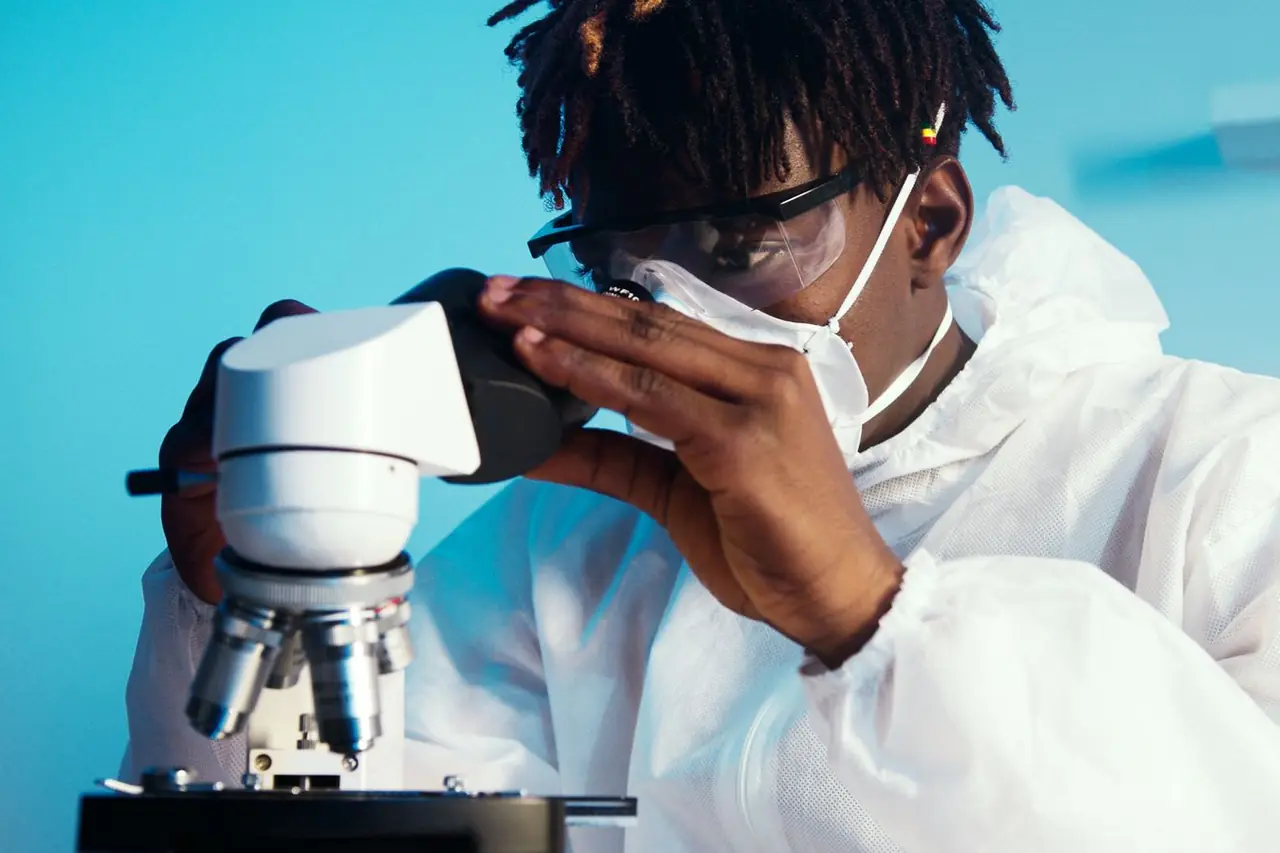
- 04Cell StructureAnimal and plant cells under the microscope, organelles, and the differences between them.1Animal cells and plant cells under the microscopeFree2The cell membrane and what crosses it9 min 10 lessons 1 h 31 min+8 more
- 05Cell Functions and SpecialisationWhat each organelle does, and how cells become specialised for different jobs.1Cells as little factories — overview of cell functionFree2The nucleus — control centre of the cell10 min 8 lessons 1 h 19 min+6 more
- 06Cell DivisionMitosis and meiosis — the stages, the differences, and why each one matters.1Why cells divide and the types of cell divisionFree2The cell cycle and what happens between divisions9 min 7 lessons 1 h 7 min+5 more
- 07Levels of OrganisationHow cells form tissues, tissues form organs, organs form systems, and systems form an organism.1Levels of organisation: from cells to whole organismsFree2Levels of organisation: organ systems, coordination and examples13 min 2 lessons 25 min
02Plant Biology3 topics · 14 lessons · 2 h 33 min
- 01Photosynthesis and Plant NutritionHow plants make their own food from sunlight, carbon dioxide, and water, and the mineral nutrients they need.1What photosynthesis is and why it mattersFree2The leaf — the factory of photosynthesis10 min 10 lessons 1 h 37 min+8 more
- 02Transport in PlantsXylem and phloem, the movement of water and minerals, transpiration, and translocation.1Transport in plants: absorption of water and mineral ionsFree2Transport in plants: transpiration, water movement and translocation15 min 2 lessons 28 min
- 03Reproduction in PlantsFlowers, pollination, fertilisation, seed and fruit formation, and asexual reproduction in plants.1Reproduction in plants: flower structure and pollinationFree2Reproduction in plants: fertilisation, seed formation and propagation15 min 2 lessons 28 min
03Animal Body Systems10 topics · 20 lessons · 4 h 49 min
- 01Food, Nutrition, and the Digestive SystemFood classes, balanced diet, the human digestive system, and digestive enzymes.1Food and nutrition: nutrient classes, balanced diets and deficiency diseasesFree2The alimentary canal: digestion, enzymes and absorption15 min 2 lessons 28 min
- 02Blood, Heart, and Circulation in MammalsBlood components, the heart, blood vessels, double circulation, and blood groups.1Blood: plasma, blood cells, clotting and blood groupsFree2The mammalian heart, blood vessels and double circulation15 min 2 lessons 29 min
- 03Transport in Lower OrganismsDiffusion, osmosis, and how simple organisms move materials without complex transport systems.1Diffusion, osmosis and active transport in simple organismsFree2Exchange surfaces and transport adaptations in lower organisms13 min 2 lessons 26 min
- 04Respiratory Systems and Gas ExchangeGas exchange in plants, fish, insects, and humans, and the structure of the human respiratory system.1Gas exchange: principles, plants and simple organismsFree2Gas exchange in fish, insects and mammals15 min 2 lessons 28 min
- 05Cellular RespirationAerobic and anaerobic respiration, ATP, and the energy released from glucose breakdown.1Aerobic respiration, ATP and energy transferFree2Anaerobic respiration, oxygen debt and fermentation14 min 2 lessons 28 min
- 06Excretion in Plants and AnimalsWhy organisms must excrete waste, and how excretion happens in plants and different animals.1Metabolic waste products and excretion in plants and animalsFree2Nitrogenous wastes, osmoregulation and homeostasis14 min 2 lessons 27 min
- 07The Kidney and Urinary SystemStructure of the kidney, the nephron, urine formation, and disorders of the urinary system.1The kidney and urinary system: structure and organisationFree2The kidney and urinary system: urine formation and water balance16 min 2 lessons 30 min
- 08Support in Plants and AnimalsHow plants stay upright, how animals are supported by skeletons, and types of skeletal systems.1Support in plants and animals: structural principlesFree2Support in plants and animals: the mammalian skeleton16 min 2 lessons 31 min
- 09Movement and LocomotionMuscles, bones, joints, and how organisms move — including locomotion in fish, birds, and mammals.1Movement and locomotion: muscles, bones and jointsFree2Movement and locomotion: locomotion in selected animals15 min 2 lessons 30 min
- 10Sense OrgansThe eye, ear, nose, tongue, and skin — structure, function, and common defects.1Sense organs: the human eye and visionFree2Sense organs: the ear, balance and other senses16 min 2 lessons 32 min
04Control & Coordination2 topics · 4 lessons · 1 h 9 min
- 01The Nervous SystemNeurons, the brain, spinal cord, reflex actions, and the central and peripheral nervous systems.1The nervous system: organisation, neurones and nerve impulsesFree2The nervous system: the brain, spinal cord and coordination17 min 2 lessons 33 min
- 02The Endocrine SystemEndocrine glands, the major hormones, and how they control body processes.1The endocrine system: glands, hormones and chemical coordinationFree2The endocrine system: major hormones, feedback and blood glucose control19 min 2 lessons 36 min
05Reproduction & Inheritance6 topics · 6 lessons · 1 h 56 min
- 01Reproduction in AnimalsReproduction in mammals, birds, fish, and insects, including life cycles and parental care.1Reproduction in animals: sexual reproduction and reproductive strategiesFree2Reproduction in animals: life cycles, development and parental care20 min 2 lessons 38 min
- 02Human Reproduction and DevelopmentMale and female reproductive systems, fertilisation, pregnancy, birth, and the menstrual cycle.1Human reproduction: reproductive systems and the menstrual cycleFree2Human reproduction: fertilisation, pregnancy, birth and reproductive health21 min 2 lessons 40 min
- 03Growth and DevelopmentPatterns of growth in plants and animals, factors affecting growth, and measuring growth.1Growth and development: principles, patterns and plant growthFree2Growth and development: germination, animal development and measurement20 min 2 lessons 38 min
Also on the syllabus · lessons in preparation
- 04Variation, Heredity, and DNASources of variation, the structure of DNA, genes, chromosomes, and how traits are inherited.
- 05Mendelian GeneticsMendel's laws, Punnett squares, monohybrid and dihybrid crosses, and sex-linked inheritance.
- 06Evolution and Natural SelectionEvidence for evolution, Darwin's theory, natural selection, and adaptation over time.
06Ecology & Environment7 topics · syllabus outline
- 01Introduction to EcologyWhat ecology is, ecological terms, and the levels of ecological study from individual to biosphere.
- 02EcosystemsBiotic and abiotic factors, energy flow, and the carbon, nitrogen, and water cycles.
- 03Food Chains and Food WebsProducers, consumers, decomposers, trophic levels, and pyramids of numbers, biomass, and energy.
- 04Population EcologyPopulation growth, factors affecting populations, carrying capacity, and density-dependent factors.
- 05Conservation of Natural ResourcesWhy we conserve, threats to biodiversity, and conservation efforts relevant to Sierra Leone.
- 06Pollution and Environmental IssuesAir, water, soil, and plastic pollution, the greenhouse effect, and what individuals can do.
- 07Adaptation in Plants and AnimalsStructural, physiological, and behavioural adaptations to different habitats.
07Health, Disease & Applied Biology6 topics · syllabus outline
- 01MicroorganismsBacteria, viruses, fungi, and protozoa — their structure, useful roles, and harmful effects.
- 02Diseases and Their CausesCommunicable and non-communicable diseases, how diseases are transmitted, and host defences.
- 03Public Health and Disease PreventionVaccination, hygiene, sanitation, malaria control, HIV/AIDS prevention, and family planning.
- 04Pests and Diseases of CropsCommon crop pests and diseases in Sierra Leone, and how farmers control them.
- 05Applied Biology in Agriculture and IndustryFermentation, antibiotics, biotechnology, and how biology supports agriculture and industry.
- 06Practical Biology SkillsSpecimen handling, biological drawings, identification, and the WAEC practical mark scheme.
 Need one-to-one help with Biology?Book a real Biology tutor, online or at home. Asking is free.
Study WASSCE Biology with WASSCE Tutor
Get all 98 Biology lessons and guided learning tools that help you prepare with confidence.
- Free account, no card needed
- Everything from 25 NLe
- No automatic renewal