WASSCE Physics · Work, Energy, and Power
Work, energy, power and conservation of energy
By the WASSCE Tutor team
Updated 10 November 2026 · 7 min read · Prepared against the WASSCE syllabus.
Energy is what makes things happen: it moves vehicles, lights homes, cooks food and keeps you alive. Physics gives it an exact meaning and a law that has never been broken: energy is never created or destroyed, only changed from one form into another.
Learning objectives
By the end of this lesson you should be able to:
- define work, energy and power and state their units
- calculate work done by a force, including from a force–distance graph
- calculate kinetic and gravitational potential energy
- apply the principle of conservation of energy
Work
Work is done when a force moves its point of application in the direction of the force:
where is the distance moved in the direction of the force. The unit is the joule (J): 1 J is the work done when a force of 1 N moves its point of application 1 m in the direction of the force.
If the force acts at angle θ to the direction of motion, only its component along the motion does work:
No work is done if there is no movement, or if the movement is perpendicular to the force. A man holding a heavy bag still does no work on it (though his muscles tire); a waiter carrying a tray horizontally at constant height does no work on the tray against gravity.
A boy pulls a box 20 m along the floor with a rope inclined at 60° to the horizontal. The tension is 50 N. Find the work done by the boy.
Work from a graph
The area under a force–distance graph is the work done.
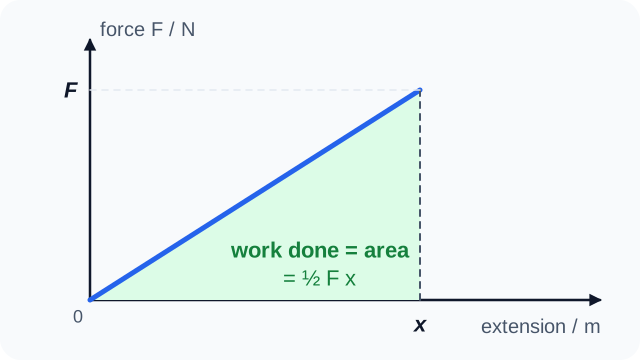
Figure 1. Work done in stretching a spring is the area under the graph. WASSCE Tutor diagram.
For a spring stretched by with a final force : (this is the elastic potential energy stored).
Energy
Energy is the capacity (ability) to do work. Its unit is also the joule (J).
Forms of energy include kinetic, gravitational potential, elastic potential, chemical, heat (thermal), electrical, light, sound and nuclear energy.
Kinetic energy
Kinetic energy is the energy a body has because of its motion:
Gravitational potential energy
Gravitational potential energy is the energy a body has because of its position (height) in a gravitational field:
A 1200 kg car moves at 15 m s⁻¹. Find its kinetic energy. How high would it have to be lifted to have the same potential energy? ( m s⁻²)
A crash at 54 km h⁻¹ is like falling from a three- or four-storey building.
The principle of conservation of energy
Principle of conservation of energy: energy can neither be created nor destroyed; it can only be changed from one form to another. The total energy of an isolated system remains constant.
For a body falling freely (no air resistance), potential energy turns into kinetic energy:
A 2 kg stone falls from rest from a height of 20 m. Find its kinetic energy and speed just before it hits the ground, and its kinetic energy halfway down. ( m s⁻²)
At the top: J, .
Just before landing: all 400 J is kinetic, so m s⁻¹.
Halfway (10 m down): J, so J. The total stays 400 J throughout.
Energy transformations
| Device or process | Energy change |
|---|---|
| Hydroelectric station (e.g. Bumbuna) | gravitational PE of water → KE → electrical |
| Generator (gen-set) | chemical (fuel) → heat → kinetic → electrical |
| Solar panel | light → electrical |
| Electric fan | electrical → kinetic (+ some heat and sound) |
| Battery charging a phone | electrical → chemical |
| Photosynthesis | light → chemical |
| Burning firewood or charcoal | chemical → heat and light |
Power
Power is the rate of doing work or the rate of transferring energy:
Its unit is the watt (W): 1 W = 1 J s⁻¹. (1 horsepower ≈ 746 W.)
For a body moving at constant speed against a force :
A 60 kg student runs up a flight of stairs 4 m high in 5 s. Find her power. ( m s⁻²)
Key points
- Work (J); no movement in the direction of the force means no work.
- Area under a force–distance graph = work done.
- ; .
- Energy is conserved: it only changes form.
- Power (W).
WASSCE examination focus
Define work, energy and power with units, state the principle of conservation of energy, and solve problems on falling bodies, pendulums and inclines using . Questions also ask for the energy changes in devices (a hydroelectric station, a generator, a solar panel) and for power in climbing stairs or lifting loads.
Quick check
- State the SI unit of power.
- A 0.5 kg ball moves at 8 m s⁻¹. Find its kinetic energy.
- A crane lifts a 500 kg load through 12 m in 20 s. Find its power output. ( m s⁻²)
Answers: 1. The watt (W). 2. J. 3. W.
Keep going with work, energy, and power
This is one of 2 lessons in Work, Energy, and Power. Start free with the first lesson of every topic, then unlock them all, plus exam-style practice marked instantly and guided learning tools, from 25 NLe.
- Free account, no card needed
- Everything from 25 NLe
- No automatic renewal
More lessons in Work, Energy, and Power
- Efficiency, vehicle power and energy sources🔒