WASSCE Physics · Wave Phenomena
Reflection, refraction and diffraction of waves
By the WASSCE Tutor team
Updated 10 November 2026 · 6 min read · Prepared against the WASSCE syllabus.
Waves bounce, bend and spread. You hear a friend talking round a corner, you see a straight stick look bent in water, and you hear your voice echo back from a hill. These are reflection, refraction and diffraction — behaviours shared by every kind of wave.
Learning objectives
By the end of this lesson you should be able to:
- state the laws of reflection and describe the reflection of water waves
- explain refraction as a change of speed and use
- describe diffraction and the effect of gap size
- give everyday examples of each phenomenon for sound and light
Reflection
Reflection is the bouncing back of a wave when it strikes a barrier or a boundary between two media.
Laws of reflection:
- The angle of incidence equals the angle of reflection.
- The incident wave (ray), the reflected wave (ray) and the normal at the point of incidence all lie in the same plane.
In a ripple tank, straight waves hitting a straight barrier at an angle are reflected at the same angle. Circular waves from a point reflected by a straight barrier appear to come from an image point behind it, just like light in a plane mirror. The wavelength, frequency and speed are unchanged by reflection.
Examples: echoes of sound, light in mirrors, radar, water waves at a harbour wall.
Refraction
Refraction is the change in direction of a wave as it passes from one medium into another, caused by a change in its speed.
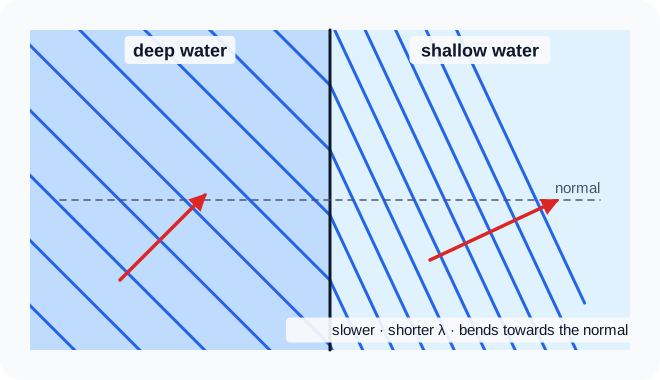
Figure 1. Water waves slow down in shallow water and bend towards the normal. WASSCE Tutor diagram.
When water waves move from deep to shallow water:
- their speed decreases
- their wavelength decreases (the wavefronts get closer together)
- their frequency stays the same
- their direction bends towards the normal (unless they meet the boundary head-on)
The refractive index from medium 1 to medium 2 is
Water waves of wavelength 3.0 cm travel at 15 cm s⁻¹ in deep water. In shallow water their speed is 10 cm s⁻¹. Find (a) their frequency, (b) their wavelength in shallow water.
(a) Hz (unchanged in both regions).
(b) cm.
Waves rolling towards Lumley Beach slow down as the water gets shallower near the shore. Their fronts swing round until they arrive almost parallel to the beach, whatever direction they came from out at sea. That is refraction.
Diffraction
Diffraction is the spreading out of waves as they pass through a gap (aperture) or round the edge of an obstacle.
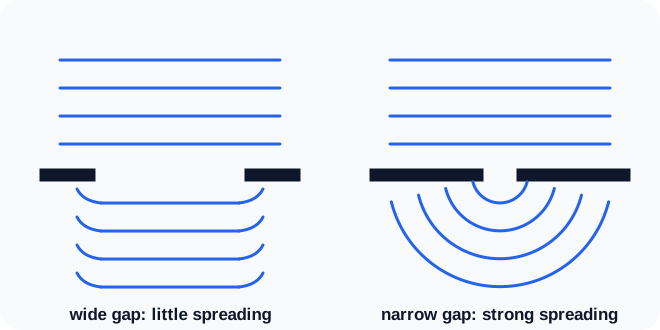
Figure 2. The narrower the gap compared with the wavelength, the more the waves spread. WASSCE Tutor diagram.
- Diffraction is greatest when the gap is about the same size as the wavelength.
- A gap much wider than the wavelength gives little diffraction.
- Diffraction does not change the wavelength, frequency or speed.
Examples:
- Sound (wavelengths about 0.3–3 m) diffracts round doorways and buildings, so you hear people you cannot see.
- Light has a tiny wavelength (about m), so it diffracts only through very narrow slits; that is why light seems to travel in straight lines and casts sharp shadows.
- Long-wave radio diffracts round hills, so it can be received in valleys; short-wave TV signals cannot, which is why some towns need relay masts.
Key points
- Reflection: angle of incidence = angle of reflection; λ, f and v unchanged.
- Refraction: change of direction due to change of speed; frequency unchanged; .
- Diffraction: spreading through gaps and round obstacles; greatest when gap ≈ wavelength.
WASSCE examination focus
Expect to describe how a ripple tank shows reflection, refraction and diffraction, to draw wavefronts before and after a boundary or gap (keep the wavelength constant through a gap, shorter in shallow water), and to explain why sound is heard round corners but light is not. Calculations use with an unchanged frequency.
Quick check
- Which quantity does not change when a wave is refracted?
- When is diffraction at a gap greatest?
- Why can you hear someone around a corner but not see them?
Answers: 1. The frequency. 2. When the width of the gap is about equal to the wavelength. 3. Sound waves have wavelengths comparable to doorways, so they diffract a lot; light's wavelength is far smaller, so it hardly diffracts.
Keep going with wave phenomena
This is one of 2 lessons in Wave Phenomena. Start free with the first lesson of every topic, then unlock them all, plus exam-style practice marked instantly and guided learning tools, from 25 NLe.
- Free account, no card needed
- Everything from 25 NLe
- No automatic renewal
More lessons in Wave Phenomena
- Superposition, interference, stationary waves and polarisation🔒