WASSCE Physics · Wave Motion and Properties
Waves: types, terms and the wave equation
By the WASSCE Tutor team
Updated 10 November 2026 · 7 min read · Prepared against the WASSCE syllabus.
The radio playing in a taxi, the light from the Sun, the ripples when a stone drops into a pond and the voice of your teacher all arrive as waves. A wave carries energy from one place to another without carrying the material along with it.
Learning objectives
By the end of this lesson you should be able to:
- define a wave and distinguish mechanical from electromagnetic waves
- distinguish transverse from longitudinal waves with examples
- define amplitude, wavelength, frequency, period and wave speed
- use and
What is a wave?
A wave is a disturbance that travels through a medium (or through space), transferring energy from one point to another without transferring the medium itself.
When a wave passes along a rope, each part of the rope only moves up and down about its rest position; the rope does not travel to the other end. When a ripple crosses a pond, a floating leaf bobs up and down but stays in roughly the same place.
Mechanical and electromagnetic waves
| Mechanical waves | Electromagnetic waves |
|---|---|
| need a material medium (solid, liquid or gas) | can travel through a vacuum |
| e.g. sound, water waves, waves on a rope or spring, seismic waves | e.g. light, radio waves, X-rays, microwaves |
| speed depends on the medium | all travel at m s⁻¹ in a vacuum |
Transverse and longitudinal waves
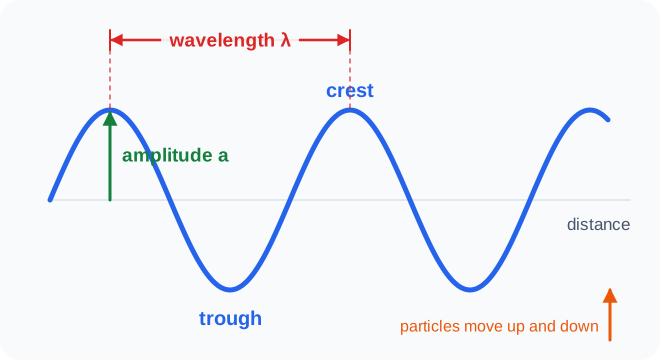
Figure 1. A transverse wave. WASSCE Tutor diagram.
- In a transverse wave, the particles of the medium vibrate perpendicular (at right angles) to the direction in which the wave travels. Examples: waves on a rope, water ripples, light and all electromagnetic waves.
- In a longitudinal wave, the particles vibrate parallel to (along) the direction of travel. Examples: sound waves, waves along a slinky spring pushed and pulled at one end.
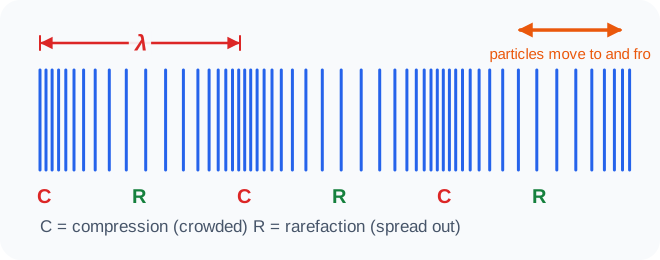
Figure 2. A longitudinal wave: compressions (C) and rarefactions (R). WASSCE Tutor diagram.
A transverse wave has crests and troughs; a longitudinal wave has compressions (particles crowded together, higher pressure) and rarefactions (particles spread out, lower pressure).
Terms used to describe waves
| Term | Symbol | Definition | Unit |
|---|---|---|---|
| Amplitude | the maximum displacement of a particle from its rest (equilibrium) position | m | |
| Wavelength | λ | the distance between two successive particles in phase, e.g. crest to crest or compression to compression | m |
| Period | the time for one complete oscillation (time for one wavelength to pass a point) | s | |
| Frequency | the number of complete oscillations (waves) per second | hertz (Hz) | |
| Wave speed | the distance travelled by the wave per second | m s⁻¹ |
Particles are in phase when they are at the same point in their motion at the same time (for example, two neighbouring crests).
The wave equation
In one period the wave moves forward one wavelength λ, so
A radio station broadcasts on a frequency of 98.0 MHz. Find the wavelength of its waves. (speed of radio waves = 3.0 × 10⁸ m s⁻¹)
Water waves have a wavelength of 0.4 m. A floating bottle bobs up and down 15 times in 10 s. Find (a) the frequency, (b) the period, (c) the speed of the waves.
(a) Hz. (b) s. (c) m s⁻¹.
Changing the medium changes the speed and the wavelength of a wave, but not its frequency: the frequency is set by the source. Light entering glass slows down and its wavelength shortens; its frequency (and colour) stays the same.
Graphs of waves
There are two kinds of graph, and they look alike — read the horizontal axis carefully.
| Graph | Horizontal axis | What you read off |
|---|---|---|
| Displacement–distance | distance along the wave | amplitude and wavelength |
| Displacement–time | time, for one particle | amplitude and period (then ) |
Okada riders and market traders across Sierra Leone keep radios tuned to stations on FM frequencies near 100 MHz, whose waves are about 3 m long. Mobile phones use microwaves of about 900 MHz to 2 GHz, with wavelengths of only 15–33 cm.
Key points
- A wave transfers energy, not matter.
- Mechanical waves need a medium; electromagnetic waves do not.
- Transverse: vibration ⟂ travel (light, ripples). Longitudinal: vibration ∥ travel (sound).
- , ; frequency is set by the source and does not change between media.
WASSCE examination focus
Define a wave, distinguish transverse and longitudinal waves with examples, define amplitude, wavelength, frequency and period, and use . You may be given a displacement–distance or displacement–time graph and asked for the amplitude, wavelength or period. Check the axis before answering.
Quick check
- Give one example of a longitudinal wave.
- A wave has frequency 50 Hz and wavelength 6 m. Find its speed.
- What happens to the frequency of a wave when it passes from air into water?
Answers: 1. Sound waves. 2. m s⁻¹. 3. It stays the same.
Keep going with wave motion and properties
This is one of 2 lessons in Wave Motion and Properties. Start free with the first lesson of every topic, then unlock them all, plus exam-style practice marked instantly and guided learning tools, from 25 NLe.
- Free account, no card needed
- Everything from 25 NLe
- No automatic renewal
More lessons in Wave Motion and Properties
- The progressive wave equation, phase and the ripple tank🔒