WASSCE Physics · Thermal Expansion
Expansion of solids: linear expansivity and its applications
By the WASSCE Tutor team
Updated 10 November 2026 · 7 min read · Prepared against the WASSCE syllabus.
Why are gaps left between the rails of a railway? Why do electric cables sag more in the heat of the dry season? Why does a tight metal lid come loose under hot water? Solids expand when heated — slightly, but with enough force to buckle rails and crack concrete.
Learning objectives
By the end of this lesson you should be able to:
- explain thermal expansion using the kinetic theory
- define linear expansivity and use
- relate area and volume expansivity to linear expansivity
- describe applications and problems caused by expansion, including the bimetallic strip
Why solids expand
When a solid is heated, its particles vibrate more vigorously and push one another slightly further apart. Each gap grows a little; over millions of particles the whole solid grows measurably. Different materials expand by different amounts because their interparticle forces differ.
Linear expansivity
The linear expansivity (coefficient of linear expansion) α of a material is the increase in length per unit original length per degree rise in temperature:
Its unit is K⁻¹ (or °C⁻¹, which is the same number).
Rearranged: and the new length is .
| Material | α / K⁻¹ (approx.) |
|---|---|
| Invar (nickel–steel alloy) | |
| Glass (ordinary) | |
| Steel / iron | |
| Concrete | |
| Copper | |
| Brass | |
| Aluminium |
A steel railway rail is 20 m long at 25 °C. How much longer is it at 45 °C? (α = 1.2 × 10⁻⁵ K⁻¹)
So a gap of about 5 mm must be left between rails.
A brass rod is 50.00 cm long at 20 °C and 50.10 cm long at 120 °C. Find the linear expansivity of brass.
Area and volume expansivity
For a solid expanding equally in all directions:
- Area (superficial) expansivity:
- Volume (cubic) expansivity:
So and .
A copper sphere has a volume of 500 cm³ at 20 °C. Find its increase in volume at 70 °C. (α for copper = 1.7 × 10⁻⁵ K⁻¹)
K⁻¹.
Applications and problems of expansion
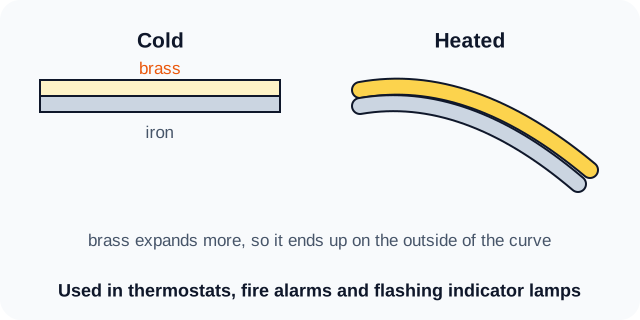
Figure 1. A bimetallic strip bends because brass expands more than iron. WASSCE Tutor diagram.
Useful applications
- Bimetallic strip thermostats: in electric irons, kettles, water heaters, fridges and fire alarms, the strip bends to make or break a circuit at a set temperature. Flashing indicator lamps also use one.
- Fitting a tight metal tyre onto a wheel (shrink fitting): the hot tyre is slipped on and contracts as it cools, gripping tightly.
- Riveting: hot rivets contract on cooling, pulling the plates together.
- Loosening a tight metal lid of a glass jar by running hot water over it: the metal expands more than the glass.
- Liquid-in-glass thermometers use the expansion of liquids.
Problems and how they are overcome
- Railway lines: gaps are left between rails (or long welded rails are pre-stressed) so they do not buckle in the heat.
- Bridges: one end rests on rollers so the bridge can expand and contract; expansion joints are built in.
- Overhead power and telephone cables are hung with slack, so they do not snap when they contract on cold nights.
- Concrete roads and pavements have gaps filled with pitch between slabs.
- Thick glass cracks if hot water is poured in suddenly, because the inside expands before the outside; Pyrex (low α) does not.
- Steel reinforcement in concrete works because steel and concrete have almost the same α.
On a hot afternoon in the dry season, the electricity cables along the roads in Bo visibly sag more than at dawn. Engineers string them with enough slack for the coldest harmattan night, when they contract the most.
Key points
- Heating makes particles vibrate more and move apart, so solids expand.
- Linear expansivity (K⁻¹); area ; volume .
- A bimetallic strip bends towards the metal with the smaller expansivity.
- Gaps, rollers, slack cables and expansion joints prevent damage from expansion.
WASSCE examination focus
Define linear expansivity (with its unit) and use it in calculations — often finding an increase in length or the expansivity from two lengths. Explain the action of a bimetallic strip in a thermostat or fire alarm, and give applications and remedies for expansion (railway gaps, rollers on bridges, sagging cables).
Quick check
- What is the SI unit of linear expansivity?
- A metal rod 2 m long expands by 1.2 mm when heated through 50 K. Find α.
- In a bimetallic strip of brass and iron, which metal is on the outside of the curve when heated?
Answers: 1. K⁻¹. 2. K⁻¹. 3. Brass (it expands more).
Keep going with thermal expansion
This is one of 2 lessons in Thermal Expansion. Start free with the first lesson of every topic, then unlock them all, plus exam-style practice marked instantly and guided learning tools, from 25 NLe.
- Free account, no card needed
- Everything from 25 NLe
- No automatic renewal
More lessons in Thermal Expansion
- Expansion of liquids and the anomalous expansion of water🔒