WASSCE Physics · Temperature and Thermometers
Temperature, temperature scales and thermometers
By the WASSCE Tutor team
Updated 10 November 2026 · 7 min read · Prepared against the WASSCE syllabus.
"It is 32 degrees today" — but 32 degrees of what, measured how? A thermometer only works because some property of a substance changes steadily with how hot it is. This lesson explains temperature, the scales we use and how a thermometer is made.
Learning objectives
By the end of this lesson you should be able to:
- distinguish temperature from heat
- explain thermometric properties and fixed points
- convert between the Celsius and Kelvin scales
- describe the liquid-in-glass and clinical thermometers and compare mercury with alcohol
Temperature and heat are different
Temperature is the degree of hotness or coldness of a body. It determines the direction in which heat flows: from a body at higher temperature to one at lower temperature.
Heat is a form of energy that is transferred from a hotter body to a colder one because of their temperature difference.
| Temperature | Heat |
|---|---|
| degree of hotness | a form of energy |
| measured with a thermometer | measured with a calorimeter (by its effects) |
| unit: kelvin (K) or °C | unit: joule (J) |
| does not depend on the amount of substance | depends on mass, material and temperature change |
A bucket of warm water can contain more heat energy than a cup of boiling water, even though the cup is at a higher temperature.
Thermometric properties
A thermometric property is a physical property of a substance that changes continuously and measurably with temperature, so it can be used to measure temperature.
| Thermometer | Thermometric property |
|---|---|
| Liquid-in-glass (mercury or alcohol) | change in volume (length) of a liquid column |
| Constant-volume gas thermometer | change in pressure of a gas at constant volume |
| Platinum resistance thermometer | change in electrical resistance of a metal wire |
| Thermocouple | e.m.f. produced at the junction of two different metals |
| Bimetallic thermometer | bending of a bimetallic strip |
| Pyrometer | colour or intensity of radiation from a hot body |
Fixed points and temperature scales
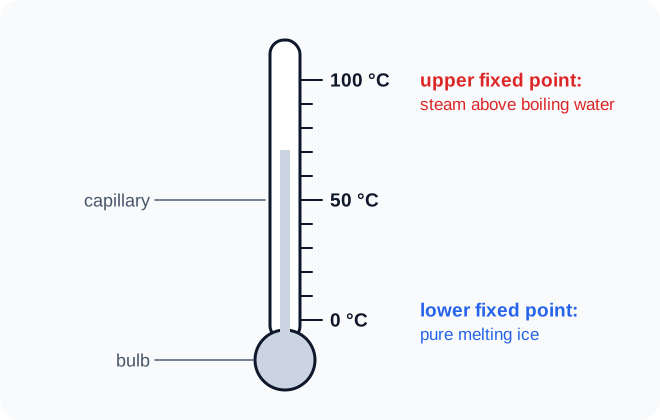
Figure 1. A liquid-in-glass thermometer and its fixed points. WASSCE Tutor diagram.
- Lower fixed point (ice point): the temperature of pure melting ice at standard atmospheric pressure, 0 °C.
- Upper fixed point (steam point): the temperature of steam above pure water boiling at standard atmospheric pressure, 100 °C.
- The fundamental interval is the difference between them (100 divisions on the Celsius scale).
Celsius and Kelvin
The Kelvin (absolute) scale starts at absolute zero, the lowest possible temperature, at which particles have the least possible energy. A change of 1 K equals a change of 1 °C.
| Celsius | Kelvin | |
|---|---|---|
| Absolute zero | −273 °C | 0 K |
| Ice point | 0 °C | 273 K |
| Normal body temperature | 37 °C | 310 K |
| Steam point | 100 °C | 373 K |
Kelvin temperatures are written without the degree sign: 300 K, not 300 °K. And a temperature difference is the same number in both scales: a rise from 20 °C to 50 °C is a rise of 30 K.
The liquid-in-glass thermometer
It consists of a thin-walled glass bulb containing the liquid, joined to a fine capillary tube of uniform bore, sealed at the top, with a scale on the stem.
Design features:
- a thin-walled bulb so heat passes in quickly (quick response)
- a narrow capillary so a small expansion gives a long movement of the thread (sensitivity)
- a uniform bore so equal temperature changes give equal lengths (a linear scale)
Mercury versus alcohol
| Mercury | Alcohol |
|---|---|
| opaque and shiny, easy to read | colourless (must be dyed) |
| does not wet glass | wets glass, so the reading can be slightly low |
| good conductor of heat: responds quickly | poor conductor |
| boils at 357 °C: good for high temperatures | boils at 78 °C: cannot measure boiling water |
| freezes at −39 °C: useless in very cold places | freezes at −115 °C: good for low temperatures |
| expansion is small but regular | expands about six times more (more sensitive) |
| poisonous | not poisonous |
The clinical thermometer
A clinical thermometer measures human body temperature (normal about 37 °C).
- Short range, typically 35 °C to 43 °C, so the scale can be widely spaced and read to 0.1 °C.
- A narrow constriction (kink) just above the bulb stops the mercury from flowing back when the thermometer is removed from the mouth or armpit, so the reading can be taken later.
- It is reset by shaking the mercury back past the constriction.
- It must not be sterilised in boiling water: 100 °C is beyond its range and would break it.
At health centres across Sierra Leone, nurses now often use digital or infrared thermometers, which use a thermistor or the infrared radiation from the forehead. A fever of 38.5 °C or more is a common warning sign of malaria.
Key points
- Temperature = degree of hotness; heat = energy transferred because of a temperature difference.
- A thermometer uses a thermometric property that changes steadily with temperature.
- Ice point 0 °C, steam point 100 °C; .
- Mercury suits high temperatures and is opaque; alcohol suits low temperatures and expands more.
- The clinical thermometer has a short range and a constriction.
WASSCE examination focus
Expect to distinguish heat and temperature, define fixed points, state thermometric properties of different thermometers, compare mercury and alcohol as thermometric liquids, and explain the features of a clinical thermometer (especially the constriction). Conversions between °C and K are frequent in objective questions.
Quick check
- Convert 27 °C to kelvin.
- What is the purpose of the constriction in a clinical thermometer?
- Give one advantage of alcohol over mercury as a thermometric liquid.
Answers: 1. 300 K. 2. It stops the mercury flowing back into the bulb, so the reading stays after the thermometer is removed. 3. For example: it can measure very low temperatures (freezes at −115 °C), or it expands more (more sensitive), or it is not poisonous.
Keep going with temperature and thermometers
This is one of 2 lessons in Temperature and Thermometers. Start free with the first lesson of every topic, then unlock them all, plus exam-style practice marked instantly and guided learning tools, from 25 NLe.
- Free account, no card needed
- Everything from 25 NLe
- No automatic renewal
More lessons in Temperature and Thermometers
- Calibrating thermometers; thermocouples and Six's thermometer🔒