WASSCE Physics · Surface Tension, Capillarity, and Viscosity
Surface tension and capillarity
By the WASSCE Tutor team
Updated 10 November 2026 · 6 min read · Prepared against the WASSCE syllabus.
A needle can float on water, insects walk on a pond, and a drop of water from a tap is round. The surface of a liquid behaves as if it were a thin, stretched skin. This lesson explains that "skin" and the rise of water in narrow tubes.
Learning objectives
By the end of this lesson you should be able to:
- define surface tension and explain it using molecular forces
- describe simple demonstrations and everyday effects of surface tension
- explain capillarity and the shape of the meniscus for water and mercury
- state the factors that reduce surface tension
Surface tension
Surface tension is the property of a liquid surface that makes it behave like a stretched elastic skin. It is measured as the force per unit length acting along the surface (unit N m⁻¹).
Molecular explanation
A molecule inside the liquid is pulled equally in all directions by its neighbours, so the resultant force on it is zero. A molecule at the surface has neighbours only beside and below it, so it feels a net inward (downward) pull. The surface molecules are therefore pulled together and the surface contracts to the smallest possible area, as if it were a stretched membrane.
This is why falling raindrops and drops of mercury are spherical: a sphere has the smallest surface area for a given volume.
Demonstrations and effects
- A dry needle or razor blade floats on water when laid gently on the surface, even though steel is denser than water. Add a drop of soap solution and it sinks.
- Insects such as pond skaters walk on water.
- A soap film on a wire loop with a loose thread: break the film on one side and the thread is pulled into a perfect arc by the film on the other side.
- A camel-hair brush spreads out in water but its hairs cling together when lifted out: the water film pulls them together.
- Water drips from a tap as drops that grow until their weight overcomes surface tension.
Factors that reduce surface tension
- Raising the temperature: hot water has lower surface tension, one reason hot water cleans better.
- Adding impurities such as soap or detergent: they reduce surface tension so water spreads and wets greasy surfaces.
Washing greasy pots with cold water alone barely works. Hot water and detergent both lower the surface tension of the water, so it spreads into the grease and lifts it off. The same idea makes a soapy cloth clean better than plain water.
Capillarity
Capillarity (capillary action) is the rise or fall of a liquid in a narrow tube (capillary tube) compared with the level of the surrounding liquid.
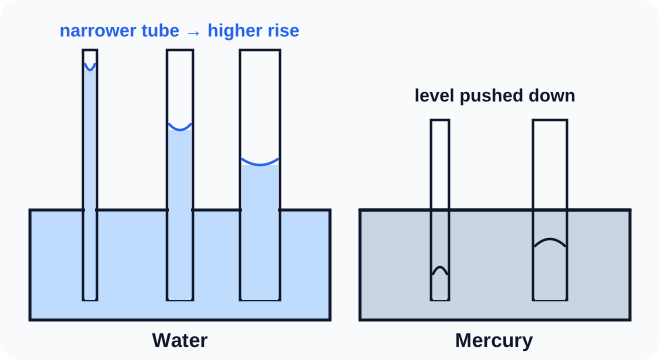
Figure 1. Capillary rise of water and capillary depression of mercury. WASSCE Tutor diagram.
| Water in glass | Mercury in glass | |
|---|---|---|
| Forces | adhesion (water–glass) > cohesion | cohesion > adhesion (mercury–glass) |
| Wetting | wets the glass | does not wet the glass |
| Meniscus | concave (curves upwards) | convex (curves downwards) |
| Level in a narrow tube | rises above the outside level | is depressed below the outside level |
The narrower the tube, the greater the rise (or depression).
Applications of capillarity
- Oil rises up the wick of a kerosene lamp.
- Water rises from the soil through tiny spaces between soil particles; farmers break up (till) the topsoil to break these capillary channels and reduce water loss.
- Blotting paper, towels and sponges soak up liquids.
- Water rises in plants partly by capillary action in narrow xylem vessels.
- Damp walls: water rises through tiny pores in bricks; a damp-proof course of plastic or bitumen stops it.
Key points
- Surface tension makes a liquid surface act like a stretched skin, caused by the net inward pull on surface molecules.
- It explains spherical drops, floating needles and insects walking on water.
- Soap, detergents and higher temperature reduce surface tension.
- Capillarity: water rises in narrow glass tubes (concave meniscus); mercury is depressed (convex meniscus). Narrower tubes give bigger effects.
WASSCE examination focus
Define surface tension and explain it in molecular terms, describe an experiment to demonstrate it (floating needle, soap film), state factors that reduce it, and explain capillarity with the meniscus shapes of water and mercury. Applications such as the lamp wick and soil water often appear.
Quick check
- Why is a raindrop spherical?
- What happens to a floating needle when detergent is added to the water? Why?
- Why does mercury not rise in a narrow glass tube?
Answers: 1. Surface tension pulls the surface to the smallest possible area, which for a given volume is a sphere. 2. It sinks, because detergent reduces the surface tension. 3. The cohesion between mercury molecules is greater than their adhesion to glass, so mercury is depressed instead.
Keep going with surface tension, capillarity, and viscosity
This is one of 2 lessons in Surface Tension, Capillarity, and Viscosity. Start free with the first lesson of every topic, then unlock them all, plus exam-style practice marked instantly and guided learning tools, from 25 NLe.
- Free account, no card needed
- Everything from 25 NLe
- No automatic renewal
More lessons in Surface Tension, Capillarity, and Viscosity
- Viscosity and terminal velocity🔒