WASSCE Physics · States of Matter and Kinetic Theory
States of matter and the kinetic theory
By the WASSCE Tutor team
Updated 10 November 2026 · 7 min read · Prepared against the WASSCE syllabus.
Why does the smell of fried fish reach the next room? Why does a wet cloth dry in the sun? Why does ice melt but a stone does not? All of these are explained by one idea: everything is made of tiny particles that never stop moving.
Learning objectives
By the end of this lesson you should be able to:
- state the main points of the kinetic theory of matter
- describe the arrangement and motion of particles in solids, liquids and gases
- explain Brownian motion and diffusion as evidence for moving particles
- use the kinetic theory to explain the properties of the three states
The kinetic theory of matter
The kinetic theory of matter states that:
- all matter is made up of tiny particles (atoms, molecules or ions)
- these particles are in constant, random motion
- there are forces of attraction between the particles, which are strongest when they are close together
- the higher the temperature, the faster the particles move (the greater their average kinetic energy)
The three states of matter
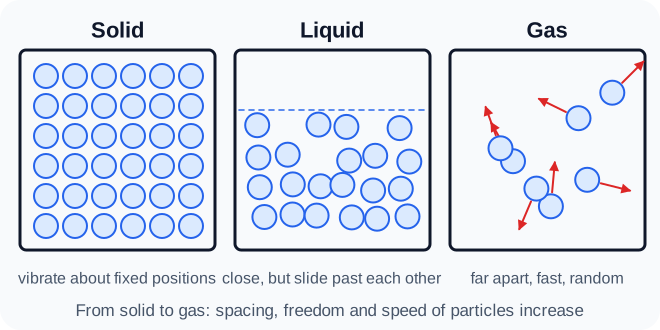
Figure 1. Particles in a solid, a liquid and a gas. WASSCE Tutor diagram.
| Property | Solid | Liquid | Gas |
|---|---|---|---|
| Arrangement | closely packed, regular pattern | close together, irregular | far apart, random |
| Motion | vibrate about fixed positions | move past one another | move rapidly in all directions |
| Forces between particles | very strong | strong, but weaker than in solids | very weak (almost none) |
| Shape | fixed | takes the shape of the container | fills the whole container |
| Volume | fixed | fixed | not fixed |
| Compressibility | almost incompressible | almost incompressible | easily compressed |
| Density | high | high | low |
Explaining the properties
- Solids keep their shape because strong forces hold each particle in place; the particles can only vibrate.
- Liquids flow because the particles, though close, can slide past one another.
- Gases fill their containers and are easily squashed because the particles are far apart with large empty spaces between them.
Evidence for moving particles
Brownian motion
Brownian motion is the continuous, random, zig-zag movement of small particles (such as smoke or pollen grains) suspended in a fluid.
Smoke-cell experiment. A little smoke is trapped in a small glass cell, lit from the side and viewed through a microscope. The smoke particles appear as bright specks that move jerkily and randomly.
Explanation: the smoke particles are being bombarded unevenly by the invisible air molecules, which are moving rapidly and randomly. At any moment more molecules hit one side than the other, so the particle is pushed first one way, then another. Raising the temperature makes the motion more vigorous.
In the smoke cell you do not see air molecules — they are far too small. You see the smoke particles, which are moved about by the air molecules hitting them.
Diffusion
Diffusion is the spreading of particles from a region of higher concentration to a region of lower concentration until they are evenly mixed, as a result of their random motion.
- The smell of perfume or of food cooking spreads through a room.
- A crystal of potassium permanganate placed in water slowly colours all the water purple, without stirring.
- Bromine vapour spreads through a gas jar of air.
Diffusion is fastest in gases (particles far apart and fast), slower in liquids, and extremely slow in solids. It is faster at higher temperatures and for lighter molecules.
When a neighbour fries fish with pepper in the compound, you can smell it inside your house within seconds. The smell molecules diffuse through the air. On a hot afternoon the smell travels faster than on a cool morning.
Changes of state, explained
| Change | What happens to the particles |
|---|---|
| Melting (solid → liquid) | heat makes particles vibrate so strongly that they break free of fixed positions |
| Boiling / evaporation (liquid → gas) | the most energetic particles escape the attractive forces completely |
| Condensation (gas → liquid) | cooled particles slow down and are pulled together by attractive forces |
| Freezing (liquid → solid) | particles lose energy and settle into fixed positions |
During melting and boiling the energy supplied breaks the bonds between particles instead of raising the temperature. This is the latent heat, studied later.
Gas pressure and temperature
Gas particles constantly collide with the walls of their container. Each collision exerts a tiny force; together they produce the pressure of the gas. Heating the gas makes the particles move faster, so they hit the walls more often and harder: the pressure rises. This is why a car tyre's pressure is higher after a long drive and why aerosol cans warn "do not heat".
Key points
- Matter is made of tiny particles in constant random motion with attractive forces between them.
- Solid: fixed positions, vibrating. Liquid: close but mobile. Gas: far apart, fast, random.
- Brownian motion (smoke cell) and diffusion are evidence that particles move.
- Higher temperature → faster particles → faster diffusion, more gas pressure.
WASSCE examination focus
Expect to state the assumptions of the kinetic theory, describe and explain the smoke-cell (Brownian motion) experiment, explain diffusion with an example, and use the kinetic theory to explain why gases are compressible, why liquids flow, or why gas pressure rises with temperature. Always refer to particles and their motion in your explanation.
Quick check
- In Brownian motion, what causes the random movement of smoke particles?
- Why is a gas easily compressed but a liquid is not?
- Give one everyday example of diffusion.
Answers: 1. Uneven bombardment by fast-moving, invisible air molecules. 2. Gas particles are far apart with large spaces between them; liquid particles are already close together. 3. For example: the smell of cooking spreading through a house.
Keep going with states of matter and kinetic theory
This is one of 2 lessons in States of Matter and Kinetic Theory. Start free with the first lesson of every topic, then unlock them all, plus exam-style practice marked instantly and guided learning tools, from 25 NLe.
- Free account, no card needed
- Everything from 25 NLe
- No automatic renewal
More lessons in States of Matter and Kinetic Theory
- Evaporation, boiling, molecular forces and crystals🔒