WASSCE Physics · Simple Machines
Machines: mechanical advantage, velocity ratio, levers and pulleys
By the WASSCE Tutor team
Updated 10 November 2026 · 8 min read · Prepared against the WASSCE syllabus.
A woman lifting a 50 kg bag of rice onto a lorry, a mechanic raising a car with a jack, a farmer moving earth in a wheelbarrow: each uses a machine to make a hard job possible. A machine never gives you energy for free, but it lets a small force overcome a large one.
Learning objectives
By the end of this lesson you should be able to:
- define a machine, mechanical advantage, velocity ratio and efficiency
- explain why the efficiency of a real machine is always less than 100%
- classify levers and calculate their mechanical advantage
- analyse pulley systems, including the block and tackle
What is a machine?
A machine is a device by which a force applied at one point (the effort) is used to overcome a force at another point (the load).
Machines make work easier by letting a small effort overcome a large load, changing the direction of a force, or moving a load faster or further.
The three key quantities
Mechanical advantage (MA) is the ratio of the load to the effort:
Velocity ratio (VR) is the ratio of the distance moved by the effort to the distance moved by the load (in the same time):
Efficiency is the ratio of the useful work output to the work input, as a percentage:
MA and VR are ratios, so they have no units.
Why efficiency is less than 100%
Some of the work input is wasted:
- overcoming friction at moving parts (turned to heat)
- lifting moving parts of the machine itself (such as the lower pulley block)
- stretching or bending parts of the machine
So the MA is always less than the VR in a real machine. VR depends only on the machine's geometry; MA depends also on friction and load. Efficiency can be improved by lubrication and by using lighter moving parts.
A machine of velocity ratio 5 lifts a load of 400 N with an effort of 100 N. Find its MA and efficiency.
Levers
A lever is a rigid bar that turns about a fixed point, the fulcrum (pivot). By the principle of moments,
so for an ideal lever .
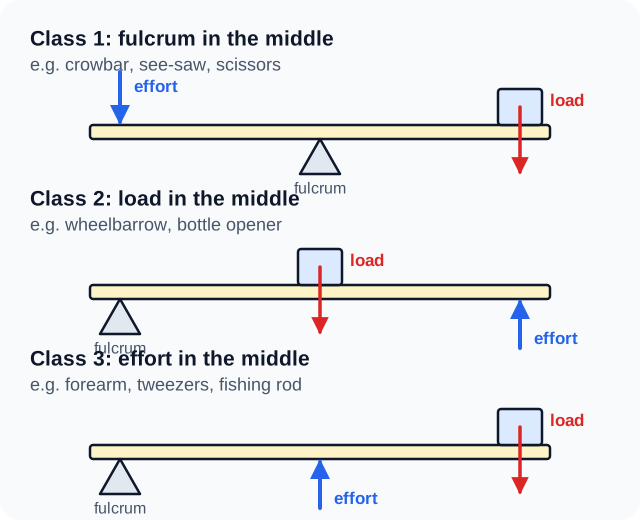
Figure 1. The three classes of lever. WASSCE Tutor diagram.
| Class | Arrangement | MA | Examples |
|---|---|---|---|
| First | fulcrum between effort and load | can be more or less than 1 | crowbar, see-saw, pliers, scissors, claw hammer |
| Second | load between fulcrum and effort | always more than 1 | wheelbarrow, bottle opener, nutcracker |
| Third | effort between fulcrum and load | always less than 1 | human forearm, tweezers, fishing rod, broom |
Third-class levers make the effort larger than the load, but they move the load further and faster: your biceps moves your hand quickly through a large distance.
A wheelbarrow carrying 600 N of sand has the load 0.4 m from the wheel axle (fulcrum); the handles are 1.2 m from the axle. Find the effort needed.
Pulleys
Single fixed pulley: changes only the direction of the force. VR = 1, so MA ≤ 1. Used to raise a flag or draw water from a well.
Single movable pulley: the load hangs on the pulley, supported by two strands. VR = 2.
Block and tackle: two blocks, each with one or more pulleys. The upper block is fixed; the lower block carries the load.
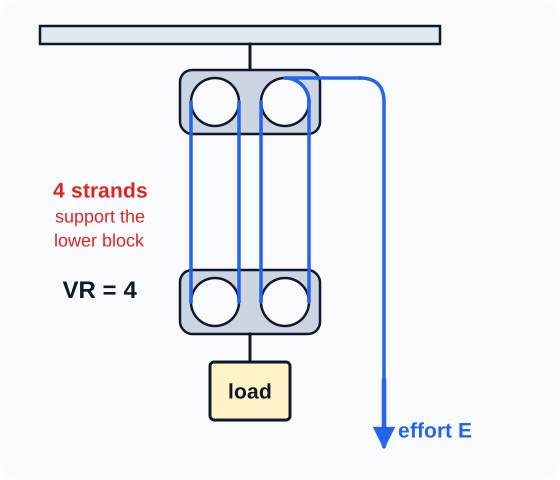
Figure 2. Count the strands that support the lower block to find the VR. WASSCE Tutor diagram.
For a pulley system, the velocity ratio = the number of rope strands supporting the movable (lower) block, which equals the total number of pulleys in both blocks for a block and tackle.
If the load rises 1 m, each of the 4 supporting strands must shorten by 1 m, so the effort end must be pulled 4 m: VR = 4.
A block and tackle has 3 pulleys in each block. An effort of 250 N lifts a load of 1200 N. Find (a) the VR, (b) the MA, (c) the efficiency, (d) the work wasted when the load is raised 2 m.
(a) VR = 3 + 3 = 6. (b) MA = . (c) .
(d) Work output J. Effort moves m, so work input J. Wasted: J.
Key points
- MA = load ÷ effort; VR = effort distance ÷ load distance; efficiency = MA ÷ VR × 100%.
- Real machines: MA < VR and efficiency < 100%, because of friction and the weight of moving parts.
- Levers: class 1 (fulcrum in the middle), class 2 (load in the middle, MA > 1), class 3 (effort in the middle, MA < 1).
- Pulley system: VR = number of strands supporting the movable block.
WASSCE examination focus
Define MA, VR and efficiency and show that efficiency = MA/VR × 100%. Explain why efficiency is less than 100%. Draw a block and tackle with a stated VR (a favourite: "draw a pulley system of velocity ratio 4") and calculate MA, efficiency and wasted work. Objective items ask you to classify levers.
Quick check
- Which class of lever is a pair of tweezers?
- A machine has VR 4 and efficiency 75%. What effort lifts a 600 N load?
- Why is the MA of a pulley system less than its VR?
Answers: 1. Third class. 2. MA , so N. 3. Some effort is used to overcome friction and to lift the movable pulley block.
Keep going with simple machines
This is one of 2 lessons in Simple Machines. Start free with the first lesson of every topic, then unlock them all, plus exam-style practice marked instantly and guided learning tools, from 25 NLe.
- Free account, no card needed
- Everything from 25 NLe
- No automatic renewal
More lessons in Simple Machines
- Inclined plane, screw jack, gears and the hydraulic press🔒