WASSCE Physics · Simple Harmonic Motion
Simple harmonic motion: the pendulum and the spring
By the WASSCE Tutor team
Updated 10 November 2026 · 7 min read · Prepared against the WASSCE syllabus.
A child on a swing, the pendulum of a wall clock, a guitar string, the bounce of a car on its springs: all repeat the same motion over and over. The simplest and most important of these repeating motions is called simple harmonic motion.
Learning objectives
By the end of this lesson you should be able to:
- describe oscillatory motion and give examples
- define simple harmonic motion (SHM) and the terms amplitude, period, frequency and phase
- explain why a simple pendulum and a mass on a spring perform SHM
- use and
Oscillations
An oscillation (vibration) is a repeated to-and-fro motion about a fixed equilibrium position.
Examples: a swinging pendulum, a loaded spring bouncing, a vibrating tuning fork, a plucked string, the molecules of a solid, a floating bottle bobbing on water.
Simple harmonic motion
Simple harmonic motion is the motion of a body whose acceleration is directly proportional to its displacement from a fixed point (the equilibrium position) and is always directed towards that point:
The minus sign shows that the acceleration is always opposite to the displacement.
The restoring force pulls the body back towards the middle; the further away it is, the harder the pull.
Terms used in SHM
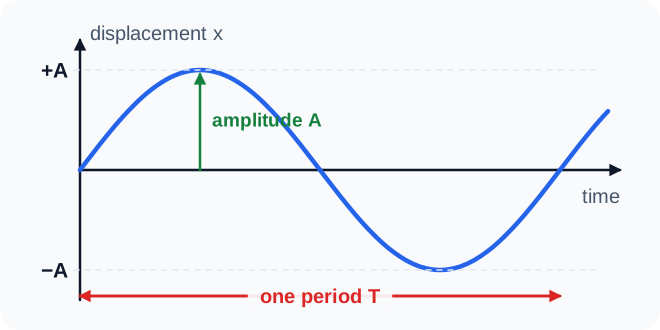
Figure 1. Displacement against time for SHM is a sine curve. WASSCE Tutor diagram.
| Term | Definition | Unit |
|---|---|---|
| Displacement | distance from the equilibrium position in a stated direction | m |
| Amplitude | the maximum displacement from the equilibrium position | m |
| Period | time for one complete oscillation | s |
| Frequency | number of complete oscillations per second, | Hz |
| Angular frequency ω | rad s⁻¹ | |
| Phase | the stage a body has reached in its cycle | — |
One complete oscillation of a pendulum is from one extreme, through the middle to the other extreme, and back again. Timing from one extreme to the other gives only half a period.
The simple pendulum
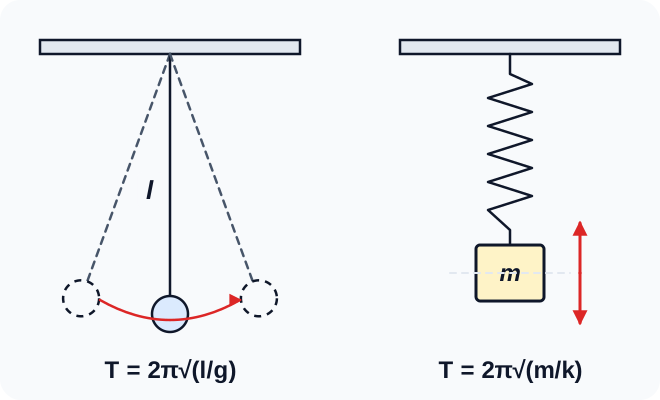
Figure 2. Two classic simple harmonic oscillators. WASSCE Tutor diagram.
A small heavy bob on a light inextensible string of length , swinging through a small angle (less than about 10°), performs SHM with period
The period:
- depends on the length and on
- does not depend on the mass of the bob
- does not depend on the amplitude (for small swings)
Find the period of a pendulum 0.9 m long where m s⁻². What length gives a period of exactly 2 s (a "seconds pendulum")?
For s: m.
A mass on a spring
A mass on a spring of stiffness (spring constant) , pulled down and released, oscillates with SHM:
A heavier mass or a softer spring (smaller ) gives a longer period.
A 0.5 kg mass hangs from a spring of spring constant 50 N m⁻¹. Find the period and frequency of its oscillations.
Velocity and acceleration during SHM
| Position | Displacement | Speed | Acceleration |
|---|---|---|---|
| Equilibrium (centre) | zero | maximum | zero |
| Extreme (end of swing) | maximum () | zero | maximum |
At the centre the restoring force is zero but the body is moving fastest, so it overshoots. At the ends the body stops momentarily, but the restoring force is greatest, so it is pulled back.
A child on a swing at a school compound: highest and momentarily still at each end of the swing, fastest as she passes through the lowest point. Pushing her at the right moment each time (at the same frequency as the swing) makes the swings bigger. That is resonance, studied with sound.
Key points
- SHM: acceleration ∝ displacement and directed towards the equilibrium position, .
- Amplitude = maximum displacement; period = time for one complete oscillation; .
- Pendulum: , independent of mass and (small) amplitude.
- Spring: .
- Speed is greatest at the centre; acceleration is greatest at the extremes.
WASSCE examination focus
Define simple harmonic motion (both parts: proportional to displacement and directed towards the fixed point), define amplitude, period and frequency, and use the pendulum and spring formulas. Objective items often ask where speed or acceleration is greatest, or what happens to the period when the mass of a pendulum bob is doubled (no change).
Quick check
- A pendulum completes 30 oscillations in 45 s. Find its period and frequency.
- What happens to the period of a simple pendulum if its length is made four times longer?
- At which point in SHM is the acceleration zero?
Answers: 1. s; Hz. 2. It doubles (). 3. At the equilibrium (centre) position.
Keep going with simple harmonic motion
This is one of 2 lessons in Simple Harmonic Motion. Start free with the first lesson of every topic, then unlock them all, plus exam-style practice marked instantly and guided learning tools, from 25 NLe.
- Free account, no card needed
- Everything from 25 NLe
- No automatic renewal
More lessons in Simple Harmonic Motion
- SHM equations, energy, damping and resonance🔒