WASSCE Physics · Scalars and Vectors
Scalars and vectors: adding and resolving vectors
By the WASSCE Tutor team
Updated 10 November 2026 · 8 min read · Prepared against the WASSCE syllabus.
Push a stalled car with a friend and the result depends not only on how hard you each push, but on which way. That "which way" is what separates vectors from scalars, and it runs through mechanics, electricity and fields.
Learning objectives
By the end of this lesson you should be able to:
- distinguish scalar and vector quantities and give examples of each
- represent a vector by a directed line drawn to scale
- add vectors using the triangle and parallelogram laws, by drawing and by calculation
- resolve a vector into two perpendicular components
Scalars and vectors
A scalar quantity has magnitude (size) only. A vector quantity has both magnitude and direction.
| Scalars | Vectors |
|---|---|
| distance | displacement |
| speed | velocity |
| mass | weight (a force) |
| time | acceleration |
| energy, work, power | force |
| temperature | momentum, impulse |
| pressure | electric field strength |
| density, volume | magnetic flux density |
Speed is a scalar; velocity is a vector. A keke going round a roundabout at a steady 20 km h⁻¹ has constant speed but changing velocity, because its direction keeps changing. Likewise distance is a scalar, displacement a vector.
Scalars add by ordinary arithmetic: 3 kg + 4 kg = 7 kg always. Vectors do not: a 3 N force and a 4 N force can give a resultant anywhere from 1 N to 7 N, depending on the angle between them.
Representing a vector
A vector is drawn as a straight line with an arrowhead:
- the length of the line, drawn to a chosen scale, represents the magnitude
- the direction of the arrow represents the direction of the vector
Example: with a scale of 1 cm to 10 N, a force of 45 N acting due east is a line 4.5 cm long pointing east.
The resultant of two vectors
The resultant of two or more vectors is the single vector that has the same effect as all of them acting together.
Vectors in the same or opposite directions
- Same direction: add. 5 N east + 3 N east = 8 N east.
- Opposite directions: subtract. 5 N east + 3 N west = 2 N east.
The parallelogram law
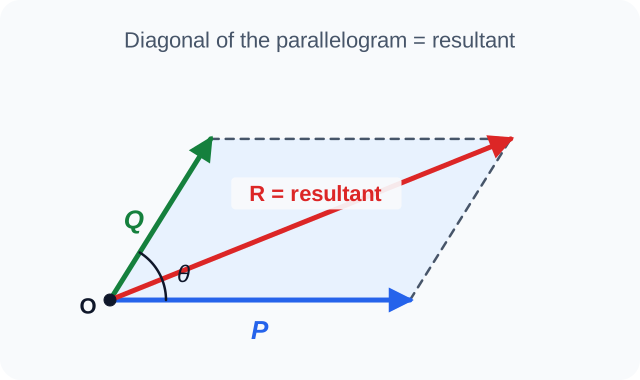
Figure 1. The parallelogram law. WASSCE Tutor diagram.
Parallelogram law of vectors: if two vectors acting at a point are represented in magnitude and direction by the two adjacent sides of a parallelogram, their resultant is represented in magnitude and direction by the diagonal of the parallelogram drawn from that point.
The triangle law is the same idea: draw the vectors nose to tail; the resultant joins the tail of the first to the nose of the last.
Calculating the resultant
Perpendicular vectors (90°): use Pythagoras and tangent.
Any angle θ between them: use the cosine rule form
A boy walks 8 m east and then 6 m north. Find his displacement.
The two displacements are at 90°:
Displacement: 10 m in the direction N 53.1° E (that is, 36.9° north of east). The distance he walked is 14 m, but his displacement is only 10 m.
Two forces of 5 N and 12 N act at a point with an angle of 60° between them. Find the resultant.
Check it is sensible: it lies between N and N.
Resolving a vector into components
A single vector can be replaced by two perpendicular vectors, its components, that together have the same effect.
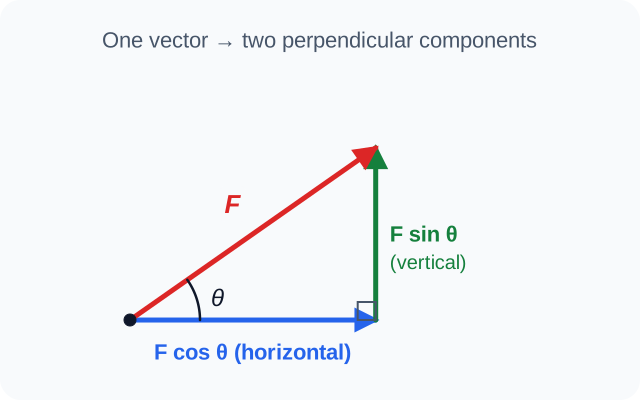
Figure 2. Resolving a vector. WASSCE Tutor diagram.
For a vector at angle to the horizontal:
A girl pulls a loaded basin across the floor with a rope at 30° to the horizontal. The tension in the rope is 40 N. Find the components.
- Horizontal (pulls the basin along): N
- Vertical (lifts it slightly): N
Only the horizontal 34.6 N moves the basin forward, which is why pulling at a steep angle wastes effort.
The cos goes with the component next to the angle (adjacent side) and sin with the one opposite it. If the angle is measured from the vertical, the vertical component is . Always check where the angle is measured from.
Key points
- Scalars: magnitude only. Vectors: magnitude and direction.
- Resultant by the parallelogram or triangle law.
- Perpendicular vectors: , .
- General angle: .
- Components: along the angle's arm, perpendicular to it.
WASSCE examination focus
Objective questions ask you to classify quantities as scalar or vector and to find the resultant of two perpendicular forces. Theory questions often ask you to state the parallelogram law, then find a resultant graphically (state your scale, draw accurately, measure length and angle) or by calculation. Always give both magnitude and direction.
Quick check
- Which is a vector: speed, energy, momentum, mass?
- Forces of 6 N and 8 N act at right angles. Find the resultant.
- A force of 50 N acts at 60° to the horizontal. Find its horizontal component.
Answers: 1. Momentum. 2. N at to the 6 N force. 3. N.
Keep going with scalars and vectors
This is one of 2 lessons in Scalars and Vectors. Start free with the first lesson of every topic, then unlock them all, plus exam-style practice marked instantly and guided learning tools, from 25 NLe.
- Free account, no card needed
- Everything from 25 NLe
- No automatic renewal
More lessons in Scalars and Vectors
- Resultant of several forces, equilibrant and relative velocity🔒