WASSCE Physics · Resonance and Musical Acoustics
Vibrating strings: harmonics, laws of strings and the sonometer
By the WASSCE Tutor team
Updated 10 November 2026 · 6 min read · Prepared against the WASSCE syllabus.
Pluck a guitar string and it vibrates at a frequency set by its length, its tension and its thickness. Tighten it, and the note rises. Shorten it with a finger on a fret, and the note rises again. This lesson explains why.
Learning objectives
By the end of this lesson you should be able to:
- explain how stationary waves form on a stretched string
- find the frequencies of the fundamental and harmonics of a string
- state the laws of vibration of strings and use
- describe the sonometer and its use
Stationary waves on a string
A string fixed at both ends (a guitar string, a sonometer wire) is plucked. Waves travel to each fixed end, reflect and superpose with the oncoming waves, setting up a stationary wave. The fixed ends cannot move, so they are always nodes.
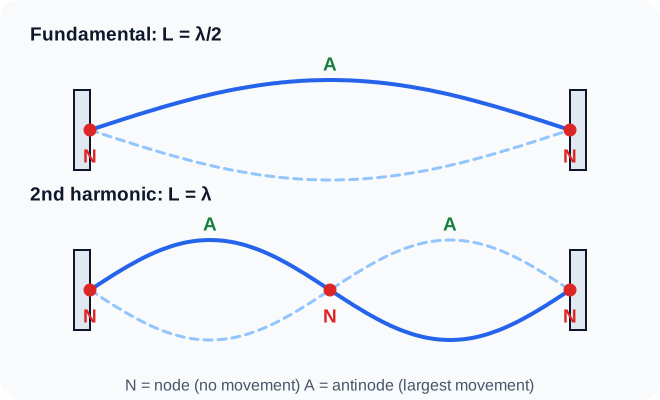
Figure 1. The fundamental and the second harmonic of a stretched string. WASSCE Tutor diagram.
Modes of vibration
| Mode | Pattern | Length | Frequency |
|---|---|---|---|
| Fundamental (1st harmonic) | 1 loop | ||
| 2nd harmonic (1st overtone) | 2 loops | ||
| 3rd harmonic (2nd overtone) | 3 loops |
A string can vibrate at all whole-number multiples of its fundamental frequency, which is why a plucked string gives a rich sound.
Speed of waves on a string
The speed of transverse waves on a string depends on the tension and the mass per unit length (kg m⁻¹):
So the fundamental frequency is
The laws of vibration of strings
For a stretched string vibrating in its fundamental mode:
- Length law: (tension and mass per unit length constant) — shortening the string raises the pitch.
- Tension law: (length and mass per unit length constant) — tightening the string raises the pitch.
- Mass law: (length and tension constant) — thicker, heavier strings give lower notes.
A wire 0.80 m long with mass per unit length 0.002 kg m⁻¹ is stretched by a tension of 80 N. Find (a) the speed of waves on it, (b) its fundamental frequency, (c) the frequency of its third harmonic.
(a) m s⁻¹.
(b) Hz.
(c) Hz.
A string sounds at 300 Hz. What is its frequency when the tension is made four times larger?
, so the frequency is multiplied by : 600 Hz.
The sonometer
A sonometer is a hollow wooden box with a wire stretched over two movable bridges. The tension is set by hanging masses from one end of the wire (over a pulley). The box amplifies the sound.
Using it to verify the length law:
- Keep the tension constant. Strike a tuning fork of known frequency and hold its stem on the box.
- Place a small paper rider on the wire midway between the bridges. Move a bridge until the paper rider is thrown off: the wire is resonating with the fork (same frequency).
- Measure the vibrating length between the bridges.
- Repeat with forks of different frequencies .
- Plot against : a straight line through the origin verifies .
Players of the kondi (thumb piano) and the guitar in Sierra Leonean music tune by exactly these laws: tightening a string or shortening a metal key raises its note.
Key points
- A string fixed at both ends has nodes at the ends; fundamental , .
- Harmonics are whole-number multiples of .
- ; .
- Laws: , , .
WASSCE examination focus
State the laws of vibration of strings, sketch the first three modes of a stretched string, and calculate frequency with . The sonometer experiment (resonance with tuning forks, paper rider, graph of against ) is a classic practical description.
Quick check
- What is the wavelength of the fundamental of a string 0.5 m long?
- If the length of a vibrating string is halved (same tension), what happens to its frequency?
- Which harmonic has three loops?
Answers: 1. m. 2. It doubles. 3. The third harmonic.
Keep going with resonance and musical acoustics
This is one of 2 lessons in Resonance and Musical Acoustics. Start free with the first lesson of every topic, then unlock them all, plus exam-style practice marked instantly and guided learning tools, from 25 NLe.
- Free account, no card needed
- Everything from 25 NLe
- No automatic renewal
More lessons in Resonance and Musical Acoustics
- Resonance in pipes and measuring the speed of sound🔒