WASSCE Physics · Resistors and Circuit Analysis
Resistors in series and parallel; solving circuits
By the WASSCE Tutor team
Updated 10 November 2026 · 6 min read · Prepared against the WASSCE syllabus.
Every circuit — from a torch to the wiring of a house — is built from components joined in series, in parallel, or a mixture. Two simple rules let you find the current and voltage anywhere in it.
Learning objectives
By the end of this lesson you should be able to:
- find the effective resistance of resistors in series and in parallel
- find the current through and p.d. across each resistor in a circuit
- solve mixed series–parallel problems
- explain why household appliances are connected in parallel
Resistors in series
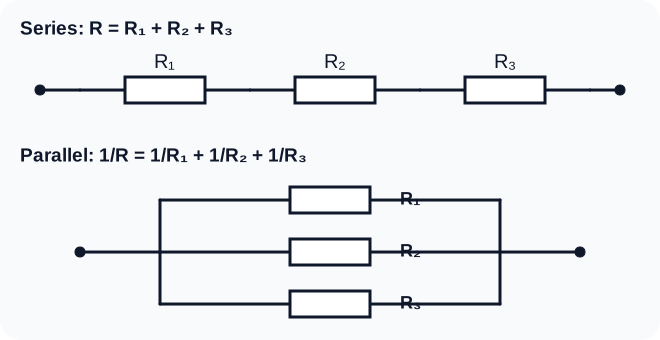
Figure 1. Resistors in series and in parallel. WASSCE Tutor diagram.
In series, resistors are joined end to end, so there is only one path:
- the same current flows through each
- the p.d.s add up to the total p.d.
The total resistance is larger than any single resistor.
Resistors in parallel
In parallel, resistors are connected side by side between the same two points:
- the same p.d. is across each
- the currents add up to the total current
The total resistance is smaller than the smallest resistor. For two resistors:
Find the combined resistance of (a) 4 Ω and 12 Ω in series, (b) 4 Ω and 12 Ω in parallel, (c) three 6 Ω resistors in parallel.
(a) Ω. (b) Ω. (c) Ω ( equal resistors in parallel give ).
Solving circuits step by step
- Combine resistors into a single effective resistance.
- Find the total current from the supply: (include internal resistance if given).
- Work back: in series, use for each part; in parallel, the p.d. is shared equally and the current divides.
A 6 Ω resistor is connected in series with a parallel pair of 4 Ω and 12 Ω resistors, across a 12 V battery of negligible internal resistance. Find (a) the total resistance, (b) the total current, (c) the p.d. across the parallel pair, (d) the current in the 4 Ω resistor.
(a) Parallel pair: Ω. Total: Ω.
(b) A.
(c) V (the 6 Ω resistor takes the other 8 V).
(d) A (and A; together 1.33 A ✓).
In parallel, the current takes more of the easier path: the smaller resistor carries the larger current. And always check that branch currents add up to the total.
Current division (two resistors in parallel)
For a current splitting between and :
Why houses are wired in parallel
- Each appliance gets the full mains voltage.
- Each can be switched on and off independently.
- If one appliance or bulb fails, the others keep working.
(Old Christmas-tree lights were wired in series: when one bulb failed, they all went out.)
In a Freetown house, the sockets, the fridge and the lights are all connected in parallel to the 230 V supply. Switching off the fan in one room does not turn off the lights.
Key points
- Series: same current;
- Parallel: same p.d.; ; two resistors: product over sum.
- Solve by combining, finding the total current, then working back.
- Household appliances are in parallel.
WASSCE examination focus
Mixed series–parallel circuits appear in almost every paper: find the effective resistance, the current in a branch, or the p.d. across a component. Draw the circuit, label each current and p.d., and check that currents at a junction add up. Explain why domestic appliances are connected in parallel.
Quick check
- Two 10 Ω resistors are in parallel. What is their combined resistance?
- In a series circuit, which quantity is the same for every component?
- A 3 A current divides between 2 Ω and 4 Ω resistors in parallel. What current flows in the 2 Ω resistor?
Answers: 1. 5 Ω. 2. The current. 3. A.
Keep going with resistors and circuit analysis
This is one of 2 lessons in Resistors and Circuit Analysis. Start free with the first lesson of every topic, then unlock them all, plus exam-style practice marked instantly and guided learning tools, from 25 NLe.
- Free account, no card needed
- Everything from 25 NLe
- No automatic renewal
More lessons in Resistors and Circuit Analysis
- Kirchhoff's rules, the metre bridge, the potentiometer and meters🔒