WASSCE Physics · Refraction and Total Internal Reflection
Refraction, Snell's law and real and apparent depth
By the WASSCE Tutor team
Updated 10 November 2026 · 7 min read · Prepared against the WASSCE syllabus.
A spoon in a glass of water looks bent. A swimming pool looks shallower than it is. A fish seen from a canoe is not quite where it appears. All because light changes speed — and therefore direction — when it passes from one material into another.
Learning objectives
By the end of this lesson you should be able to:
- define refraction and state the laws of refraction (Snell's law)
- define refractive index and calculate it in several ways
- trace a ray through a rectangular glass block
- explain real and apparent depth and use
What is refraction?
Refraction is the bending (change of direction) of light as it passes obliquely from one transparent medium into another, because its speed changes.
- Light entering a denser medium (air → glass, air → water) slows down and bends towards the normal.
- Light entering a less dense medium (glass → air) speeds up and bends away from the normal.
- A ray striking the boundary along the normal (at 0°) passes straight through without bending, though it still changes speed.
The laws of refraction
- The incident ray, the refracted ray and the normal at the point of incidence all lie in the same plane.
- Snell's law: the ratio of the sine of the angle of incidence to the sine of the angle of refraction is a constant for a given pair of media:
The constant is the refractive index of the second medium relative to the first.
Refractive index
( is the critical angle, covered next lesson.)
| Medium | Refractive index |
|---|---|
| Air | 1.00 |
| Water | 1.33 |
| Glass (crown) | 1.50 |
| Diamond | 2.42 |
A ray of light strikes a glass block at an angle of incidence of 45°. The angle of refraction is 28°. Find the refractive index of the glass and the speed of light in it. (speed of light in air = 3.0 × 10⁸ m s⁻¹)
Light passes from air into water (n = 1.33) at an angle of incidence of 60°. Find the angle of refraction.
Refraction through a rectangular glass block
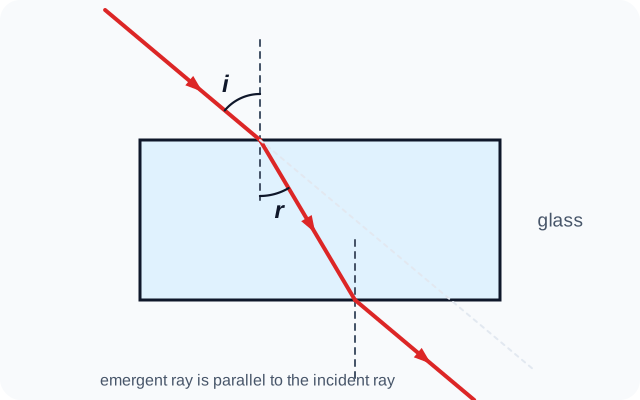
Figure 1. Refraction through a parallel-sided glass block. WASSCE Tutor diagram.
The ray bends towards the normal on entering and away from it on leaving. Because the two faces are parallel, the emergent ray is parallel to the incident ray but laterally displaced (shifted sideways). The thicker the block and the larger the angle of incidence, the greater the displacement.
Practical: verifying Snell's law with a glass block
- Trace the outline of the block on paper. Draw a normal and an incident ray at angle ; fix two pins on it.
- Looking through the opposite face, fix two more pins in line with the images of the first two.
- Remove the block, join the points to draw the emergent ray, and join entry to exit to get the refracted ray. Measure .
- Repeat for several values of . Plot against : a straight line through the origin; its gradient is .
Precautions: pins upright and well apart; look at the bottom of the pins to avoid parallax; draw thin, sharp lines.
Real and apparent depth
Light from an object under water bends away from the normal as it leaves the water, so the object appears nearer the surface than it really is.
A coin lies at the bottom of a bucket of water 40 cm deep. How deep does it appear when viewed from directly above? (n of water = 4/3)
The coin seems to be raised by cm (the displacement).
Fishermen spearing fish in the shallows of a river aim below where the fish appears, because refraction makes it look higher than it is. The same effect makes a stream look shallower than it is — a real danger for anyone wading in.
Key points
- Refraction: bending due to a change of speed between media.
- Into a denser medium → towards the normal; into a less dense medium → away from the normal.
- Snell's law: (constant).
- .
- A glass block shifts a ray sideways without changing its direction.
WASSCE examination focus
State the laws of refraction, calculate refractive index from angles, speeds or depths, and describe the glass-block (pin) experiment to verify Snell's law with a graph of against . Real-and-apparent-depth problems are frequent in objective papers.
Quick check
- Why does light bend when it enters glass from air?
- A ray enters glass with i = 30° and r = 19.5°. Find n.
- A pool is 2 m deep. How deep does it appear to a person looking down (n = 4/3)?
Answers: 1. Its speed decreases in glass. 2. . 3. m.
Keep going with refraction and total internal reflection
This is one of 2 lessons in Refraction and Total Internal Reflection. Start free with the first lesson of every topic, then unlock them all, plus exam-style practice marked instantly and guided learning tools, from 25 NLe.
- Free account, no card needed
- Everything from 25 NLe
- No automatic renewal
More lessons in Refraction and Total Internal Reflection
- Critical angle, total internal reflection and optical fibres🔒