WASSCE Physics · Reflection of Light
Reflection at plane mirrors
By the WASSCE Tutor team
Updated 10 November 2026 · 6 min read · Prepared against the WASSCE syllabus.
A looking glass, a car's side mirror, a periscope on a submarine and a dentist's little mirror all follow the same two laws of reflection. Learn them, and every mirror question becomes geometry.
Learning objectives
By the end of this lesson you should be able to:
- state the laws of reflection and distinguish regular and diffuse reflection
- describe the characteristics of the image in a plane mirror
- locate images by ray diagrams
- find the number of images in inclined mirrors and the effect of rotating a mirror
- explain the periscope and other uses of plane mirrors
The laws of reflection
- The angle of incidence equals the angle of reflection ().
- The incident ray, the reflected ray and the normal at the point of incidence all lie in the same plane.
Angles are measured from the normal (the line at 90° to the mirror), not from the mirror surface.
Regular and diffuse reflection
- Regular (specular) reflection: a smooth, polished surface (a mirror, still water) reflects a parallel beam as a parallel beam, giving clear images.
- Diffuse reflection: a rough surface (paper, a wall) scatters the light in many directions. Each ray still obeys the laws of reflection, but the normals point in different directions. Diffuse reflection is what lets us see non-luminous objects from any angle.
The image in a plane mirror
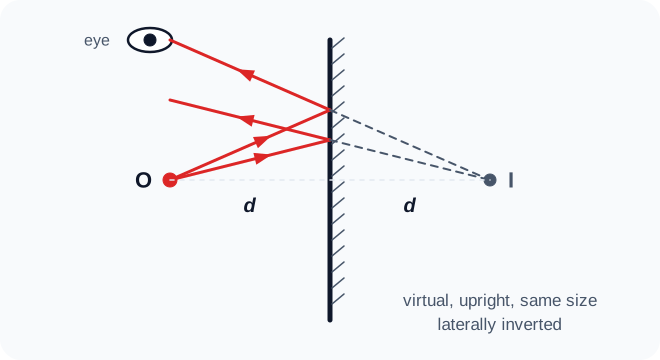
Figure 1. The image appears as far behind the mirror as the object is in front. WASSCE Tutor diagram.
The image formed by a plane mirror is:
- Virtual (cannot be formed on a screen; the rays only appear to come from it)
- Upright (erect)
- The same size as the object
- As far behind the mirror as the object is in front
- Laterally inverted (left and right are swapped)
"AMBULANCE" is printed in mirror writing on the front of ambulances so that drivers ahead read it correctly in their rear-view mirrors. That is lateral inversion put to work.
A girl stands 3 m in front of a plane mirror. (a) How far is she from her image? (b) She walks 1 m towards the mirror. How far is she now from her image?
(a) Image is 3 m behind the mirror: m.
(b) She is 2 m from the mirror; the image is 2 m behind it: m. (Moving 1 m closer brings her 2 m closer to her image.)
To see your whole body in a plane mirror, the mirror needs to be only half your height, whatever your distance from it.
Rotating a mirror
If a mirror is rotated through an angle θ while the incident ray stays fixed, the reflected ray turns through 2θ. This is used in sensitive meters (the mirror galvanometer) to magnify small rotations.
Images in inclined mirrors
Two plane mirrors at angle θ to each other form multiple images:
| Angle between mirrors | Number of images |
|---|---|
| 90° | 3 |
| 60° | 5 |
| 45° | 7 |
| 0° (parallel) | infinitely many |
This is the principle of the kaleidoscope (mirrors at 60°).
Uses of plane mirrors
- Periscope: two plane mirrors at 45°, facing each other, in a tube. Light turns through 90° at each mirror, so you can see over a wall or crowd (or above water from a submarine). The image is upright, the same size and virtual.
- Looking glasses and dressing mirrors; the rear-view mirror inside a car
- Kaleidoscopes and decorations
- In sextants and mirror galvanometers
- The "infinite" corridor in barbers' shops with mirrors on opposite walls
Key points
- Laws: ; incident ray, reflected ray and normal are in one plane.
- Plane-mirror image: virtual, upright, same size, same distance behind, laterally inverted.
- Rotating a mirror by θ turns the reflected ray by 2θ.
- Number of images in mirrors at θ: .
- Periscope: two mirrors at 45°.
WASSCE examination focus
State the laws of reflection, list the characteristics of a plane-mirror image, construct a ray diagram to locate an image, use , and explain the periscope with a diagram. Objective items on lateral inversion, mirror rotation (2θ) and image distances are very common.
Quick check
- A ray strikes a plane mirror at 30° to the mirror surface. What is the angle of reflection?
- How many images are formed by two mirrors inclined at 72°?
- A mirror is turned through 15°. Through what angle does the reflected ray turn?
Answers: 1. The angle of incidence (from the normal) is 60°, so the angle of reflection is 60°. 2. . 3. 30°.
Keep going with reflection of light
This is one of 2 lessons in Reflection of Light. Start free with the first lesson of every topic, then unlock them all, plus exam-style practice marked instantly and guided learning tools, from 25 NLe.
- Free account, no card needed
- Everything from 25 NLe
- No automatic renewal
More lessons in Reflection of Light
- Concave and convex mirrors and the mirror formula🔒