WASSCE Physics · Radioactivity and Nuclear Physics
Radioactivity: alpha, beta, gamma and half-life
By the WASSCE Tutor team
Updated 10 November 2026 · 6 min read · Prepared against the WASSCE syllabus.
Some atoms are unstable. Without any outside cause, their nuclei break up and fire out particles or rays. This radioactivity is used to treat cancer, date ancient bones and generate electricity — and it must be handled with respect.
Learning objectives
By the end of this lesson you should be able to:
- define radioactivity and name the three types of radiation
- compare the nature, charge, penetration and ionising power of alpha, beta and gamma radiation
- write equations for alpha and beta decay
- define half-life and solve half-life problems
Radioactivity
Radioactivity (radioactive decay) is the spontaneous disintegration of the unstable nuclei of certain atoms, with the emission of alpha particles, beta particles and/or gamma rays.
Decay is spontaneous (it happens by itself) and random (we cannot predict when a particular nucleus will decay). It is not affected by temperature, pressure or chemical combination.
The three radiations
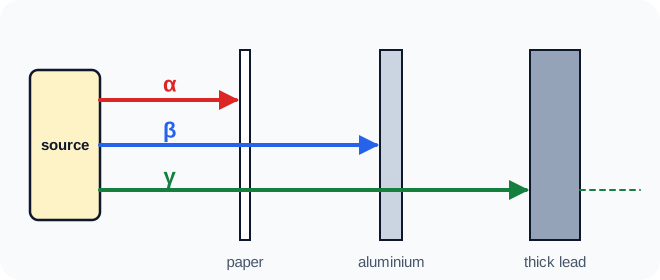
Figure 1. Penetrating power of alpha, beta and gamma radiation. WASSCE Tutor diagram.
| Property | Alpha (α) | Beta (β) | Gamma (γ) |
|---|---|---|---|
| Nature | helium nucleus (2 protons + 2 neutrons) | fast electron | electromagnetic wave (photon) |
| Charge | +2 | −1 | 0 |
| Relative mass | 4 | 0 | |
| Speed | about 5% of the speed of light | up to about 99% of | speed of light |
| Penetration | least: stopped by paper or a few cm of air | stopped by a few mm of aluminium | most: reduced by thick lead or concrete |
| Ionising power | strongest | moderate | weakest |
| Deflection in fields | slightly, towards negative | strongly, towards positive | not deflected |
The greater the ionising power, the faster the radiation loses its energy, so the less penetrating it is.
Nuclear equations
In any nuclear equation, the nucleon numbers (top) and the proton numbers (bottom) must balance.
Alpha decay: the nucleus loses 2 protons and 2 neutrons. falls by 4, falls by 2.
Beta decay: a neutron changes into a proton and an electron, which is emitted. is unchanged, rises by 1.
Gamma emission: no change in or ; the nucleus simply loses energy.
emits an alpha particle, and the product then emits a beta particle. Find the final nuclide's proton and nucleon numbers.
After α: , .
After β: , .
Final: .
Half-life
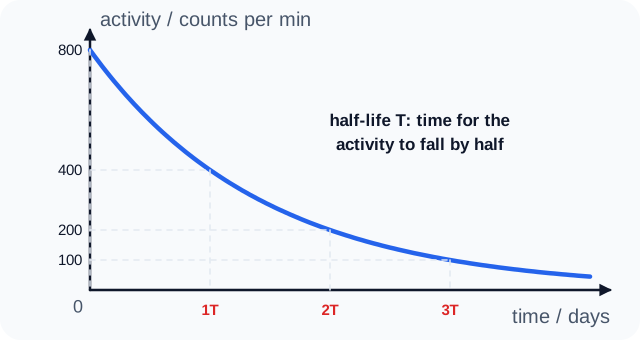
Figure 2. Radioactive decay curve. WASSCE Tutor diagram.
The half-life of a radioactive substance is the time taken for half of the radioactive nuclei in a sample to decay (equivalently, for its activity to fall to half).
After half-lives, the fraction remaining is :
Half-lives range from fractions of a second to billions of years (uranium-238: 4.5 × 10⁹ years; carbon-14: 5730 years; iodine-131: 8 days).
A radioactive sample has a half-life of 6 hours. What fraction remains after 24 hours? If it starts with 160 g, what mass remains?
Number of half-lives . Fraction remaining .
Mass remaining g. (160 → 80 → 40 → 20 → 10.)
The activity of a sample falls from 800 to 100 counts per minute in 15 days. Find its half-life.
: three half-lives in 15 days, so days.
After two half-lives, a quarter remains, not none. Half-life halves what is left each time; it never reaches exactly zero.
Key points
- Radioactive decay is spontaneous and random, unaffected by physical or chemical conditions.
- α: helium nucleus, +2, least penetrating, most ionising. β: electron, −1. γ: EM wave, most penetrating, least ionising.
- α decay: , . β decay: same, .
- Half-life: time for half the nuclei to decay; after half-lives, remains.
WASSCE examination focus
Compare alpha, beta and gamma radiation (nature, charge, penetration, ionisation, deflection), complete nuclear equations, and solve half-life problems (fractions remaining, masses, activities, or reading half-life from a decay curve). These appear in nearly every paper.
Quick check
- Which radiation is the most penetrating?
- emits a beta particle. What is the product?
- A source has a half-life of 2 days. What fraction remains after 6 days?
Answers: 1. Gamma. 2. (protactinium): unchanged, up by 1. 3. .
Keep going with radioactivity and nuclear physics
This is one of 2 lessons in Radioactivity and Nuclear Physics. Start free with the first lesson of every topic, then unlock them all, plus exam-style practice marked instantly and guided learning tools, from 25 NLe.
- Free account, no card needed
- Everything from 25 NLe
- No automatic renewal
More lessons in Radioactivity and Nuclear Physics
- Detectors, fission, fusion and uses of radioisotopes🔒