WASSCE Physics · Projectile Motion
Projectiles: horizontal launch, time of flight, height and range
By the WASSCE Tutor team
Updated 10 November 2026 · 7 min read · Prepared against the WASSCE syllabus.
A footballer's long pass, water from a hose, a stone from a catapult: all follow the same curved path. The secret is to stop looking at the curve and look at two separate, simple motions happening at once.
Learning objectives
By the end of this lesson you should be able to:
- define a projectile and describe its path
- explain why horizontal and vertical motions are treated independently
- solve problems on bodies projected horizontally from a height
- calculate time of flight, maximum height and range for a body projected at an angle
What is a projectile?
A projectile is a body thrown into the air that then moves under the action of gravity alone (air resistance neglected). Its path is called its trajectory; it is a parabola.
Two independent motions
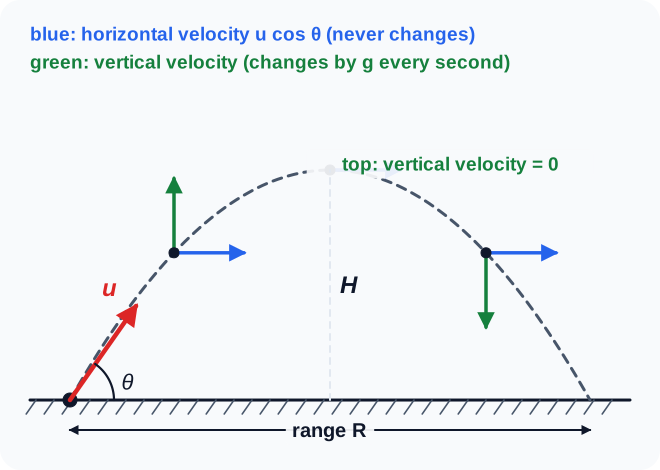
Figure 1. The horizontal velocity never changes; the vertical velocity changes by every second. WASSCE Tutor diagram.
| Horizontal motion | Vertical motion | |
|---|---|---|
| Force acting | none (no air resistance) | weight, downwards |
| Acceleration | 0 | downwards |
| Velocity | constant | changes by each second |
| Equation |
The two motions share only one thing: time. Find the time from one motion and use it in the other.
Drop one orange from your hand and, at the same moment, flick another horizontally off the table edge at the same height. They hit the floor together. The horizontal flick does not delay the fall, because vertical and horizontal motions are independent.
Case 1: projected horizontally from a height
Initial velocity is horizontal, so and .
- Time to fall height :
- Horizontal distance:
- Velocity on landing: horizontal , vertical ; speed
A stone is thrown horizontally at 15 m s⁻¹ from the top of a cliff 45 m high. Find (a) the time to reach the ground, (b) how far from the foot of the cliff it lands, (c) its speed on impact. ( m s⁻²)
(a) s.
(b) m.
(c) Vertical velocity m s⁻¹; horizontal m s⁻¹.
at below the horizontal.
Case 2: projected at an angle θ from the ground
Resolve the initial velocity:
| Quantity | Formula | Reason |
|---|---|---|
| Time to the highest point | vertical velocity becomes zero | |
| Maximum height | ||
| Time of flight | back to launch height | |
| Horizontal range |
The range formula comes from and .
A ball is kicked from the ground at 20 m s⁻¹ at 30° to the horizontal. Find (a) the time of flight, (b) the maximum height, (c) the range. ( m s⁻²)
m s⁻¹, m s⁻¹.
(a) s.
(b) m.
(c) m (or m).
Maximum range
is largest (equal to 1) when , that is θ = 45°:
Angles that add up to 90° (such as 30° and 60°) give the same range, because . The steeper throw goes higher and stays in the air longer.
At the highest point the projectile is not at rest. Its vertical velocity is zero, but its horizontal velocity is unchanged. Its speed at the top is , its smallest speed in the whole flight.
Key points
- A projectile moves under gravity alone; its path is a parabola.
- Horizontal: constant velocity . Vertical: acceleration downwards. Time links them.
- Horizontal launch from height : , range .
- At angle θ: , , ; maximum range at 45°.
WASSCE examination focus
Objective items ask for the angle of maximum range, the velocity at the highest point, or the time of flight. Theory items give a horizontal launch from a cliff or table, or a launch at an angle, and ask for time, range and impact velocity. Resolve the velocity first and keep horizontal and vertical working in separate columns.
Quick check
- What is the vertical acceleration of a projectile at the top of its path?
- A ball rolls off a table 1.25 m high at 4 m s⁻¹. How far from the table does it land? ( m s⁻²)
- Which angle of projection gives the same range as 25°?
Answers: 1. (10 m s⁻²) downwards. 2. s; distance m. 3. 65°.
Keep going with projectile motion
This is one of 2 lessons in Projectile Motion. Start free with the first lesson of every topic, then unlock them all, plus exam-style practice marked instantly and guided learning tools, from 25 NLe.
- Free account, no card needed
- Everything from 25 NLe
- No automatic renewal
More lessons in Projectile Motion
- Projectile velocity, the trajectory equation and air resistance🔒