WASSCE Physics · Photoelectric Effect and Wave-Particle Duality
The photoelectric effect and Einstein's equation
By the WASSCE Tutor team
Updated 10 November 2026 · 7 min read · Prepared against the WASSCE syllabus.
Shine bright red light on a zinc plate for hours and nothing happens. Shine a weak ultraviolet lamp on it and electrons fly off at once. The wave theory of light could not explain this. Einstein could — by treating light as a stream of energy packets called photons.
Learning objectives
By the end of this lesson you should be able to:
- describe the photoelectric effect and its experimental observations
- explain why the wave theory fails and how the photon theory succeeds
- use Einstein's equation
- define work function, threshold frequency and stopping potential
The photoelectric effect
The photoelectric effect is the emission of electrons from a metal surface when electromagnetic radiation of sufficiently high frequency falls on it. The emitted electrons are called photoelectrons.
Demonstration: a clean zinc plate on a negatively charged gold-leaf electroscope. Ultraviolet light makes the leaf collapse (electrons are emitted and the charge leaks away). Visible light — however bright — has no effect. A sheet of glass (which absorbs UV) placed in the beam stops the effect.
The observations
- Electrons are emitted only if the frequency of the light is above a threshold frequency , which depends on the metal. Below there is no emission, however intense the light.
- Emission is instantaneous: there is no delay, even with very dim light.
- The maximum kinetic energy of the photoelectrons depends on the frequency, not the intensity; it increases linearly with frequency.
- The number of electrons emitted per second (the photocurrent) is proportional to the intensity of the light.
The wave theory predicts that brighter light (bigger waves) should give electrons more energy, and that dim light should take time to build up enough energy — both wrong.
The photon explanation
Einstein proposed that light consists of packets of energy called photons (quanta), each with energy
where J s is Planck's constant.
- Each photon gives all its energy to one electron.
- The electron needs a minimum energy, the work function (or φ), to escape from the metal.
- Any energy left over becomes the electron's kinetic energy.
Einstein's photoelectric equation:
- The work function is the minimum energy needed to remove an electron from the surface of a metal.
- The threshold frequency is the minimum frequency that causes emission: .
This explains every observation: a photon with cannot free an electron no matter how many photons arrive (intensity); one photon, one electron, so emission is instant; higher frequency means more energy left over; brighter light means more photons, so more electrons.
The work function of sodium is 2.3 eV. Light of wavelength 400 nm falls on it. Find (a) the photon energy in eV, (b) the maximum kinetic energy of the photoelectrons, (c) the threshold frequency. (h = 6.63 × 10⁻³⁴ J s, c = 3.0 × 10⁸ m s⁻¹, 1 eV = 1.6 × 10⁻¹⁹ J)
(a) J eV.
(b) eV.
(c) Hz.
The graph of kinetic energy against frequency
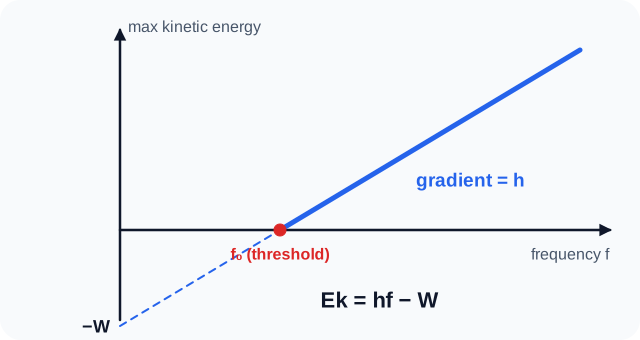
Figure 1. Maximum kinetic energy against frequency. WASSCE Tutor diagram.
- Gradient (the same for every metal).
- Intercept on the frequency axis .
- Intercept on the energy axis .
Stopping potential
If a reverse p.d. is applied to repel the photoelectrons, the current falls to zero at the stopping potential , where
So measures the maximum kinetic energy directly (in electronvolts it is numerically equal: a stopping potential of 0.81 V means a maximum kinetic energy of 0.81 eV).
Key points
- Photoelectric effect: emission of electrons by radiation above a threshold frequency.
- Photon energy ; one photon frees one electron.
- ; .
- Intensity affects the number of electrons; frequency affects their energy.
- – graph: gradient , intercept .
WASSCE examination focus
Define the photoelectric effect, work function and threshold frequency, state Einstein's equation, explain why the wave theory fails, and calculate photon energies, maximum kinetic energies and threshold frequencies. Interpreting the – graph is common. Convert eV to J where needed.
Quick check
- What happens to the number of photoelectrons if the light intensity is doubled (frequency unchanged)?
- A metal has a work function of 3.0 eV. Will photons of energy 2.5 eV cause emission?
- What does the gradient of the against graph give?
Answers: 1. It doubles (their maximum kinetic energy is unchanged). 2. No: each photon has less energy than the work function. 3. Planck's constant, .
Keep going with photoelectric effect and wave-particle duality
This is one of 2 lessons in Photoelectric Effect and Wave-Particle Duality. Start free with the first lesson of every topic, then unlock them all, plus exam-style practice marked instantly and guided learning tools, from 25 NLe.
- Free account, no card needed
- Everything from 25 NLe
- No automatic renewal
More lessons in Photoelectric Effect and Wave-Particle Duality
- Wave-particle duality, de Broglie waves and photocells🔒