WASSCE Physics · Motion under Gravity
Free fall: bodies dropped and thrown upwards
By the WASSCE Tutor team
Updated 10 November 2026 · 8 min read · Prepared against the WASSCE syllabus.
Drop a stone and a sheet of paper together: the stone wins. Crumple the paper into a tight ball and they land together. Air, not mass, made the difference. Without air, every object falls with exactly the same acceleration.
Learning objectives
By the end of this lesson you should be able to:
- define acceleration due to gravity and free fall
- apply the equations of motion to bodies falling or thrown vertically
- find the maximum height and time of flight of a body thrown upwards
- interpret the velocity–time graph of vertical motion
Free fall and the acceleration due to gravity
A body is in free fall when the only force acting on it is its weight (air resistance is negligible). It then falls with a constant acceleration called the acceleration due to gravity, .
Near the Earth's surface m s⁻². WASSCE questions usually say take m s⁻²; use whatever value the question gives.
Key facts about free fall:
- is the same for all bodies at the same place, whatever their mass.
- always acts vertically downwards, whether the body is moving up or down.
- varies slightly over the Earth: larger at the poles than at the equator, smaller at the top of a mountain.
"Heavy things fall faster" is false in a vacuum. A heavier body has a bigger weight, but it also has more mass to accelerate; the two effects cancel (). Air resistance is what slows light, broad objects such as a feather or a leaf.
The equations of motion for vertical motion
Replace with and with height . Choose a direction as positive and stick to it.
Taking downwards as positive (convenient for dropped bodies):
Taking upwards as positive (convenient for bodies thrown up): use :
A body dropped from rest
A coconut falls from rest from a tree 20 m high. Find (a) the time to reach the ground, (b) its speed on impact. Take m s⁻².
Downwards positive, , m.
(a) s.
(b) m s⁻¹ (or ).
A body thrown vertically upwards
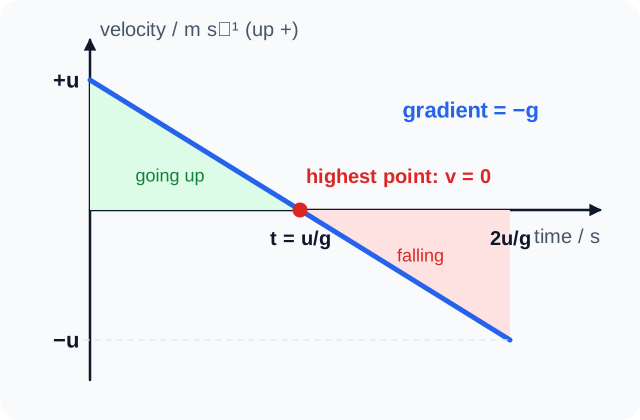
Figure 1. Velocity–time graph for a body thrown upwards (up positive). WASSCE Tutor diagram.
At the highest point the velocity is momentarily zero (but the acceleration is still downwards). Setting :
| Quantity | Result | How it is found |
|---|---|---|
| Time to reach the top | ||
| Maximum height | ||
| Time of flight (back to the thrower) | twice the time up | |
| Speed on return to the thrower | (same as launch speed) | symmetry, no air resistance |
A ball is thrown vertically upwards at 30 m s⁻¹. Find (a) the maximum height, (b) the time to reach it, (c) the total time in the air, (d) its velocity after 4 s. Take m s⁻².
Up positive.
(a) m.
(b) s.
(c) s.
(d) m s⁻¹. The minus sign means it is now moving downwards at 10 m s⁻¹.
At the top of its flight, but . If the acceleration were zero there, the ball would stay in the air. Objective questions test this often: "At the highest point, the acceleration is…" — answer: , downwards.
Energy view (a useful check)
Ignoring air resistance, kinetic energy at launch becomes potential energy at the top:
the same result, with the mass cancelling.
Terminal velocity
In air, a falling body feels air resistance that grows with its speed. Eventually air resistance equals the weight; the resultant force is then zero and the body falls at a constant terminal velocity. A skydiver reaches about 55 m s⁻¹; opening a parachute raises the air resistance and lowers the terminal velocity to about 5 m s⁻¹.
A raindrop falling from a cloud 1000 m up would hit the ground at about 140 m s⁻¹ if there were no air, enough to injure. Air resistance gives raindrops a terminal velocity of only a few metres per second, which is why the rainy season in Freetown is wet but not dangerous.
Key points
- Free fall: only weight acts; acceleration (take 10 m s⁻² unless told otherwise), the same for all masses.
- Use the equations of motion with ; choose a positive direction and keep to it.
- Thrown up: , , time of flight .
- At the top: , downwards.
- With air resistance, a falling body reaches a constant terminal velocity.
WASSCE examination focus
Objective items test "the acceleration at the highest point", time of flight and maximum height. Theory items combine vertical motion with energy, or ask for the velocity–time graph of a ball thrown up and caught (a single straight line crossing the time axis, not a "V" shape). State your sign convention at the start.
Quick check
- A stone is dropped from a bridge and hits the water 3 s later. How high is the bridge? ( m s⁻²)
- A ball is thrown up at 20 m s⁻¹. What is its maximum height?
- What is the velocity of the ball in question 2 after 3 s?
Answers: 1. m. 2. m. 3. m s⁻¹: 10 m s⁻¹ downwards.
Keep going with motion under gravity
This is one of 2 lessons in Motion under Gravity. Start free with the first lesson of every topic, then unlock them all, plus exam-style practice marked instantly and guided learning tools, from 25 NLe.
- Free account, no card needed
- Everything from 25 NLe
- No automatic renewal
More lessons in Motion under Gravity
- Harder vertical motion problems and measuring g🔒