WASSCE Physics · Motion in a Straight Line
Distance, displacement, speed, velocity and acceleration
By the WASSCE Tutor team
Updated 11 November 2026 · 9 min read · Prepared against the WASSCE syllabus.
You sit still in a poda-poda while it races along Wilkinson Road. Are you moving? Relative to the vehicle, no; relative to the road, yes. Physics describes motion carefully, with five quantities you must never mix up: distance, displacement, speed, velocity and acceleration.
Learning objectives
By the end of this lesson you should be able to:
- describe motion relative to a reference point, using a sign for direction
- distinguish distance from displacement and speed from velocity
- calculate average speed, average velocity and acceleration
- convert between km h⁻¹ and m s⁻¹
Describing motion
A body is in motion when its position changes with time relative to a chosen reference point. For motion along a straight line, choose one direction as positive (say east). Then:
- m means 12 m east of the reference point;
- m means 5 m west of it.
The sign tells you the direction; the number tells you the size.
Distance and displacement
- Distance is the total length of the path travelled. It is a scalar: it has size only.
- Displacement is the change in position, measured in a straight line from start to finish in a stated direction. It is a vector.
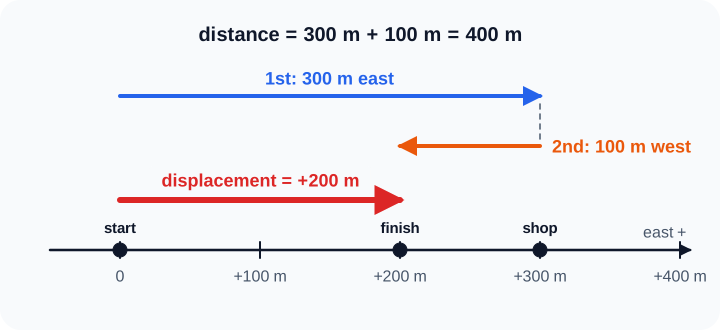
Figure 1. Distance and displacement on a straight road. WASSCE Tutor diagram.
A student walks 300 m east to a shop, then 100 m west. Find the distance travelled and the displacement.
Distance m.
Taking east as positive: displacement m, that is 200 m east of the start.
Distance can never be negative. Displacement can be positive, negative or zero, and its size can never be larger than the distance.
A runner completes one 400 m lap of the National Stadium track and stops where she started. Find the distance and the displacement.
Distance m. She ends where she began, so displacement .
Do not say she "travelled 0 m": zero is the displacement, not the distance.
Speed and velocity
Speed is a scalar; velocity is a vector, so it carries a direction (or a sign). Both are measured in m s⁻¹.
A cyclist rides 600 m east in 120 s, then 200 m west in 40 s. Find her average speed and average velocity for the whole journey.
Total distance m; total time s.
Displacement m (east).
The two answers differ because she turned back.
Converting km h⁻¹ and m s⁻¹
- km h⁻¹ → m s⁻¹: multiply by . So .
- m s⁻¹ → km h⁻¹: multiply by . So .
A vehicle covers 1.8 km in 3 minutes. Find its average speed in m s⁻¹ and in km h⁻¹.
Instantaneous speed
Average speed describes a whole journey. Instantaneous speed is the speed at one moment: the number on a car's speedometer. On a displacement–time graph it is the gradient of the tangent at that instant (see the next lesson).
Acceleration
Acceleration is the rate of change of velocity:
where is the initial velocity, the final velocity and the time taken. Its unit is m s⁻². Acceleration is a vector.
A bus speeds up from 5 m s⁻¹ to 17 m s⁻¹ in 6 s. Find its acceleration.
When a body slows down, its acceleration is opposite to its velocity. This is called deceleration or retardation.
A car moving east at 20 m s⁻¹ stops uniformly in 5 s. Taking east as positive, find its acceleration.
The minus sign means the acceleration points west, against the motion. The car has a deceleration of 4.0 m s⁻².
"Negative acceleration" does not always mean slowing down. A body moving west (negative) that speeds up also has a negative acceleration. Decide the sign from your chosen positive direction, and say in words whether the body is speeding up or slowing down.
Okada riders in Bo and Makeni know acceleration by feel. Pulling away from a junction, a bike might reach 12 m s⁻¹ (about 43 km h⁻¹) in 6 s, an acceleration of 2 m s⁻². Braking hard from the same speed to rest in 2 s is a deceleration of 6 m s⁻², which is why passengers lurch forward.
Key points
- Choose a positive direction; signs show direction along a line.
- Distance (scalar) is the path length; displacement (vector) is the straight-line change in position, with direction.
- Average speed = total distance ÷ time; average velocity = displacement ÷ time.
- km h⁻¹ × 5/18 = m s⁻¹; m s⁻¹ × 18/5 = km h⁻¹.
- , in m s⁻²; deceleration is acceleration opposite to the motion.
WASSCE examination focus
WASSCE asks you to define distance, displacement, speed, velocity and acceleration and to classify them as scalars or vectors. Calculations involve journeys with a change of direction (where average speed and average velocity differ), unit conversion between km h⁻¹ and m s⁻¹, and acceleration or deceleration from . Always state the direction of a vector answer.
Quick check
- A student walks 250 m north and then 90 m south. Find the distance and the displacement.
- Convert 72 km h⁻¹ to m s⁻¹.
- A cyclist travels 500 m east in 100 s, then 200 m west in 50 s. Find the average speed and the average velocity.
- A car's velocity rises from 8 m s⁻¹ to 26 m s⁻¹ in 6 s. Find its acceleration.
- Is speed a scalar or a vector? Is velocity?
Answers: 1. Distance 340 m; displacement 160 m north. 2. 20 m s⁻¹. 3. Speed m s⁻¹; velocity m s⁻¹ east. 4. m s⁻². 5. Speed is a scalar; velocity is a vector.
Keep going with motion in a straight line
This is one of 2 lessons in Motion in a Straight Line. Start free with the first lesson of every topic, then unlock them all, plus exam-style practice marked instantly and guided learning tools, from 25 NLe.
- Free account, no card needed
- Everything from 25 NLe
- No automatic renewal
More lessons in Motion in a Straight Line
- Motion graphs and the ticker-tape timer🔒