WASSCE Physics · Moments and Turning Effects
Moments, the principle of moments and couples
By the WASSCE Tutor team
Updated 11 November 2026 · 7 min read · Prepared against the WASSCE syllabus.
You can open a heavy door easily by pushing at the handle and hardly at all by pushing near the hinges. Same force, different effect. That turning effect, the moment, explains spanners, see-saws, wheelbarrows and why lorries carrying tall loads overturn.
Learning objectives
By the end of this lesson you should be able to:
- define the moment of a force and state its unit
- state and apply the principle of moments
- state the conditions for equilibrium of a body under parallel forces
- define a couple and calculate its moment
Moment of a force
The moment of a force about a point is the product of the force and the perpendicular distance from the point to the line of action of the force:
Its SI unit is the newton metre (N m).
The point about which the body turns is the pivot or fulcrum. Moments are either clockwise or anticlockwise.
- A 20 N force at the end of a 0.25 m spanner, at right angles to it: moment N m.
- The same force applied with a 0.5 m spanner: 10 N m. A longer handle gives a bigger turning effect for the same force.
Use the perpendicular distance to the line of action. If a force of 50 N acts at the end of a 2 m rod but at 30° to the rod, the perpendicular distance is m, so the moment is N m, not 100 N m.
The principle of moments
Principle of moments: when a body is in equilibrium, the sum of the clockwise moments about any point equals the sum of the anticlockwise moments about the same point.
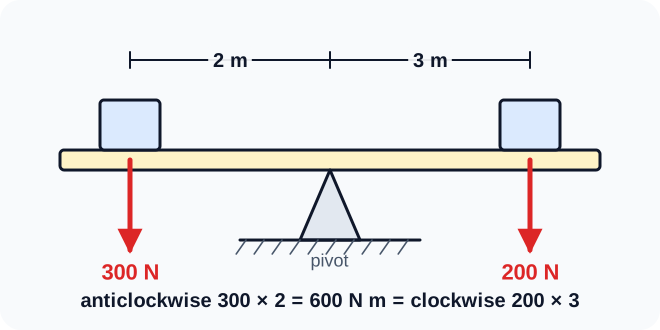
Figure 1. The principle of moments on a balanced beam. WASSCE Tutor diagram.
A see-saw is pivoted at its centre. Musa (300 N) sits 2 m from the pivot. Where must Aminata (200 N) sit to balance it?
on the other side of the pivot.
Conditions for equilibrium under parallel forces
For a body acted on by parallel forces to be in equilibrium:
- The sum of the forces in one direction equals the sum in the opposite direction (upward forces = downward forces): no resultant force, so no translation.
- The sum of clockwise moments equals the sum of anticlockwise moments about any point: no resultant moment, so no rotation.
A uniform metre rule weighing 1 N is pivoted at the 50 cm mark. A 2 N weight hangs at the 10 cm mark. Where must a 4 N weight hang to balance the rule? Find the reaction at the pivot.
The rule's own weight acts at its centre (50 cm), right at the pivot, so it has no moment.
Anticlockwise moment: N cm.
Clockwise moment: cm to the right of the pivot, so at the 70 cm mark.
Upward reaction = total downward force N.
A uniform plank 6 m long and weighing 400 N rests on two supports, one at each end. A 600 N man stands 2 m from the left end. Find the reactions at the supports.
Take moments about the left support (so its reaction has no moment). Let the right reaction be :
Upward forces = downward forces: N.
The support nearer the man carries more of the load.
Choose the pivot cleverly. Taking moments about a point where an unknown force acts removes that force from the equation. Then use "upward forces = downward forces" for the second unknown.
Couples
A couple is a pair of equal, parallel and opposite forces whose lines of action do not coincide. It produces rotation only, with no translation.
where is one of the two forces and is the perpendicular distance between them. This moment is also called the torque of the couple.
Examples: turning a tap, a steering wheel, a screwdriver, a bottle top; the forces on the coil of an electric motor.
A driver applies forces of 30 N at opposite ends of a steering wheel of diameter 0.4 m. Find the moment of the couple.
Key points
- Moment = force × perpendicular distance from the pivot (N m).
- Principle of moments: clockwise moments = anticlockwise moments in equilibrium.
- Parallel forces in equilibrium: upward = downward, and clockwise = anticlockwise.
- A couple: two equal, opposite, parallel forces; moment = force × distance between them.
WASSCE examination focus
State the principle of moments precisely, then solve beam problems: a uniform rod with loads and supports, or a metre rule balanced on a knife edge. Remember that a uniform rod's weight acts at its midpoint. A frequent practical asks you to find the mass of a metre rule or of an unknown object by balancing.
Quick check
- What is the SI unit of the moment of a force?
- A 40 N force acts at right angles to a door, 0.8 m from the hinges. Find its moment.
- State the two conditions for a body to be in equilibrium under parallel forces.
Answers: 1. Newton metre (N m). 2. N m. 3. The sum of upward forces equals the sum of downward forces; the sum of clockwise moments equals the sum of anticlockwise moments about any point.
Keep going with moments and turning effects
This is one of 2 lessons in Moments and Turning Effects. Start free with the first lesson of every topic, then unlock them all, plus exam-style practice marked instantly and guided learning tools, from 25 NLe.
- Free account, no card needed
- Everything from 25 NLe
- No automatic renewal
More lessons in Moments and Turning Effects
- Centre of gravity and stability🔒