WASSCE Physics · Magnetic Effects of Current
Magnetic effect of a current: wires, solenoids and electromagnets
By the WASSCE Tutor team
Updated 10 November 2026 · 6 min read · Prepared against the WASSCE syllabus.
In 1820, Oersted noticed a compass needle twitch when he switched on a current in a nearby wire: electricity produces magnetism. That discovery led directly to electromagnets, electric bells, loudspeakers and motors.
Learning objectives
By the end of this lesson you should be able to:
- describe the magnetic fields of a straight wire and a solenoid
- use the right-hand grip rule to find field directions
- describe an electromagnet and the factors affecting its strength
- explain the electric bell and the relay
The field round a straight wire
A current in a straight wire produces a magnetic field of concentric circles centred on the wire. The field is strongest close to the wire and weakens with distance.
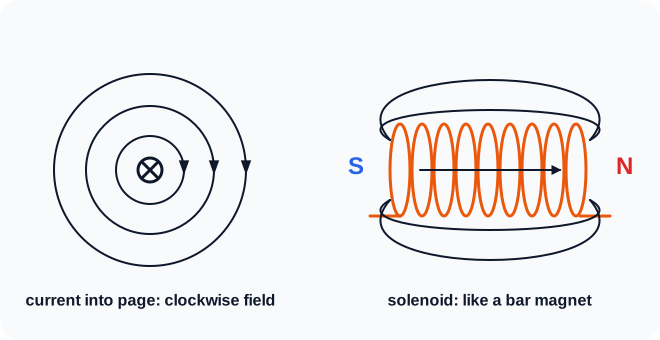
Figure 1. Magnetic fields of a straight wire and a solenoid. WASSCE Tutor diagram.
Right-hand grip rule (straight wire): grip the wire with the right hand with the thumb pointing in the direction of the current; the curled fingers show the direction of the magnetic field lines.
On diagrams, current into the page is shown as ⊗ (the tail of an arrow), and current out of the page as ⊙ (the point of an arrow). Current into the page gives a clockwise field.
The field of a solenoid
A solenoid is a long coil of wire. When current flows, its field is like that of a bar magnet: almost uniform inside, with a north pole at one end and a south pole at the other.
Finding the poles:
- Right-hand grip rule (solenoid): grip the coil so the fingers curl in the direction of the current; the thumb points to the north pole.
- Or look at an end: if the current flows anticlockwise, that end is a N pole; if clockwise, it is a S pole.
The field strength increases with:
- more turns per unit length
- larger current
- a soft-iron core inside the coil
Electromagnets
An electromagnet is a coil of wire wound on a soft-iron core. It is a magnet only while current flows.
Soft iron is used because it is easily magnetised and loses its magnetism at once when the current is switched off (steel would stay magnetised).
Uses: lifting scrap iron, electric bells, relays, circuit breakers, loudspeakers, telephone earpieces, magnetic door locks, separating iron from other waste.
The electric bell
- Pressing the bell push completes the circuit; current flows through the electromagnet.
- The electromagnet attracts the soft-iron armature; the hammer strikes the gong.
- As the armature moves, it pulls away from the contact screw, breaking the circuit.
- The electromagnet loses its magnetism; the spring pulls the armature back, remaking the contact.
- The cycle repeats rapidly, so the bell rings continuously while the push is pressed.
The relay
A relay is a switch operated by an electromagnet. A small current in the coil circuit attracts an armature that closes (or opens) contacts in a second circuit, which may carry a large current or high voltage. Relays let a small, safe circuit control a large one — for example the starter motor of a car, or a water pump controlled by a float switch.
In the electric bell at a school gate, and in the circuit breakers of a house distribution board, an electromagnet is at work. A circuit breaker's electromagnet pulls open a switch when the current becomes dangerously large.
Key points
- A current in a straight wire produces circular field lines; right-hand grip rule gives the direction.
- A solenoid's field is like a bar magnet's; increase it with more turns, more current and a soft-iron core.
- Electromagnets use soft iron because it magnetises and demagnetises easily.
- The electric bell makes and breaks its own circuit; a relay lets a small current switch a large one.
WASSCE examination focus
Sketch the field round a straight wire and a solenoid (with directions), state the right-hand grip rule, list factors affecting the strength of an electromagnet, and explain how an electric bell works (with a labelled diagram). Explain why soft iron is used for the core.
Quick check
- What shape are the field lines round a long straight current-carrying wire?
- Give two ways of increasing the strength of an electromagnet.
- Why is the core of an electromagnet made of soft iron rather than steel?
Answers: 1. Concentric circles centred on the wire. 2. For example: increase the current; increase the number of turns (or use a soft-iron core). 3. Soft iron loses its magnetism immediately when the current stops; steel would stay magnetised.
Keep going with magnetic effects of current
This is one of 2 lessons in Magnetic Effects of Current. Start free with the first lesson of every topic, then unlock them all, plus exam-style practice marked instantly and guided learning tools, from 25 NLe.
- Free account, no card needed
- Everything from 25 NLe
- No automatic renewal
More lessons in Magnetic Effects of Current
- The motor effect, Fleming's left-hand rule and the d.c. motor🔒