WASSCE Physics · Light as a Wave
Light: straight-line travel, shadows, eclipses and the pinhole camera
By the WASSCE Tutor team
Updated 10 November 2026 · 7 min read · Prepared against the WASSCE syllabus.
You see this page because light from it enters your eyes. Light travels so fast and so straight that for centuries people thought it was instantaneous. This lesson covers the basics: how light travels, how shadows and eclipses form, and the simplest camera of all.
Learning objectives
By the end of this lesson you should be able to:
- distinguish luminous and non-luminous objects, and transparent, translucent and opaque materials
- describe rays and beams and demonstrate the rectilinear propagation of light
- explain the formation of shadows, umbra and penumbra, and eclipses
- describe the pinhole camera and calculate magnification
Sources of light
- Luminous objects produce their own light: the Sun, a lamp, a candle flame, a firefly.
- Non-luminous objects are seen only because they reflect light into our eyes: the Moon, this page, a person.
| Material | Light passes through? | Examples |
|---|---|---|
| Transparent | yes, clearly; objects seen sharply | clear glass, clean water, air |
| Translucent | partly; objects seen blurred | frosted glass, tracing paper, thin cloth |
| Opaque | no | wood, metal, a brick wall |
Rays and beams
A ray is the direction (path) along which light travels, drawn as a straight line with an arrow. A beam is a stream (bundle) of rays.
| Beam | Rays |
|---|---|
| Parallel | rays stay the same distance apart (light from the distant Sun, a torch reflector) |
| Converging | rays come together to a point (after a convex lens) |
| Diverging | rays spread out from a point (from a lamp or candle) |
Light travels in straight lines
Rectilinear propagation of light: light travels in straight lines in a uniform medium.
Demonstration: three cards with a small hole in each are lined up in front of a candle. The flame is visible through all three holes only when the holes lie on a straight line (checked with a thread pulled tight through them). Move one card sideways and the flame disappears.
Evidence in daily life: sharp shadows; sunbeams through gaps in clouds or a window; we cannot see round corners.
Shadows
A shadow is a region that light cannot reach because an opaque object blocks it.
- A point source gives a sharp shadow (umbra only).
- An extended (large) source gives a dark central umbra surrounded by a lighter penumbra.
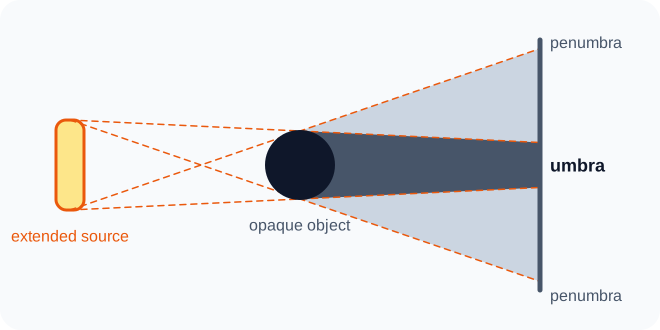
Figure 1. Umbra and penumbra from an extended source. WASSCE Tutor diagram.
- Umbra: the region of total shadow, which receives no light from the source.
- Penumbra: the region of partial shadow, which receives light from part of the source.
Eclipses
Eclipse of the Sun (solar eclipse): the Moon passes between the Sun and the Earth, casting its shadow on the Earth. People in the umbra see a total eclipse; in the penumbra, a partial eclipse. It can happen only at new moon.
Eclipse of the Moon (lunar eclipse): the Earth passes between the Sun and the Moon, and the Moon moves into the Earth's shadow. It can happen only at full moon.
A total solar eclipse crossed parts of West Africa in March 2006, darkening the sky at midday. In Sierra Leone it was seen as a deep partial eclipse. Watching one safely needs proper eclipse filters or a pinhole projector — never look at the Sun directly.
The pinhole camera
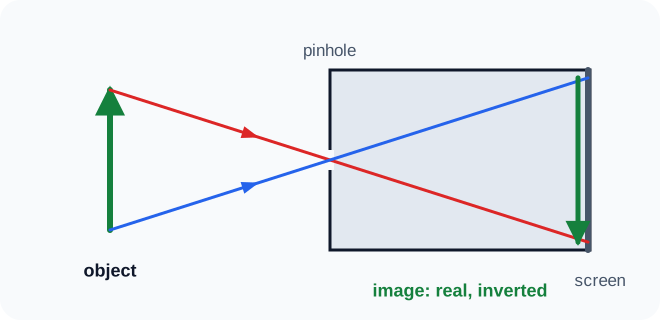
Figure 2. The pinhole camera forms a real, inverted image. WASSCE Tutor diagram.
A light-tight box with a small pinhole at the front and a screen of tracing paper at the back. Rays from each point of the object travel in straight lines through the hole and form an image on the screen.
Characteristics of the image: real, inverted (upside down and laterally inverted), and it can be magnified or diminished.
Magnification
A tree 15 m tall is 60 m from a pinhole camera whose screen is 20 cm behind the pinhole. Find the height of the image.
Effects of changing the pinhole
| Change | Effect on the image |
|---|---|
| Moving the screen further from the hole | larger, but dimmer |
| Enlarging the hole | brighter but blurred (overlapping images) |
| Making several holes | several overlapping images |
| Moving the object closer | larger image |
Key points
- Luminous objects emit light; non-luminous ones reflect it.
- Light travels in straight lines (rectilinear propagation).
- An extended source gives an umbra (total shadow) and a penumbra (partial shadow).
- Solar eclipse: Moon between Sun and Earth; lunar eclipse: Earth between Sun and Moon.
- Pinhole camera: real, inverted image; .
WASSCE examination focus
Describe an experiment showing that light travels in straight lines, explain the formation of umbra and penumbra (with a ray diagram), explain eclipses with diagrams, and describe the pinhole camera — the nature of its image and the effect of enlarging the hole. Magnification calculations are frequent.
Quick check
- Give one example of a translucent material.
- What is the nature of the image in a pinhole camera?
- A pinhole camera 10 cm long views a 2 m tall man 20 m away. Find the image height.
Answers: 1. For example: frosted glass or tracing paper. 2. Real and inverted. 3. , so the image is m = 1 cm tall.
Keep going with light as a wave
This is one of 2 lessons in Light as a Wave. Start free with the first lesson of every topic, then unlock them all, plus exam-style practice marked instantly and guided learning tools, from 25 NLe.
- Free account, no card needed
- Everything from 25 NLe
- No automatic renewal
More lessons in Light as a Wave
- The nature of light: speed, theories, interference and polarisation🔒