WASSCE Physics · Gas Laws
Boyle's law, Charles's law and the pressure law
By the WASSCE Tutor team
Updated 10 November 2026 · 6 min read · Prepared against the WASSCE syllabus.
Pump air into a football and it gets firmer; heat an aerosol can and it may explode; squeeze a sealed syringe and the air inside resists more and more. Gases obey three simple laws linking their pressure, volume and temperature.
Learning objectives
By the end of this lesson you should be able to:
- state Boyle's law, Charles's law and the pressure law
- explain absolute zero and why the Kelvin scale is used in gas calculations
- solve problems using , and
- interpret the graphs of the gas laws
The variables
A fixed mass of gas is described by its pressure , volume and absolute temperature (in kelvin). Each gas law keeps one variable constant and links the other two.
Boyle's law
Boyle's law: the volume of a fixed mass of gas is inversely proportional to its pressure, provided the temperature remains constant.
A bicycle pump contains 200 cm³ of air at atmospheric pressure (100 kPa). The outlet is blocked and the air is compressed slowly (constant temperature) to 80 cm³. Find the new pressure.
Kinetic explanation: halving the volume crowds the same number of molecules into half the space, so they strike each unit area of the walls twice as often; the pressure doubles.
Charles's law
Charles's law: the volume of a fixed mass of gas is directly proportional to its absolute temperature, provided the pressure remains constant.
A balloon holds 3.0 litres of air at 27 °C. What is its volume at 77 °C, at the same pressure?
Convert to kelvin: K, K.
Always use kelvin in gas law calculations. Using Celsius gives nonsense: doubling from 20 °C to 40 °C does not double the volume, because the absolute temperature only rises from 293 K to 313 K.
The pressure law
Pressure law (Gay-Lussac's law): the pressure of a fixed mass of gas is directly proportional to its absolute temperature, provided the volume remains constant.
A car tyre has a pressure of 200 kPa at 27 °C in the morning. After a long drive in the sun its temperature is 57 °C. Find the new pressure (volume constant).
Absolute zero
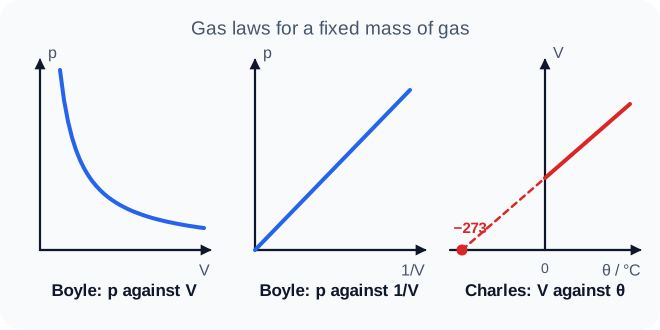
Figure 1. Graphs of the gas laws. WASSCE Tutor diagram.
If the volume–temperature (or pressure–temperature) graph of any gas is extended backwards, it meets the temperature axis at about −273 °C. At this temperature the volume (or pressure) would be zero.
Absolute zero (0 K, −273 °C) is the lowest possible temperature, at which the molecules of a substance have their minimum kinetic energy. The Kelvin scale starts at absolute zero: .
Graphs to recognise
| Law | Graph | Shape |
|---|---|---|
| Boyle | against | curve (hyperbola) |
| Boyle | against | straight line through the origin |
| Boyle | against | horizontal line |
| Charles | against (K) | straight line through the origin |
| Charles | against θ (°C) | straight line meeting the θ-axis at −273 °C |
| Pressure law | against (K) | straight line through the origin |
Key points
- Boyle (constant ): .
- Charles (constant ): .
- Pressure law (constant ): .
- Use kelvin: . Absolute zero is −273 °C.
WASSCE examination focus
State each gas law with its condition (fixed mass, and what is kept constant), solve problems (converting to kelvin), sketch or identify the graphs, and explain a law using the kinetic theory. Objective items often show a graph and ask which law it represents.
Quick check
- Which quantity is kept constant in Boyle's law?
- A gas at 100 kPa occupies 6 litres. What volume does it occupy at 300 kPa (same temperature)?
- Convert −73 °C to kelvin.
Answers: 1. Temperature (and the mass of gas). 2. 2 litres. 3. 200 K.
Keep going with gas laws
This is one of 2 lessons in Gas Laws. Start free with the first lesson of every topic, then unlock them all, plus exam-style practice marked instantly and guided learning tools, from 25 NLe.
- Free account, no card needed
- Everything from 25 NLe
- No automatic renewal
More lessons in Gas Laws
- The general gas law and the kinetic theory of gases🔒