WASSCE Physics · Friction
Friction: static, limiting and kinetic friction
By the WASSCE Tutor team
Updated 10 November 2026 · 8 min read · Prepared against the WASSCE syllabus.
Without friction you could not walk, a car could not brake, a nail would slide out of wood and a knot would come undone. Yet friction also wears out engines and wastes fuel. This lesson explains what friction is, how big it can get, and how to calculate it.
Learning objectives
By the end of this lesson you should be able to:
- define friction and distinguish static, limiting and kinetic (dynamic) friction
- state the laws of solid friction
- define and calculate the coefficient of friction
- solve problems involving friction on horizontal surfaces
What is friction?
Friction is the force that opposes relative motion (or the tendency to move) between two surfaces in contact. It acts along the surfaces, opposite to the direction of motion or attempted motion.
Friction arises because even smooth-looking surfaces are rough on a microscopic scale. Their tiny bumps interlock and form temporary bonds where they touch.
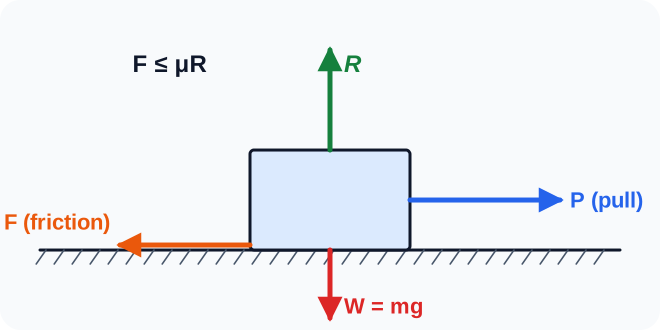
Figure 1. The forces on a block pulled along a rough floor. WASSCE Tutor diagram.
Static, limiting and kinetic friction
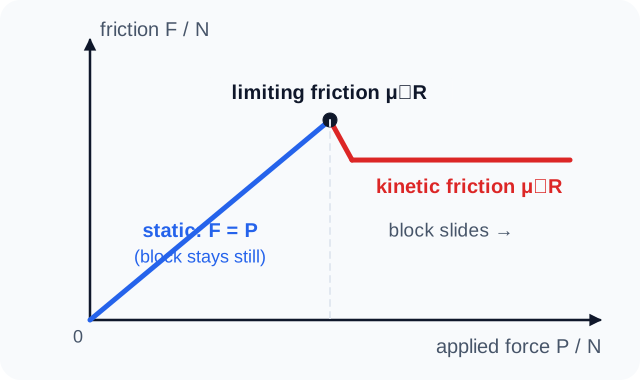
Figure 2. How friction responds as the pull increases. WASSCE Tutor diagram.
| Type | When | Size |
|---|---|---|
| Static friction | the body is at rest and a force tries to move it | adjusts itself to equal the applied force, up to a maximum |
| Limiting friction | the body is just about to move | the maximum value of static friction, |
| Kinetic (dynamic, sliding) friction | the body is sliding | roughly constant, , a little less than limiting friction |
This explains why it takes more force to start pushing a heavy box than to keep it sliding.
Coefficient of friction
The coefficient of static friction is the ratio of the limiting friction to the normal reaction:
The coefficient of kinetic friction is the ratio of the kinetic friction to the normal reaction. Both are pure numbers (no unit).
On a horizontal surface with no other vertical forces, , so .
| Surfaces | Approximate |
|---|---|
| Rubber tyre on dry tarmac | 0.8–1.0 |
| Rubber tyre on wet road | 0.4–0.6 |
| Wood on wood | 0.3–0.5 |
| Steel on steel (dry) | 0.6 |
| Steel on ice | 0.03 |
The laws of solid friction
- Friction opposes the relative motion of the surfaces.
- Friction is independent of the area of contact (for the same normal reaction).
- Limiting friction is directly proportional to the normal reaction: .
- Friction depends on the nature of the surfaces in contact.
- Kinetic friction is roughly independent of the speed of sliding (for moderate speeds).
Worked examples
1. A 20 kg crate rests on a floor. The coefficient of static friction is 0.4 and of kinetic friction 0.3. ( m s⁻²)
(a) What horizontal force just starts it moving?
N, so N.
(b) What force keeps it moving at constant speed?
N.
(c) A force of 100 N is applied. Find the acceleration.
Once sliding, friction is 60 N. Resultant N, so m s⁻².
(d) A force of 50 N is applied to the crate at rest. What is the friction?
50 N is less than 80 N, so the crate does not move: static friction is just 50 N, equal to the push. Friction is not automatically .
gives the maximum static friction. If the push is smaller than this, friction equals the push and the body stays at rest.
2. A car of mass 1000 kg travelling at 20 m s⁻¹ brakes hard and skids to a stop. The coefficient of kinetic friction between tyres and road is 0.8. Find the stopping distance. ( m s⁻²)
Friction N; deceleration m s⁻².
On a wet road with , the deceleration halves and the stopping distance doubles to 50 m.
Pulling at an angle
If a rope pulls at angle θ above the horizontal, part of the pull lifts the body, so the normal reaction is reduced:
A 10 kg box is pulled by a rope at 30° above the horizontal; . Find the tension needed to keep it moving steadily. ( m s⁻²)
Horizontally:
Pushing down at 30° instead would increase and need more force.
Key points
- Friction opposes relative motion and acts along the surfaces.
- Static friction matches the applied force up to the limiting value ; kinetic friction is slightly less.
- has no unit; friction does not depend on contact area.
- Use the resultant force (applied minus friction) in .
WASSCE examination focus
You may be asked to state the laws of friction, define the coefficient of static friction, distinguish static and dynamic friction, and calculate the force needed to move a body or its acceleration when friction acts. The friction-against-applied-force graph sometimes appears for interpretation.
Quick check
- What is the unit of the coefficient of friction?
- A 50 N block needs 20 N to start it sliding on a horizontal bench. Find .
- Does increasing the area of contact (same weight) increase friction?
Answers: 1. It has no unit. 2. . 3. No: friction is independent of the area of contact.
Keep going with friction
This is one of 2 lessons in Friction. Start free with the first lesson of every topic, then unlock them all, plus exam-style practice marked instantly and guided learning tools, from 25 NLe.
- Free account, no card needed
- Everything from 25 NLe
- No automatic renewal
More lessons in Friction
- Friction on slopes, viscosity and reducing friction🔒