WASSCE Physics · Equilibrium of Forces
Equilibrium of forces: triangle of forces and Lami's theorem
By the WASSCE Tutor team
Updated 10 November 2026 · 7 min read · Prepared against the WASSCE syllabus.
A signboard hanging from two wires outside a shop in Kissy is perfectly still: every force on it is balanced. Engineers who design bridges, cranes and roofs spend their lives making sure forces add up to zero. This lesson shows you how.
Learning objectives
By the end of this lesson you should be able to:
- state the conditions for equilibrium of a particle under concurrent forces
- apply the triangle of forces and Lami's theorem
- solve equilibrium problems by resolving forces
- find tensions in strings supporting a hanging load
Equilibrium
A body is in equilibrium when it is at rest or moving with uniform velocity, so that it has no acceleration. This happens when the resultant force on it is zero (and, for a large body, the resultant moment is zero).
Concurrent forces are forces whose lines of action pass through one point. For a body under concurrent forces, equilibrium needs only one condition:
In words: the sum of the forces in any direction is zero — upward forces equal downward forces, leftward forces equal rightward forces.
Resultant and equilibrant
- The resultant is the single force that has the same effect as all the forces together.
- The equilibrant is the single force that balances them: equal in size to the resultant, opposite in direction.
The triangle of forces
Triangle of forces: if three forces acting at a point are in equilibrium, they can be represented in magnitude and direction by the three sides of a triangle taken in order (nose to tail).
The converse is also true: if three forces can be drawn as a closed triangle, they are in equilibrium. More generally, any number of forces in equilibrium form a closed polygon (the polygon of forces).
Lami's theorem
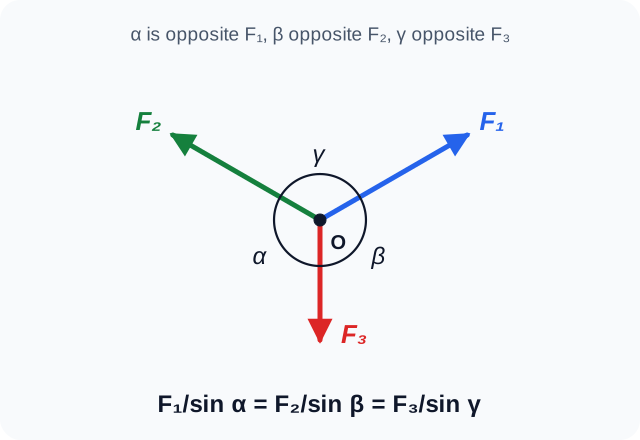
Figure 1. Lami's theorem: each force is paired with the angle between the other two. WASSCE Tutor diagram.
Lami's theorem: if three concurrent forces are in equilibrium, each force is proportional to the sine of the angle between the other two:
Worked examples
1. A lamp of weight 40 N hangs from the midpoint of a wire. Each half of the wire makes 30° with the horizontal. Find the tension in the wire.
By symmetry both tensions are equal, . Resolve vertically: the upward components balance the weight.
Horizontally, to the left balances to the right automatically.
The flatter the wire, the larger the tension. If each half made only 5° with the horizontal, N. A washing line can never be pulled perfectly straight when anything hangs on it: the tension would have to be infinite.
2. A weight of 100 N is supported by two strings. One makes 30° with the vertical and the other 60° with the vertical, on opposite sides. Find the tensions (30° string) and (60° string).
The angle between the two strings is . The angle between and the weight (straight down) is ; between and the weight, .
By Lami's theorem:
Check by resolving horizontally: and . ✓ The string nearer the vertical carries more of the load.
3. A box of weight 50 N is pulled aside by a horizontal force until the rope it hangs from makes 37° with the vertical. Find and the tension in the rope.
Resolve vertically: N.
Resolve horizontally: N.
(Quick check: , so N. ✓)
A body on a smooth inclined plane
On a smooth (frictionless) slope at angle θ, a block can be held still by a force up the slope. Resolving along and perpendicular to the slope:
For a 20 N block on a smooth 30° slope: N, and the normal reaction N.
Key points
- Equilibrium: zero acceleration, zero resultant force (, ).
- The equilibrant is equal and opposite to the resultant.
- Three forces in equilibrium form a closed triangle of forces.
- Lami's theorem: , each angle being between the other two forces.
- Resolving in two perpendicular directions solves almost every problem.
WASSCE examination focus
Expect to state the conditions of equilibrium, state Lami's theorem or the triangle of forces, and calculate tensions in strings holding a load. Draw a clear force diagram with angles marked. If you use Lami's theorem, show which angle goes with which force; if you resolve, write both the vertical and horizontal equations.
Quick check
- What is the resultant force on a body in equilibrium?
- A 60 N weight hangs from the middle of a wire whose halves each make 30° with the horizontal. Find the tension.
- A 30 N block rests on a smooth 30° slope, held by a force up the slope. Find that force.
Answers: 1. Zero. 2. N. 3. N.
Keep going with equilibrium of forces
This is one of 2 lessons in Equilibrium of Forces. Start free with the first lesson of every topic, then unlock them all, plus exam-style practice marked instantly and guided learning tools, from 25 NLe.
- Free account, no card needed
- Everything from 25 NLe
- No automatic renewal
More lessons in Equilibrium of Forces
- Equilibrium on inclined planes🔒