WASSCE Physics · Equations of Motion
The equations of uniformly accelerated motion
By the WASSCE Tutor team
Updated 10 November 2026 · 8 min read · Prepared against the WASSCE syllabus.
A driver sees a child step onto the road 40 m ahead. Will the car stop in time? Three short equations answer that question exactly, and they are among the most tested results in WASSCE Physics.
Learning objectives
By the end of this lesson you should be able to:
- state the conditions under which the equations of motion apply
- derive the four equations of uniformly accelerated motion from a velocity–time graph
- choose the right equation for a problem and solve it with correct units
The quantities and their symbols
| Symbol | Quantity | SI unit |
|---|---|---|
| initial velocity | m s⁻¹ | |
| final velocity | m s⁻¹ | |
| acceleration (constant) | m s⁻² | |
| time taken | s | |
| displacement | m |
The equations of motion apply only to motion in a straight line with uniform (constant) acceleration. If the acceleration changes, they cannot be used.
A negative acceleration (deceleration or retardation) is allowed: it simply means the body is slowing down in the positive direction.
Deriving the equations from a velocity–time graph
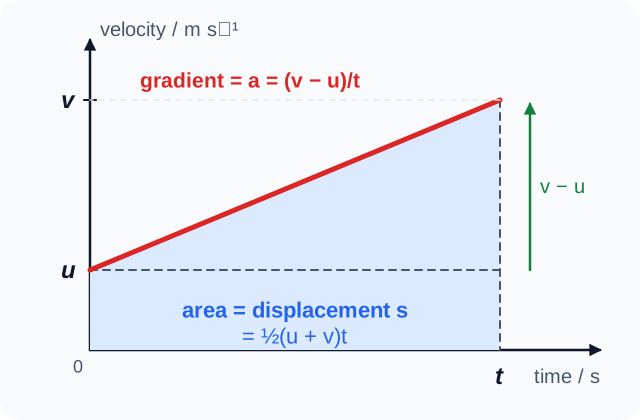
Figure 1. Velocity–time graph for uniform acceleration. WASSCE Tutor diagram.
First equation. The gradient of a velocity–time graph is the acceleration:
Second equation. The area under the graph is the displacement. The area is a trapezium:
Third equation. Substitute into the second:
(Equivalently, the area is a rectangle plus a triangle .)
Fourth equation. From the first, . Substitute into the second:
"Derive " and "Show that " are common theory questions worth 3–4 marks. Start from the graph (or from the definitions of acceleration and average velocity) and show every substitution.
Choosing the right equation
Each equation leaves out one of the five quantities. List what you know and what you want; pick the equation that does not contain the quantity you neither know nor need.
| Equation | Quantity it does not contain |
|---|---|
"Starts from rest" means . "Comes to rest" or "stops" means . "Uniform velocity" means . Write these down before you start; many lost marks come from reading the question too quickly.
Worked examples
1. A minibus starts from rest and accelerates uniformly at 2 m s⁻² for 8 s. Find its final velocity and the distance covered.
Known: , m s⁻², s.
2. A car travelling at 20 m s⁻¹ brakes and stops in 40 m. Find the deceleration and the time taken to stop.
Known: , , . Want (time not given): use .
The deceleration is 5 m s⁻². Time: s.
Check with m. ✓
3. A motorcycle moving at 10 m s⁻¹ accelerates uniformly at 1.5 m s⁻² over a distance of 100 m. Find its final velocity.
4. A body moving with uniform acceleration covers 30 m in the 3rd second and 40 m in the 5th second. Find its acceleration and initial velocity.
Distance in the th second .
- 3rd second:
- 5th second:
Subtract: m s⁻². Then m s⁻¹.
Back to the driver and the child
A taxi on Wilkinson Road is travelling at 15 m s⁻¹ (54 km h⁻¹). The driver reacts after 0.7 s, then brakes at 6 m s⁻².
- Thinking distance (no braking yet): m.
- Braking distance: m.
- Stopping distance: m.
The taxi stops about 11 m short of the child 40 m ahead. At 25 m s⁻¹ (90 km h⁻¹) the stopping distance becomes m: it would not stop in time. Doubling speed roughly quadruples braking distance, because .
Key points
- The equations apply to straight-line motion with constant acceleration only.
- , , , .
- Pick the equation that leaves out the quantity you do not need.
- Deceleration gives a negative ; braking distance is proportional to .
WASSCE examination focus
Expect at least one calculation per paper: stopping distances, distance in the th second, or two-stage journeys read from a velocity–time graph. Write the list of knowns (, , , , ) first, quote the equation, substitute with units and box the answer. Derivations of the equations are a favourite short theory item.
Quick check
- A ball rolls from rest down a slope with acceleration 4 m s⁻². How far does it go in 5 s?
- A train slows from 30 m s⁻¹ to 10 m s⁻¹ over 400 m. Find the deceleration.
- Which equation would you use if the time is neither given nor asked for?
Answers: 1. m. 2. m s⁻², a deceleration of 1 m s⁻². 3. .
Keep going with equations of motion
This is one of 2 lessons in Equations of Motion. Start free with the first lesson of every topic, then unlock them all, plus exam-style practice marked instantly and guided learning tools, from 25 NLe.
- Free account, no card needed
- Everything from 25 NLe
- No automatic renewal
More lessons in Equations of Motion
- Multi-stage journeys and chase problems🔒