WASSCE Physics · Electrostatics
Static electricity: charging, induction and the electroscope
By the WASSCE Tutor team
Updated 10 November 2026 · 7 min read · Prepared against the WASSCE syllabus.
Rub a plastic comb on dry hair and it picks up scraps of paper. Take off a nylon shirt in the harmattan and it crackles. Lightning flashes across the sky in the rainy season. All are static electricity: charges that build up and stay put — until they suddenly jump.
Learning objectives
By the end of this lesson you should be able to:
- explain charging by friction in terms of electron transfer
- state the law of electrostatics and distinguish conductors from insulators
- describe charging by contact and by induction
- describe the gold-leaf electroscope and its uses
Charge and electrons
All matter is made of atoms containing positive protons (in the nucleus) and negative electrons (around it). A neutral object has equal numbers of each.
An object becomes charged when it gains or loses electrons. Gaining electrons makes it negative; losing electrons makes it positive. Protons do not move: only electrons are transferred.
The SI unit of charge is the coulomb (C). One electron carries C.
Charging by friction (rubbing)
When two different insulators are rubbed together, electrons move from one to the other:
| Rubbed together | Becomes negative | Becomes positive |
|---|---|---|
| polythene rod and wool | polythene (gains electrons) | wool |
| glass (or Perspex) rod and silk | silk | glass (loses electrons) |
| plastic comb and dry hair | comb | hair |
The two materials always gain equal and opposite charges.
The law of electrostatics
Like charges repel; unlike charges attract.
A charged object also attracts small uncharged objects (such as scraps of paper) by inducing opposite charges on their near side.
Attraction does not prove that an object is charged — a charged rod attracts neutral paper too. Repulsion is the only sure test: if two objects repel, both must be charged with the same sign.
Conductors and insulators
| Conductors | Insulators |
|---|---|
| allow charge to flow through them easily (they have free electrons) | do not allow charge to flow |
| metals (copper, aluminium), graphite, the human body, the Earth, water with impurities | plastic, rubber, glass, dry wood, silk, dry air |
A conductor can be charged by rubbing only if it is held by an insulating handle; otherwise the charge flows away through the hand to the Earth (earthing).
Charging by contact and by induction
By contact (conduction): touching a charged rod to a neutral conductor shares the charge; the conductor gets the same sign of charge as the rod.
By induction (charging without touching), for example to make a metal sphere positive using a negative rod:
- Bring the negative rod near (not touching) the insulated sphere. Electrons in the sphere are repelled to the far side; the near side becomes positive.
- Earth the sphere (touch it with a finger) while the rod is still near. The repelled electrons flow away to the Earth.
- Remove the earth connection first, then remove the rod.
- The sphere is left with a positive charge — opposite to the rod.
How many electrons must be removed from a neutral object to give it a charge of +3.2 × 10⁻¹⁸ C?
The gold-leaf electroscope
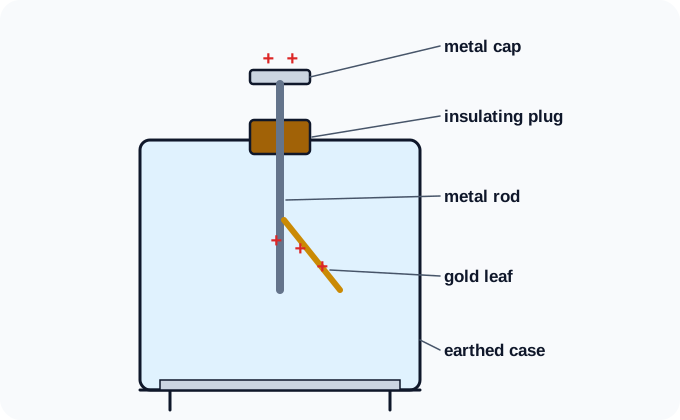
Figure 1. The gold-leaf electroscope. WASSCE Tutor diagram.
When the cap is charged, the charge spreads over the rod and the leaf. The rod and leaf carry the same charge, so they repel and the leaf diverges (rises).
Uses:
- To detect charge: the leaf rises if an object brought near the cap is charged.
- To find the sign of a charge: charge the electroscope with a known sign (say positive). Bring the test object near the cap:
- if the leaf diverges further, the object has the same charge;
- if the leaf collapses, the object has the opposite charge or is uncharged — so only an increase in divergence is a reliable test.
- To compare conductors and insulators: touch the cap of a charged electroscope with the material; a conductor discharges it quickly (leaf falls), an insulator does not.
Key points
- Charging means gaining or losing electrons; protons do not move.
- Like charges repel, unlike attract; repulsion is the only sure test of charge.
- Conductors let charge flow; insulators do not.
- Induction gives a charge opposite to the inducing charge: bring near, earth, remove earth, remove rod.
- Gold-leaf electroscope: detects charge, tests its sign (increase in divergence), compares conductors.
WASSCE examination focus
Explain charging by friction in terms of electrons, describe charging by induction step by step (the order "remove the earth, then the rod" matters), and describe the gold-leaf electroscope — how it detects charge and how to find the sign of an unknown charge. Objective items ask which material is a conductor or what happens to the leaf.
Quick check
- A polythene rod rubbed with wool becomes negative. Explain why.
- What is the only sure test that a body is charged?
- What sign of charge does a sphere get when charged by induction using a positive rod?
Answers: 1. Electrons are transferred from the wool to the polythene. 2. Repulsion (by a body of known charge). 3. Negative (opposite to the inducing rod).
Keep going with electrostatics
This is one of 2 lessons in Electrostatics. Start free with the first lesson of every topic, then unlock them all, plus exam-style practice marked instantly and guided learning tools, from 25 NLe.
- Free account, no card needed
- Everything from 25 NLe
- No automatic renewal
More lessons in Electrostatics
- Coulomb's law, electric fields, potential and lightning🔒