WASSCE Physics · Electromagnetic Induction
Electromagnetic induction: Faraday's and Lenz's laws
By the WASSCE Tutor team
Updated 10 November 2026 · 6 min read · Prepared against the WASSCE syllabus.
Move a magnet into a coil and a current appears from nowhere — no battery needed. Faraday's discovery of electromagnetic induction is how almost all the world's electricity is generated, from Bumbuna's turbines to a bicycle dynamo.
Learning objectives
By the end of this lesson you should be able to:
- describe experiments showing electromagnetic induction
- state Faraday's and Lenz's laws of electromagnetic induction
- use Fleming's right-hand rule to find the direction of an induced current
- state the factors affecting the size of the induced e.m.f.
Electromagnetic induction
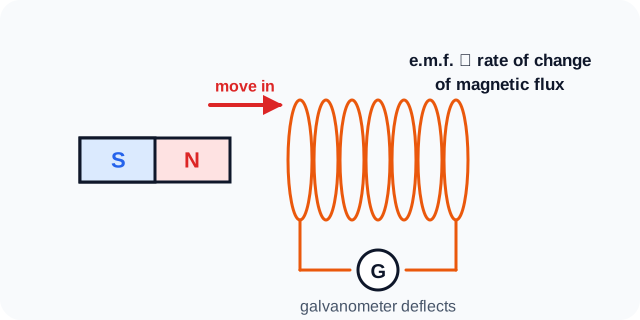
Figure 1. Inducing a current by moving a magnet into a coil. WASSCE Tutor diagram.
Electromagnetic induction is the production of an e.m.f. (and a current, if the circuit is complete) in a conductor when the magnetic flux linking it changes.
Observations with a magnet and a coil connected to a galvanometer:
| Action | Galvanometer |
|---|---|
| magnet pushed into the coil | deflects one way |
| magnet held still inside the coil | no deflection |
| magnet pulled out | deflects the opposite way |
| magnet moved faster | larger deflection |
| stronger magnet, or coil with more turns | larger deflection |
The same happens if the coil is moved instead of the magnet: what matters is relative motion — a changing magnetic field through the coil.
A straight wire moved across a magnetic field (cutting the field lines) also has an e.m.f. induced in it.
Faraday's law
Faraday's law of electromagnetic induction: the magnitude of the induced e.m.f. is directly proportional to the rate of change of magnetic flux linking the circuit:
Here Φ is the magnetic flux (in webers, Wb; for a flux density through an area at right angles), and the number of turns.
Factors affecting the induced e.m.f.
- the speed of relative motion (rate of change of flux)
- the strength of the magnetic field
- the number of turns on the coil
- the area of the coil
The flux through a coil of 200 turns changes from 0.004 Wb to 0.001 Wb in 0.1 s. Find the average induced e.m.f.
For a straight conductor of length moving at speed at right angles to a field :
A rod 0.5 m long moves at 4 m s⁻¹ at right angles to a magnetic field of 0.2 T. Find the e.m.f. induced across its ends.
Lenz's law
Lenz's law: the direction of the induced current is always such as to oppose the change producing it.
When the N pole of a magnet is pushed into a coil, the induced current makes that end of the coil a N pole, which repels the approaching magnet. When the magnet is pulled out, that end becomes a S pole, attracting it back. Either way, you must do work against the opposing force — and that work becomes the electrical energy. Lenz's law is the conservation of energy in electromagnetism (the minus sign in Faraday's law).
Fleming's right-hand rule
Fleming's right-hand rule (the dynamo rule): hold the thumb, first finger and second finger of the right hand mutually at right angles. If the thuMb points in the direction of Motion of the conductor and the First finger along the Field (N → S), the seCond finger gives the direction of the induced Current.
Left hand for motors (force on a current), right hand for generators (induced current). A memory aid: "Generators are Right" (dynamo — right; motor — left).
Key points
- A changing magnetic flux through a circuit induces an e.m.f.; no change, no e.m.f.
- Faraday: e.m.f. ∝ rate of change of flux; , .
- Lenz: the induced current opposes the change causing it (conservation of energy).
- Fleming's right-hand rule gives the direction of the induced current.
WASSCE examination focus
Describe an experiment demonstrating electromagnetic induction, state Faraday's and Lenz's laws, give the factors affecting the induced e.m.f., and explain how Lenz's law follows from the conservation of energy. Calculations with and appear in theory papers.
Quick check
- What happens to the galvanometer when a magnet is held still inside a coil?
- State Lenz's law.
- Find the e.m.f. induced in a 0.4 m wire moving at 5 m s⁻¹ across a 0.1 T field.
Answers: 1. Nothing: there is no deflection because the flux is not changing. 2. The induced current flows in a direction that opposes the change producing it. 3. V.
Keep going with electromagnetic induction
This is one of 2 lessons in Electromagnetic Induction. Start free with the first lesson of every topic, then unlock them all, plus exam-style practice marked instantly and guided learning tools, from 25 NLe.
- Free account, no card needed
- Everything from 25 NLe
- No automatic renewal
More lessons in Electromagnetic Induction
- Generators, mutual and self-induction, and eddy currents🔒