WASSCE Physics · Electrolysis
Electrolysis: electrolytes, ions and electroplating
By the WASSCE Tutor team
Updated 10 November 2026 · 6 min read · Prepared against the WASSCE syllabus.
Pass a current through salt water and bubbles of gas appear at the wires. Pass it through copper sulphate and copper coats the negative plate. Electrolysis — chemical change caused by electric current — is used to plate cutlery, refine metals and charge car batteries.
Learning objectives
By the end of this lesson you should be able to:
- define electrolysis, electrolyte, electrodes, anode and cathode
- explain conduction in electrolytes by the movement of ions
- describe the electrolysis of copper(II) sulphate and of acidified water
- distinguish conductors, electrolytes and non-electrolytes
Key terms
- Electrolysis is the chemical decomposition of a substance (in solution or molten) by the passage of an electric current.
- An electrolyte is a substance that conducts electricity when molten or in solution and is decomposed by it (acids, bases, salts in water).
- Electrodes are the conductors through which current enters and leaves the electrolyte. The anode is connected to the positive terminal; the cathode to the negative terminal.
- A voltameter is the vessel in which electrolysis takes place.
Substances that do not conduct when dissolved or molten (sugar solution, pure water, paraffin) are non-electrolytes.
How electrolytes conduct
In an electrolyte the current is carried by ions (charged atoms or groups of atoms), not by electrons:
- positive ions (cations) — such as H⁺, Cu²⁺, Na⁺ — move to the cathode (−)
- negative ions (anions) — such as SO₄²⁻, OH⁻, Cl⁻ — move to the anode (+)
At the electrodes the ions gain or lose electrons and are discharged as atoms or molecules.
| Conduction in metals | Conduction in electrolytes |
|---|---|
| by free electrons | by ions (positive and negative) |
| no chemical change | chemical decomposition |
| resistance increases with temperature | resistance decreases with temperature |
Electrolysis of copper(II) sulphate with copper electrodes
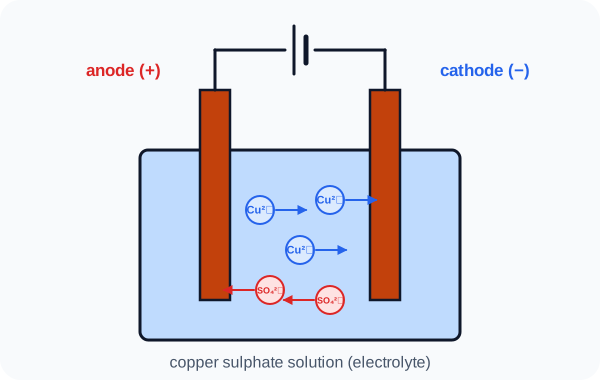
Figure 1. Electrolysis of copper sulphate with copper electrodes. WASSCE Tutor diagram.
- At the cathode: Cu²⁺ ions gain electrons and are deposited as copper. . The cathode gains mass.
- At the anode: copper atoms lose electrons and go into solution. . The anode loses mass.
- The concentration (and blue colour) of the solution stays the same: copper is simply transferred from anode to cathode.
This is the principle of copper refining and electroplating.
Electrolysis of acidified water (Hofmann voltameter)
Pure water barely conducts, so a little dilute sulphuric acid is added. With inert platinum electrodes:
- at the cathode: hydrogen ions are discharged — hydrogen gas is released
- at the anode: oxygen gas is released
- the volume of hydrogen is twice the volume of oxygen (water is H₂O)
Applications of electrolysis
- Electroplating: coating a cheap metal with a thin layer of a better-looking or corrosion-resistant one (chromium on bicycle handlebars, silver on cutlery, gold on jewellery).
- Refining of metals such as copper to high purity.
- Extraction of reactive metals such as aluminium and sodium from their molten ores.
- Charging of secondary cells (lead–acid car batteries).
- Electrotyping and anodising aluminium.
Electroplating a spoon with silver
- Cathode: the spoon to be plated (cleaned first)
- Anode: a bar of pure silver
- Electrolyte: a solution of a silver salt (such as silver nitrate)
- Use a small current for a long time, so the coating is even and firmly attached.
Jewellers in Freetown's markets electroplate brass and copper jewellery with a thin layer of gold or silver. The object is made the cathode, so the precious-metal ions are deposited on it.
Key points
- Electrolysis: chemical decomposition by an electric current; current carried by ions.
- Cations (+) go to the cathode (−); anions (−) go to the anode (+).
- CuSO₄ with copper electrodes: copper moves from anode to cathode; concentration unchanged.
- Acidified water: hydrogen at the cathode, oxygen at the anode, volume ratio 2 : 1.
- Uses: electroplating, refining, extraction, charging batteries.
WASSCE examination focus
Define electrolysis and electrolyte, explain conduction by ions, describe the electrolysis of copper sulphate (what happens at each electrode and to the solution), and describe how to electroplate an object (which is the cathode, which the anode, and what electrolyte). Compare conduction in metals and in electrolytes.
Quick check
- To which electrode do positive ions move?
- In electroplating a spoon with silver, what is the spoon connected to?
- What happens to the colour of copper sulphate solution during electrolysis with copper electrodes?
Answers: 1. The cathode (negative electrode). 2. The negative terminal: it is the cathode. 3. It stays the same, because copper dissolves from the anode as fast as it is deposited on the cathode.
Keep going with electrolysis
This is one of 2 lessons in Electrolysis. Start free with the first lesson of every topic, then unlock them all, plus exam-style practice marked instantly and guided learning tools, from 25 NLe.
- Free account, no card needed
- Everything from 25 NLe
- No automatic renewal
More lessons in Electrolysis
- Faraday's laws of electrolysis and cells🔒