WASSCE Physics · Elasticity and Hooke's Law
Elasticity and Hooke's law
By the WASSCE Tutor team
Updated 10 November 2026 · 7 min read · Prepared against the WASSCE syllabus.
A spring scale in the market, the springs under a motorbike seat, a catapult and the rubber in a sandal all stretch and spring back. How far they stretch, and when they stop springing back, is the subject of elasticity.
Learning objectives
By the end of this lesson you should be able to:
- define elasticity, elastic limit and plastic deformation
- state Hooke's law and use
- interpret a load–extension graph for a spring and a metal wire
- describe an experiment to verify Hooke's law
Elasticity
Elasticity is the property of a material that enables it to return to its original shape and size after the force deforming it is removed.
A material that does not return to its original shape is plastic (for example plasticine, wet clay, chewing gum). Many materials are elastic for small forces and plastic for large ones: a spring stretched too far stays permanently longer.
Hooke's law
Hooke's law: the extension of an elastic material is directly proportional to the force (load) applied, provided the elastic limit (more precisely, the limit of proportionality) is not exceeded.
where is the force (N), the extension (m) and the spring constant (or force constant) in N m⁻¹.
The extension is the increase in length: , where is the original (natural) length.
The spring constant measures stiffness: a large means a stiff spring that stretches little.
A spring of natural length 20 cm stretches to 24 cm when a 6 N weight hangs on it. Find (a) the spring constant, (b) the length when the load is 9 N (within the elastic limit).
(a) Extension .
(b) , so the length is cm.
Use the extension, not the stretched length. In part (b) above, many candidates answer 6 cm instead of 26 cm, or use 24 cm as if it were the extension.
The load–extension graph
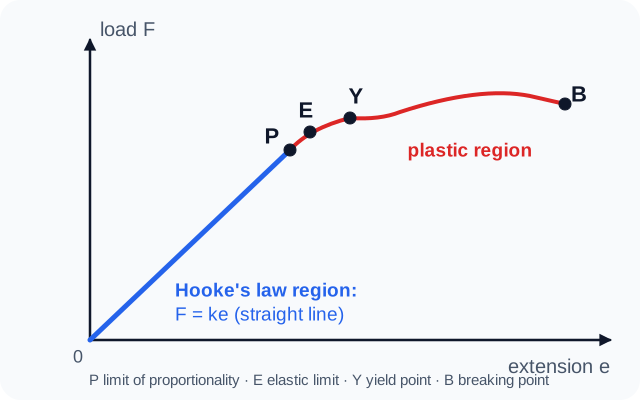
Figure 1. Load–extension graph for a metal wire. WASSCE Tutor diagram.
| Point | Meaning |
|---|---|
| O to P | straight line through the origin: Hooke's law is obeyed; gradient (when load is on the y-axis) |
| P, limit of proportionality | beyond this, extension is no longer proportional to load |
| E, elastic limit | the greatest load from which the material still returns to its original length |
| Y, yield point | the material suddenly stretches a lot for little extra load: it starts to flow (plastic) |
| B, breaking point | the wire snaps |
Beyond the elastic limit the deformation is permanent: removing the load leaves a permanent set (extension).
Experiment: verifying Hooke's law
- Clamp a spiral spring vertically with a pointer at its lower end against a vertical metre rule. Hang a light scale pan.
- Record the pointer reading with no load ().
- Add loads in equal steps (e.g. 0.5 N), recording the pointer reading each time.
- Remove the loads one at a time and record the readings again (they should match, showing the elastic limit was not exceeded).
- Calculate the extension for each load. Plot load (y) against extension (x).
- A straight line through the origin verifies Hooke's law; its gradient is .
Precautions: avoid parallax when reading the pointer (eye level); allow the spring to come to rest before reading; do not exceed the elastic limit; take readings while loading and unloading.
Work done in stretching (elastic potential energy)
The work done in stretching a spring is the area under the force–extension graph:
How much energy is stored in the spring above (k = 150 N m⁻¹) when it is stretched by 4 cm?
Key points
- Elasticity: returning to the original shape when the force is removed.
- Hooke's law: , valid up to the limit of proportionality.
- Extension = new length − natural length.
- Beyond the elastic limit, deformation is permanent; then come the yield point and breaking point.
- Energy stored .
WASSCE examination focus
State Hooke's law (include "provided the elastic limit is not exceeded"), solve spring problems with , interpret the load–extension graph (label the elastic limit, yield point, breaking point), and describe the experiment to verify Hooke's law with precautions. Spring-balance practicals are common.
Quick check
- A spring of N m⁻¹ is pulled by 10 N. Find its extension.
- What does the gradient of a load–extension graph give?
- What happens if a spring is loaded beyond its elastic limit?
Answers: 1. m (5 cm). 2. The spring constant (with load on the vertical axis). 3. It is permanently stretched and does not return to its original length.
Keep going with elasticity and hooke's law
This is one of 2 lessons in Elasticity and Hooke's Law. Start free with the first lesson of every topic, then unlock them all, plus exam-style practice marked instantly and guided learning tools, from 25 NLe.
- Free account, no card needed
- Everything from 25 NLe
- No automatic renewal
More lessons in Elasticity and Hooke's Law
- Stress, strain, Young's modulus and springs🔒