WASSCE Physics · Domestic Electricity and Safety
House wiring, the three-pin plug, fuses and earthing
By the WASSCE Tutor team
Updated 10 November 2026 · 7 min read · Prepared against the WASSCE syllabus.
Every year, faulty wiring, overloaded sockets and illegal connections cause fires and electric shocks in homes and markets. Knowing how a house is wired — and what each safety device does — can save a life.
Learning objectives
By the end of this lesson you should be able to:
- describe how electricity reaches and is distributed in a house
- explain the functions of the live, neutral and earth wires
- wire a three-pin plug correctly
- explain the functions of fuses, circuit breakers, switches and earthing
From the grid to the house
Electricity reaches a house through two service cables from a pole transformer: the live and the neutral. Inside, they pass through:
- the supplier's main fuse (sealed)
- the electricity meter (EDSA prepaid meter), which measures the energy used in kWh
- the consumer unit (distribution board), with a main switch and separate fuses or circuit breakers for each circuit: lighting, sockets, cooker, water heater
All appliances are connected in parallel, so each gets the full 230 V and can be switched on and off independently.
Live, neutral and earth
| Wire | Colour (modern) | Function |
|---|---|---|
| Live (L) | brown (older: red) | carries the current to the appliance at about 230 V (alternating); dangerous |
| Neutral (N) | blue (older: black) | completes the circuit back to the supply; kept close to 0 V at the substation |
| Earth (E) | green and yellow (older: green) | a safety wire connected to the metal case of the appliance and to the ground |
Switches and fuses are always placed in the live wire. Then, when the switch is off or the fuse has blown, the appliance is disconnected from the high voltage. A switch in the neutral would leave the appliance "live" even when switched off.
The three-pin plug
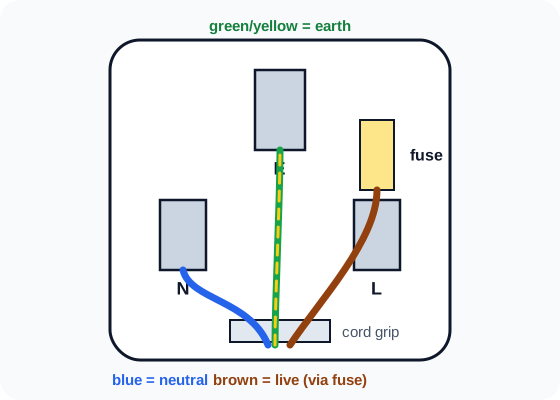
Figure 1. Wiring a three-pin plug. WASSCE Tutor diagram.
Looking into the back of the plug with the cover off and the cable at the bottom:
- Brown (live) → right-hand pin, through the fuse
- Blue (neutral) → left-hand pin
- Green/yellow (earth) → top (longest) pin
- The cord grip clamps the outer sheath of the cable firmly, so the wires cannot be pulled out of their terminals.
The earth pin is longest so that it connects first and disconnects last.
Fuses
A fuse is a short, thin piece of wire with a low melting point, placed in the live wire. If the current exceeds its rating, the wire melts and breaks the circuit, protecting the cable from overheating and causing a fire.
Choosing a fuse
Calculate the normal working current, , then choose the next standard rating above it (common ratings: 3 A, 5 A, 13 A).
Which fuse (3 A, 5 A or 13 A) should be fitted to the plug of (a) a 920 W iron, (b) a 60 W lamp, on a 230 V supply?
(a) A → 5 A fuse.
(b) A → 3 A fuse.
A fuse with too high a rating (or a piece of ordinary wire or a nail used instead) will not melt when a fault occurs, so the cable can overheat and start a fire. Always use the correct rating, and never "bridge" a blown fuse.
Circuit breakers
A circuit breaker is an automatic switch that trips (opens) when the current is too large — usually by the magnetic pull of an electromagnet or the bending of a bimetallic strip. Advantages over fuses: it acts faster, and it can simply be reset after the fault is cleared.
A residual current device (RCD) compares the currents in the live and neutral wires and cuts off the supply in milliseconds if they differ (because current is leaking — perhaps through a person — to earth). It gives excellent protection against electric shock.
Earthing
If a fault makes the live wire touch the metal case of an appliance (such as a kettle or a fridge), anyone touching it could get a severe shock. With an earth wire attached to the case, a large current flows straight to earth through the low-resistance earth wire. This blows the fuse (or trips the breaker) at once, disconnecting the supply and making the appliance safe.
Double-insulated appliances (with plastic cases, marked ⧈) need no earth wire.
Key points
- Appliances are connected in parallel; the meter records energy in kWh.
- Live = brown, neutral = blue, earth = green/yellow; switches and fuses go in the live.
- Plug: brown → right pin via fuse, blue → left, green/yellow → top; cord grip on the sheath.
- Fuse rating: just above the working current .
- Earthing + fuse: a live-to-case fault blows the fuse and protects the user.
WASSCE examination focus
Draw and label a correctly wired three-pin plug, explain the functions of the fuse and the earth wire (and why the fuse is in the live wire), calculate the correct fuse rating for an appliance, and compare fuses and circuit breakers. These are frequent short theory questions.
Quick check
- What colour is the live wire in modern wiring?
- Why are switches placed in the live wire?
- A kettle is rated 2.3 kW, 230 V. Which fuse — 3 A, 5 A or 13 A — should it have?
Answers: 1. Brown. 2. So that when the switch is off, the appliance is disconnected from the high voltage and is safe. 3. A, so a 13 A fuse.
Keep going with domestic electricity and safety
This is one of 2 lessons in Domestic Electricity and Safety. Start free with the first lesson of every topic, then unlock them all, plus exam-style practice marked instantly and guided learning tools, from 25 NLe.
- Free account, no card needed
- Everything from 25 NLe
- No automatic renewal
More lessons in Domestic Electricity and Safety
- Electrical safety, first aid, two-way switching and saving energy🔒