WASSCE Physics · Dispersion and the Electromagnetic Spectrum
Dispersion, the visible spectrum and colour
By the WASSCE Tutor team
Updated 10 November 2026 · 6 min read · Prepared against the WASSCE syllabus.
Sunlight looks white, but a glass prism — or a shower of rain with the Sun behind you — splits it into a band of colours. Colour is not something objects "have"; it depends on which wavelengths of light they reflect.
Learning objectives
By the end of this lesson you should be able to:
- describe and explain dispersion of white light by a prism
- name the colours of the visible spectrum in order
- explain how a pure spectrum is produced and how colours recombine
- explain the colour of objects and the mixing of coloured lights and pigments
Dispersion
Dispersion is the separation of white light into its component colours when it passes through a prism (or another refracting medium).
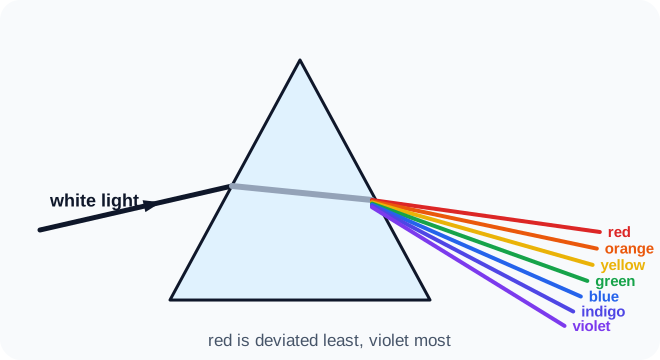
Figure 1. Dispersion of white light by a prism. WASSCE Tutor diagram.
Why it happens: white light is a mixture of colours with different wavelengths. Glass has a slightly different refractive index for each colour: highest for violet and lowest for red. So violet is slowed and bent most, and red least, and the colours spread out.
The order of the colours in the visible spectrum, from least to most deviated:
Red, Orange, Yellow, Green, Blue, Indigo, Violet (remember ROY G BIV).
Red has the longest wavelength (about 700 nm) and violet the shortest (about 400 nm).
Pure and impure spectra
A spectrum produced by a prism with a wide beam is impure: the colours overlap. A pure spectrum (colours sharply separated) is obtained by:
- using a narrow slit as the source of light,
- a converging lens to make the light from the slit parallel before it enters the prism,
- the prism set at minimum deviation,
- a second converging lens to focus each colour sharply on a screen.
A spectrometer is an instrument built on this arrangement.
Recombining colours
The colours of the spectrum can be recombined into white light:
- with a second, inverted prism placed after the first
- with Newton's colour disc: a disc painted in the spectrum colours appears white (or greyish) when spun rapidly, because the eye retains each colour briefly
The rainbow
A rainbow forms when sunlight enters raindrops, is refracted (and dispersed) on entering, totally internally reflected at the back of the drop, and refracted again as it leaves. Each colour leaves at a slightly different angle, so you see a band of colours — red on the outside, violet on the inside. You see a rainbow only with the Sun behind you and rain in front.
During the rainy season in Freetown, rainbows often appear over the hills in the late afternoon, when the Sun is low in the west and showers are falling to the east.
Colour of objects
An opaque object appears coloured because it reflects some colours and absorbs the rest.
| Object in white light | Reflects | Absorbs |
|---|---|---|
| white paper | all colours | none |
| black cloth | none | all colours |
| red cloth | red | all other colours |
| green leaf | green | most other colours |
Seen in coloured light: a red shirt in red light looks red; in green light it looks black, because there is no red light for it to reflect.
A transparent filter transmits its own colour and absorbs the others: a red filter lets only red light through.
Mixing coloured lights (additive mixing)
The primary colours of light are red, green and blue. Adding them:
| Mixture | Result |
|---|---|
| red + green | yellow |
| red + blue | magenta |
| green + blue | cyan |
| red + green + blue | white |
Two colours that add to make white are complementary: red and cyan, green and magenta, blue and yellow. Television and phone screens make every colour from tiny red, green and blue dots.
Mixing paints (subtractive mixing)
Paints and dyes work by absorbing (subtracting) colours. Mixing yellow and cyan (blue-green) paint gives green, because only green is reflected by both. Mixing many paints tends towards black.
Key points
- Dispersion: white light splits into colours because the refractive index differs for each colour.
- Order: ROYGBIV; red deviated least (longest wavelength), violet most.
- Objects reflect their own colour and absorb the rest; coloured lighting changes how they look.
- Primary colours of light: red, green, blue; red + green = yellow, all three = white.
WASSCE examination focus
Explain dispersion, list the colours of the spectrum in order, describe how a pure spectrum is obtained, and explain the appearance of coloured objects under white and coloured light (a red object in green light appears black). The rainbow and additive mixing of light appear in objective questions.
Quick check
- Which colour is deviated most by a prism?
- What colour does a blue cloth appear in red light?
- What is the result of adding red and green light?
Answers: 1. Violet. 2. Black (it absorbs red and there is no blue light to reflect). 3. Yellow.
Keep going with dispersion and the electromagnetic spectrum
This is one of 2 lessons in Dispersion and the Electromagnetic Spectrum. Start free with the first lesson of every topic, then unlock them all, plus exam-style practice marked instantly and guided learning tools, from 25 NLe.
- Free account, no card needed
- Everything from 25 NLe
- No automatic renewal
More lessons in Dispersion and the Electromagnetic Spectrum
- The electromagnetic spectrum: properties, uses and dangers🔒