WASSCE Physics · Density and Pressure in Fluids
Density, pressure in liquids and atmospheric pressure
By the WASSCE Tutor team
Updated 10 November 2026 · 8 min read · Prepared against the WASSCE syllabus.
Why does a sharp knife cut better than a blunt one? Why are the walls of a dam thicker at the bottom? Why do your ears pop when a plane takes off? Pressure answers all three — and pressure in liquids and air is one of the most examined topics in WASSCE Physics.
Learning objectives
By the end of this lesson you should be able to:
- define density and relative density and calculate them
- define pressure and calculate pressure in solids and liquids
- use and explain the properties of liquid pressure
- explain atmospheric pressure, the mercury barometer and the manometer
- state Pascal's principle and apply it to hydraulic machines
Density and relative density
Density is mass per unit volume: , in kg m⁻³ (or g cm⁻³; 1 g cm⁻³ = 1000 kg m⁻³).
Relative density is the ratio of the density of a substance to the density of water (no unit):
Water has density 1000 kg m⁻³ (RD = 1). Mercury has RD 13.6, so its density is 13 600 kg m⁻³.
Pressure
Pressure is the force acting normally (perpendicularly) per unit area:
Its SI unit is the pascal (Pa): 1 Pa = 1 N m⁻².
The same force produces a larger pressure on a smaller area:
- a sharp knife or a needle has a tiny area, so it cuts or pierces easily
- tractors and lorries have wide tyres; camels have broad feet: large areas give low pressure, so they do not sink into soft ground
- a woman in stiletto heels exerts more pressure on a floor than an elephant standing on its broad feet
A block of weight 120 N measures 0.2 m × 0.3 m × 0.5 m. Find the greatest and least pressures it can exert on the floor.
- Greatest pressure: smallest face, m². Pa.
- Least pressure: largest face, m². Pa.
Pressure in liquids
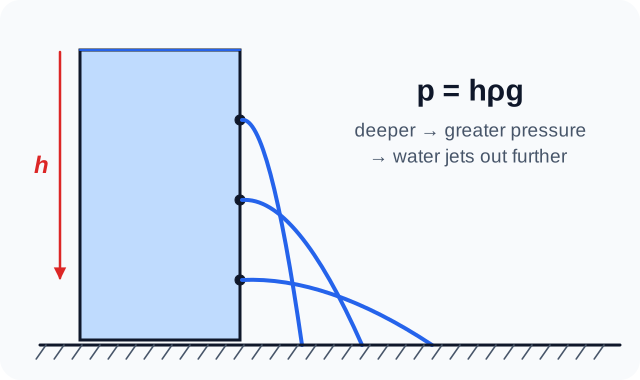
Figure 1. Pressure in a liquid increases with depth. WASSCE Tutor diagram.
The pressure at depth in a liquid of density is
(plus atmospheric pressure acting on the surface, if the total pressure is wanted).
Properties of pressure in a liquid
- Pressure increases with depth.
- At a given depth, pressure acts equally in all directions.
- Pressure depends on depth and density only — not on the shape or cross-section of the container.
- A liquid finds its own level: the surface is at the same height in connected vessels.
Find the pressure due to water at the bottom of a well 12 m deep. If atmospheric pressure is Pa, find the total pressure there. ( kg m⁻³, m s⁻²)
Total Pa.
Dams such as Bumbuna are built much thicker at the base because the water pressure on the wall increases with depth. Divers in the Atlantic off the Freetown peninsula feel the pressure on their ears increase rapidly as they go down: every 10 m of sea water adds about one atmosphere.
Atmospheric pressure
The air above us has weight, so it exerts a pressure: atmospheric pressure, about Pa at sea level (often called 1 atmosphere, or 760 mmHg). It decreases with altitude.
Evidence: the collapsing-can experiment (a can with a little water is boiled, sealed and cooled — it is crushed by atmospheric pressure as the steam condenses); drinking through a straw; a rubber sucker sticking to a wall.
The mercury barometer
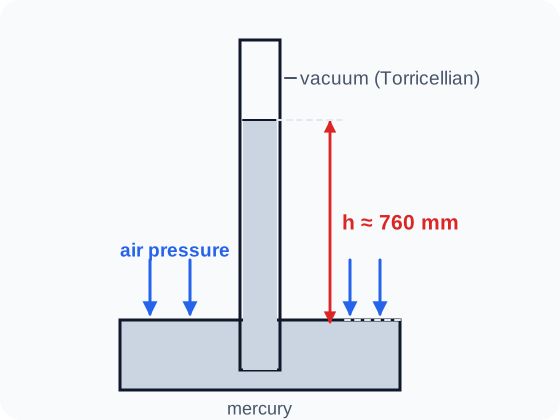
Figure 2. A simple mercury barometer. WASSCE Tutor diagram.
Atmospheric pressure on the mercury in the dish supports the column. At sea level the column is about 760 mm high:
Tilting the tube does not change the vertical height of the column. Water is not used because the column would need to be about 10.3 m tall.
The manometer
A U-tube manometer measures the pressure of a gas supply. One arm is connected to the gas; the other is open to the air. The difference in liquid levels gives the excess pressure of the gas above atmospheric: .
Pascal's principle and hydraulic machines
Pascal's principle: pressure applied to an enclosed fluid is transmitted equally to every part of the fluid and to the walls of the container.
In a hydraulic press, a small force on a small piston produces a large force on a large piston: . Applications: hydraulic jacks, hydraulic car brakes, barber's chairs, hydraulic lifts in garages.
Key points
- Density ; relative density compares with water (no unit).
- Pressure (Pa); smaller area → greater pressure.
- Liquid pressure : increases with depth, same in all directions, independent of the container's shape.
- Atmospheric pressure ≈ Pa ≈ 760 mmHg; measured with a barometer.
- Pascal's principle underlies hydraulic machines.
WASSCE examination focus
Calculations with and appear every year, often with atmospheric pressure added. You may be asked to describe the simple mercury barometer, explain why mercury and not water is used, state Pascal's principle and explain a hydraulic press or brake. Give units at every step.
Quick check
- Why do tractors have wide tyres?
- Find the pressure at a depth of 5 m in water ( kg m⁻³, m s⁻²).
- State one reason why mercury is used in barometers.
Answers: 1. To spread the weight over a large area, reducing the pressure so they do not sink into soft soil. 2. Pa. 3. For example: its high density gives a short, convenient column (about 0.76 m instead of about 10 m for water).
Keep going with density and pressure in fluids
This is one of 2 lessons in Density and Pressure in Fluids. Start free with the first lesson of every topic, then unlock them all, plus exam-style practice marked instantly and guided learning tools, from 25 NLe.
- Free account, no card needed
- Everything from 25 NLe
- No automatic renewal
More lessons in Density and Pressure in Fluids
- Archimedes' principle, flotation and the hydrometer🔒