WASSCE Physics · Current Electricity and Ohm's Law
Electric current, potential difference and Ohm's law
By the WASSCE Tutor team
Updated 10 November 2026 · 7 min read · Prepared against the WASSCE syllabus.
Flip a switch and the bulb lights instantly, yet the electrons in the wire crawl along at less than a millimetre a second. Electric current is a flow of charge driven by a potential difference, and Ohm's law ties the two together.
Learning objectives
By the end of this lesson you should be able to:
- define electric current, potential difference and e.m.f., with their units
- state Ohm's law and use
- connect ammeters and voltmeters correctly in a circuit
- interpret current–voltage graphs for ohmic and non-ohmic conductors
Electric current
Electric current is the rate of flow of electric charge:
Its unit is the ampere (A). One ampere is a flow of one coulomb per second (1 A = 1 C s⁻¹).
In metals, current is carried by free electrons, which move from the negative terminal towards the positive. By convention, the direction of conventional current is from positive to negative (the direction positive charge would move).
A current of 0.5 A flows through a lamp for 2 minutes. How much charge passes? How many electrons is that? (e = 1.6 × 10⁻¹⁹ C)
Potential difference and e.m.f.
The potential difference (p.d.) between two points in a circuit is the work done (energy converted) per unit charge moving between them: . Unit: the volt (1 V = 1 J C⁻¹).
The electromotive force (e.m.f.) of a cell is the total energy supplied per unit charge that it drives round a complete circuit — equal to the p.d. across its terminals when it supplies no current (open circuit).
The circuit and its meters
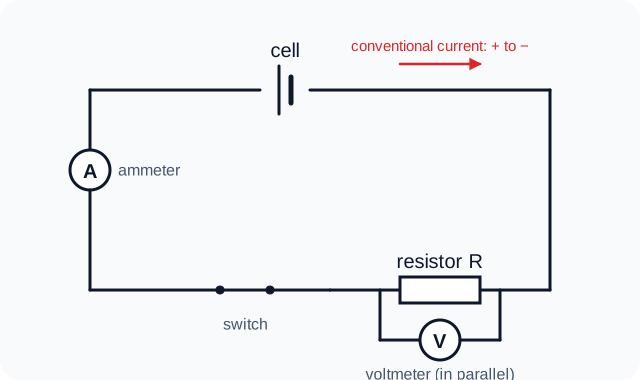
Figure 1. The ammeter goes in series; the voltmeter goes in parallel. WASSCE Tutor diagram.
| Meter | Measures | Connected | Ideal resistance |
|---|---|---|---|
| Ammeter | current | in series | very low (so it does not reduce the current) |
| Voltmeter | potential difference | in parallel across the component | very high (so it draws almost no current) |
Ohm's law
Ohm's law: the current flowing through a metallic conductor is directly proportional to the potential difference across its ends, provided the temperature and other physical conditions remain constant.
The constant is the resistance, measured in ohms (Ω): 1 Ω = 1 V A⁻¹.
A p.d. of 12 V across a resistor drives a current of 0.4 A. Find its resistance. What current flows if the p.d. is raised to 18 V?
Verifying Ohm's law (practical)
- Connect a cell (or variable supply), a rheostat, an ammeter and the resistor (e.g. a coil of wire) in series, with a voltmeter across the resistor.
- Adjust the rheostat to get different currents; record and each time (at least five readings).
- Plot against . A straight line through the origin verifies Ohm's law; its gradient is .
Precautions: keep the current small and switch off between readings so the wire does not heat up; check for zero errors on the meters; ensure tight connections.
Current–voltage graphs
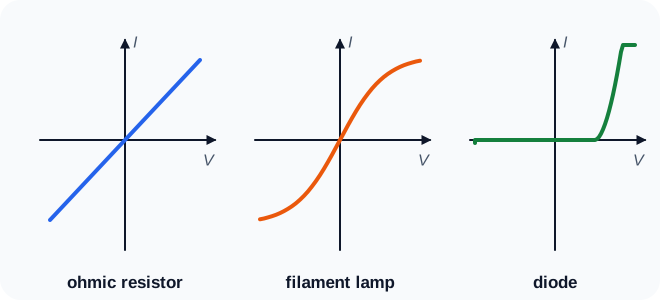
Figure 2. Ohmic and non-ohmic conductors. WASSCE Tutor diagram.
| Component | Graph | Behaviour |
|---|---|---|
| Metal wire at constant temperature | straight line through the origin | ohmic: constant |
| Filament lamp | curve that flattens | non-ohmic: resistance rises as the filament heats |
| Semiconductor diode | current only in one direction (above about 0.6 V) | non-ohmic: conducts forward, blocks reverse |
| Thermistor | current rises more steeply as it warms | resistance falls as temperature rises |
Key points
- (A); conventional current flows from + to −.
- p.d. (V); e.m.f. is the energy per coulomb supplied by the source.
- Ammeter in series (low resistance); voltmeter in parallel (high resistance).
- Ohm's law: at constant temperature; in ohms.
- Ohmic conductors give a straight-line I–V graph; lamps and diodes do not.
WASSCE examination focus
Define current, p.d. and e.m.f., state Ohm's law (with the condition "temperature constant"), and describe the experiment to verify it with a circuit diagram, graph and precautions. You may be asked to sketch I–V graphs for a wire, a filament lamp and a diode. Calculations with and are routine.
Quick check
- How is an ammeter connected in a circuit?
- A 6 V battery drives 0.2 A through a resistor. Find the resistance.
- Why is the I–V graph of a filament lamp curved?
Answers: 1. In series. 2. Ω. 3. As the current increases, the filament gets hotter and its resistance increases.
Keep going with current electricity and ohm's law
This is one of 2 lessons in Current Electricity and Ohm's Law. Start free with the first lesson of every topic, then unlock them all, plus exam-style practice marked instantly and guided learning tools, from 25 NLe.
- Free account, no card needed
- Everything from 25 NLe
- No automatic renewal
More lessons in Current Electricity and Ohm's Law
- Resistivity, internal resistance and e.m.f.🔒