WASSCE Physics · Circular Motion
Uniform circular motion and centripetal force
By the WASSCE Tutor team
Updated 10 November 2026 · 7 min read · Prepared against the WASSCE syllabus.
A body moving in a circle at steady speed is accelerating, even though its speed never changes. That surprising fact explains why you slide across the seat when a vehicle turns, how a spin dryer works and what holds the Moon in its orbit.
Learning objectives
By the end of this lesson you should be able to:
- define angular displacement, angular velocity, period and frequency
- relate linear speed to angular velocity,
- explain why a body in uniform circular motion is accelerating
- calculate centripetal acceleration and centripetal force
Describing circular motion
Uniform circular motion is motion in a circle at constant speed.
| Quantity | Symbol | Meaning | Unit |
|---|---|---|---|
| Angular displacement | θ | angle turned through | radian (rad) |
| Angular velocity | ω | rate of change of angle, | rad s⁻¹ |
| Period | time for one complete revolution | s | |
| Frequency | revolutions per second, | Hz |
One complete revolution is radians (360°), so
One radian is the angle subtended at the centre of a circle by an arc equal in length to the radius. , so .
Linear speed and angular velocity
In one revolution a body travels the circumference in time :
Points further from the centre move faster for the same ω: the outside of a turning wheel moves faster than the hub.
Why circular motion is accelerated
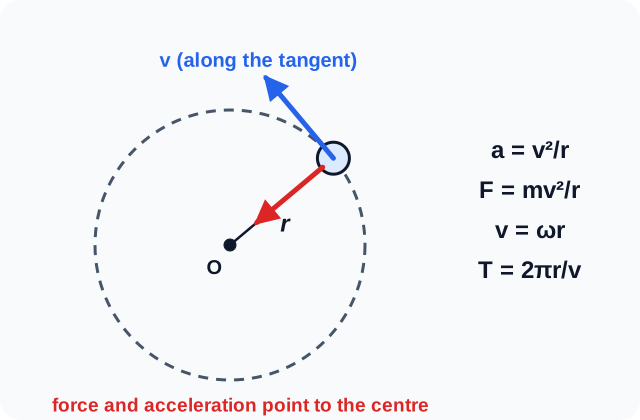
Figure 1. Velocity is along the tangent; acceleration and force point to the centre. WASSCE Tutor diagram.
Velocity is a vector. Although the speed is constant, the direction of motion changes continuously, so the velocity changes. A changing velocity means an acceleration. This acceleration is directed towards the centre of the circle and is called centripetal ("centre-seeking") acceleration:
By Newton's second law, a resultant force must cause it. This centripetal force also acts towards the centre:
Centripetal force is not a new kind of force. It is the name for whatever resultant force points to the centre: tension in a string, friction between tyres and road, gravity on a satellite, or the electric force on an electron in an atom. If that force disappears, the body moves off along the tangent in a straight line (Newton's first law), not outwards along the radius.
Worked examples
1. A stone of mass 0.2 kg is whirled in a horizontal circle of radius 0.5 m at 3 revolutions per second. Find (a) the angular velocity, (b) the linear speed, (c) the tension in the string.
(a) rad s⁻¹.
(b) m s⁻¹.
(c) N.
2. A car of mass 800 kg takes a bend of radius 50 m on a level road at 15 m s⁻¹. Find the friction force needed. If the maximum friction is 4000 N, what is the greatest safe speed?
Greatest speed: m s⁻¹.
Above this the tyres cannot supply enough centripetal force, and the car skids outwards along a tangent.
A spin dryer or the spinning drum of a washing machine uses this idea: the drum wall pushes the clothes towards the centre, but the water passes through the holes, which supply no force. With nothing to keep it moving in a circle, the water flies off along tangents and leaves the clothes.
Applications
- Vehicles on bends: friction provides the centripetal force; roads are banked to help.
- Spin dryers and centrifuges: separate water from clothes, cream from milk, blood cells from plasma.
- Satellites and the Moon: gravity provides the centripetal force.
- Cyclists lean inwards when turning.
- "Wall of death" riders and fairground rides.
Key points
- Uniform circular motion: constant speed, changing velocity, so it is accelerated.
- , .
- Centripetal acceleration , towards the centre.
- Centripetal force , provided by tension, friction, gravity or another real force.
- If the force stops, the body moves off along the tangent.
WASSCE examination focus
Expect to explain why a body moving in a circle at constant speed is accelerating, to define angular velocity and the radian, and to calculate centripetal force or tension for a stone on a string or a car on a bend. Objective items often ask for the direction of centripetal acceleration (towards the centre) or what happens when a string breaks (moves along the tangent).
Quick check
- In which direction does the centripetal acceleration act?
- A wheel makes 120 revolutions per minute. Find its angular velocity.
- What provides the centripetal force for a car turning on a flat road?
Answers: 1. Towards the centre of the circle. 2. Hz, rad s⁻¹. 3. Friction between the tyres and the road.
Keep going with circular motion
This is one of 2 lessons in Circular Motion. Start free with the first lesson of every topic, then unlock them all, plus exam-style practice marked instantly and guided learning tools, from 25 NLe.
- Free account, no card needed
- Everything from 25 NLe
- No automatic renewal
More lessons in Circular Motion
- Vertical circles, banked roads, gravitation and satellites🔒