WASSCE Physics · Change of State
Latent heat: melting, boiling and the heating curve
By the WASSCE Tutor team
Updated 10 November 2026 · 7 min read · Prepared against the WASSCE syllabus.
Put a pot of water on the fire and watch the thermometer. It climbs steadily to 100 °C — and then stops, even though the fire still burns. Where is all that heat going? Into changing water to steam. That hidden heat is latent heat.
Learning objectives
By the end of this lesson you should be able to:
- describe the changes of state and interpret a heating curve
- define latent heat, specific latent heat of fusion and of vaporisation
- use together with
- explain latent heat using the kinetic theory
Changes of state
| Change | Name | Heat |
|---|---|---|
| solid → liquid | melting (fusion) | absorbed |
| liquid → solid | freezing (solidification) | given out |
| liquid → gas | boiling / evaporation (vaporisation) | absorbed |
| gas → liquid | condensation | given out |
| solid → gas directly | sublimation (e.g. iodine, camphor, naphthalene) | absorbed |
The heating curve
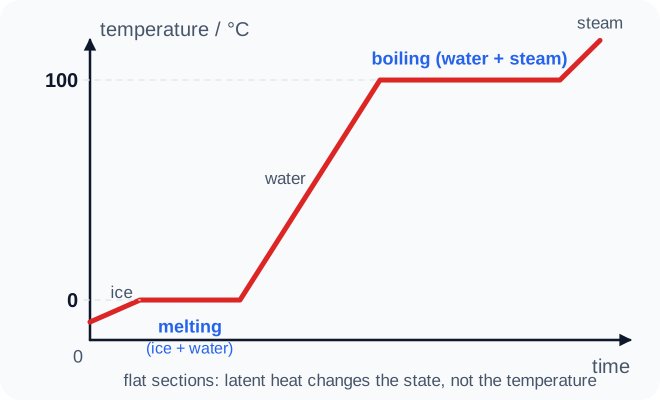
Figure 1. Heating curve of water. WASSCE Tutor diagram.
- Ice warms from −10 °C to 0 °C (temperature rises).
- At 0 °C the ice melts: the temperature stays constant until all the ice has melted.
- Water warms from 0 °C to 100 °C.
- At 100 °C the water boils: the temperature stays constant until all the water has become steam.
- Steam warms above 100 °C.
The flat sections show that heat is being absorbed without a change in temperature. This heat is latent ("hidden") heat.
Latent heat
Latent heat is the heat absorbed or released when a substance changes state without a change in temperature.
Specific latent heat of fusion : the quantity of heat needed to change 1 kg of a substance from solid to liquid at its melting point, without a change in temperature.
Specific latent heat of vaporisation : the quantity of heat needed to change 1 kg of a substance from liquid to vapour at its boiling point, without a change in temperature.
| Substance | Value |
|---|---|
| Ice (fusion) | J kg⁻¹ (336 kJ kg⁻¹) |
| Water (vaporisation) | J kg⁻¹ (2260 kJ kg⁻¹) |
It takes almost seven times as much energy to boil away water as to melt the same mass of ice.
Kinetic explanation
- During melting, the energy supplied does not speed the particles up (temperature unchanged); it breaks the bonds holding them in fixed positions.
- During boiling, the energy separates the particles completely, overcoming their attraction and pushing back the atmosphere as the vapour expands. This needs far more energy, which is why .
Worked examples
How much heat is needed to melt 2 kg of ice at 0 °C? ( J kg⁻¹)
Find the heat needed to change 0.5 kg of ice at −10 °C completely into steam at 100 °C. (, J kg⁻¹ K⁻¹, , J kg⁻¹)
| Stage | Heat |
|---|---|
| Warm ice −10 → 0 °C | J |
| Melt ice at 0 °C | J |
| Warm water 0 → 100 °C | J |
| Boil water at 100 °C | J |
| Total | 1 518 500 J ≈ 1.52 MJ |
Boiling takes three-quarters of the total.
Ice at 0 °C is added to 0.4 kg of water at 30 °C until the water just reaches 0 °C with all the ice melted. What mass of ice was added?
Heat lost by water J.
Heat gained by ice (melting only) .
A scald from steam is worse than one from boiling water at the same temperature. Each kilogram of steam that condenses on the skin releases 2.26 MJ of latent heat before it even starts to cool as water.
Key points
- Temperature stays constant during a change of state; the heat goes into breaking bonds (latent heat).
- : for melting, for boiling.
- For ice at 0 °C, J kg⁻¹; for water at 100 °C, J kg⁻¹.
- Multi-stage problems: add for each temperature change and for each change of state.
WASSCE examination focus
Define the specific latent heats precisely (include "at constant temperature" / "at its melting/boiling point"), interpret or sketch a heating or cooling curve, and calculate the total heat for a multi-stage change — the ice-to-steam calculation is a favourite. Explain why steam scalds are more severe than boiling-water scalds.
Quick check
- Why does the temperature stay constant while ice melts?
- How much heat is released when 0.2 kg of steam condenses at 100 °C? ( J kg⁻¹)
- Name a substance that sublimes.
Answers: 1. The heat supplied breaks the bonds between the particles instead of increasing their kinetic energy. 2. J. 3. For example: iodine, camphor or naphthalene.
Keep going with change of state
This is one of 2 lessons in Change of State. Start free with the first lesson of every topic, then unlock them all, plus exam-style practice marked instantly and guided learning tools, from 25 NLe.
- Free account, no card needed
- Everything from 25 NLe
- No automatic renewal
More lessons in Change of State
- Vapour pressure, boiling point, refrigerators and humidity🔒