WASSCE Physics · Alternating Current and Transformers
Alternating current: peak and r.m.s. values
By the WASSCE Tutor team
Updated 10 November 2026 · 6 min read · Prepared against the WASSCE syllabus.
The electricity from the wall socket is not a steady push in one direction: it reverses fifty times every second. Alternating current is easy to generate and, above all, easy to transform to different voltages — which is why every power grid uses it.
Learning objectives
By the end of this lesson you should be able to:
- describe alternating current and its waveform
- define peak value, frequency, period and r.m.s. value
- convert between peak and r.m.s. values
- compare a.c. and d.c.
What is alternating current?
Alternating current (a.c.) is a current that periodically reverses its direction, usually varying sinusoidally with time. Direct current (d.c.) flows in one direction only.
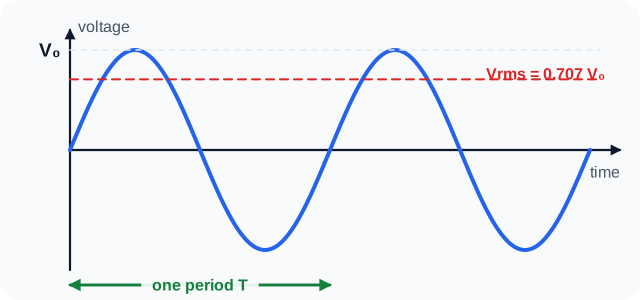
Figure 1. An alternating voltage. WASSCE Tutor diagram.
| Term | Meaning |
|---|---|
| Peak value or | the maximum value of the voltage or current |
| Period | time for one complete cycle |
| Frequency | number of cycles per second, (mains: 50 Hz in Sierra Leone) |
| Peak-to-peak value |
The r.m.s. value
Because an alternating current keeps changing, we need a single "effective" value to compare it with d.c.
The root-mean-square (r.m.s.) value of an alternating current is the value of the steady direct current that would produce the same heating effect in the same resistor:
Mains voltages are always quoted as r.m.s. values. Sierra Leone's mains supply is about 230 V r.m.s., so its peak value is about V.
An alternating voltage has a peak value of 340 V and a frequency of 50 Hz. Find (a) the r.m.s. voltage, (b) the period.
(a) V. (b) s.
An a.c. supply of 220 V r.m.s. is connected to a 55 Ω heater. Find (a) the r.m.s. current, (b) the peak current, (c) the average power.
(a) A.
(b) A.
(c) W.
Power calculations with a.c. use r.m.s. values (). Using peak values gives twice the real average power.
Measuring a.c.
- Ordinary moving-coil meters cannot read a.c. directly (the needle would try to swing back and forth 50 times a second and stay at zero). They are used with a rectifier.
- Moving-iron and hot-wire meters work with both a.c. and d.c., and read r.m.s. values.
- A cathode-ray oscilloscope (CRO) displays the waveform, so the peak value and period can be read directly.
a.c. versus d.c.
| a.c. | d.c. | |
|---|---|---|
| direction | reverses periodically | one direction |
| sources | generators (alternators), the mains | cells, batteries, solar cells, rectified a.c. |
| voltage can be changed by a transformer | yes | no |
| transmission over long distances | efficient (step up with transformers) | less convenient |
| needed for | most household appliances | electroplating, charging batteries, electronics |
Rectification converts a.c. into d.c. using diodes (covered with semiconductors). Phone chargers contain a transformer, a rectifier and a smoothing capacitor.
Key points
- a.c. reverses direction periodically; mains frequency in Sierra Leone is 50 Hz.
- , ; mains is about 230 V r.m.s. (about 325 V peak).
- r.m.s. value = steady d.c. giving the same heating effect.
- a.c. can be transformed to high or low voltages; d.c. cannot.
WASSCE examination focus
Define the r.m.s. value of an alternating current and use , read peak value and period from a waveform, and compare a.c. and d.c. (including why a.c. is used for transmission). Calculations of power with r.m.s. values are common.
Quick check
- The peak value of an alternating current is 10 A. What is its r.m.s. value?
- What is the period of a 50 Hz supply?
- Why is a.c. rather than d.c. used in the national grid?
Answers: 1. A. 2. 0.02 s. 3. Its voltage can be stepped up and down with transformers, so power can be transmitted at high voltage with small losses.
Keep going with alternating current and transformers
This is one of 2 lessons in Alternating Current and Transformers. Start free with the first lesson of every topic, then unlock them all, plus exam-style practice marked instantly and guided learning tools, from 25 NLe.
- Free account, no card needed
- Everything from 25 NLe
- No automatic renewal
More lessons in Alternating Current and Transformers
- Transformers and a.c. circuits🔒