WASSCE Mathematics · Surds
Surds: meaning and recognising irrational roots
By the WASSCE Tutor team
Updated 12 November 2026 · 12 min read · Prepared against the WASSCE syllabus.
. Easy — it's a rational number. But — the decimal continues forever without repeating. It can't be written as a fraction. Numbers like this — irrational square roots of non-perfect-square integers — are called surds.
Surds appear all over WAEC: in geometry (lengths of diagonals), in algebra (solutions to quadratics with the quadratic formula), in trigonometry (exact values of sine and cosine). WAEC tests surd manipulation directly in nearly every paper.
This lesson defines surds, distinguishes them from rationals, and introduces the key notation. The next lesson covers simplification, operations, and rationalising denominators.
Surd: An irrational number that can be expressed as the -th root of a positive integer that is not a perfect -th power.
For square roots: is a surd if is a positive integer that is not a perfect square.
Examples of surds:
NOT surds (rational results): (perfect squares).
Cube roots: are surds. are not.
Learning objectives
By the end of this lesson you should be able to:
- define a surd and distinguish surds from rational numbers
- recognise square roots, cube roots and higher roots that are surds
- use the product and quotient properties of surds
- connect surds with fractional indices
Recognising surds
Square roots
The square roots of perfect squares are NOT surds (they're integers): .
The square roots of all other positive integers ARE surds: .
Higher roots
For cube roots: is a surd if is not a perfect cube.
Perfect cubes: .
So (not a surd), (not), but are all surds.
Why surds matter
Surds can't be represented exactly by a terminating or repeating decimal. They must be expressed either:
- As the radical itself (e.g., ).
- As a numerical approximation (e.g., ).
WAEC typically asks for the exact answer — in surd form — rather than a decimal approximation.
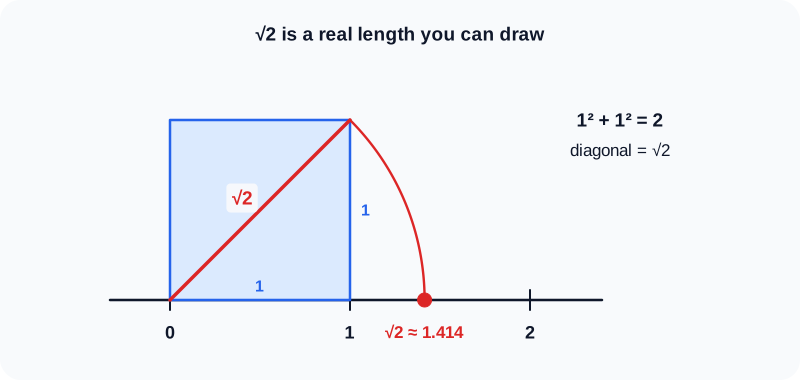
Figure 1. √2 is the diagonal of a unit square: an exact length that cannot be written as a fraction. WASSCE Tutor diagram.
Common surds and their approximate values
Knowing the approximate value of common surds helps with estimation:
| Surd | Approximate value |
|---|---|
Memorising to two decimal places is sufficient for most WAEC questions.
Notation
- or — the square root of .
- or — the -th root of .
- — cube root.
- The expression inside the radical sign is called the radicand.
- A surd of the form where is positive and not a perfect -th power is a pure surd.
- A surd combined with rational numbers, like or , is a mixed expression.
Connection to indices
From the Indices topic:
So , , .
This lets us use the laws of indices to manipulate surds.
Key properties of surds
Product property
This works for any .
Examples:
- .
- .
- .
- . (Squaring undoes square root.)
Quotient property
Examples:
- .
- .
- .
Power property
For : . This is the inverse of taking the square root.
Negation of square root
The square root function returns the non-negative root by convention. So , not . The negative root is .
Note: you can never take the square root of a negative number in the real number system. is not a real number. (It's a complex number, , beyond WAEC scope.)
Examples — distinguishing surds and rationals
Example 1
Which of the following are surds, and which are rationals?
(a) — , rational (not a surd). (b) — is not a perfect square. Surd. (c) — , rational. (d) — , rational. (e) — is not a perfect cube. Surd. (f) — , rational. (g) — contains a surd, the expression is irrational. (We would need to rationalise it: see the next lesson.) (h) — contains a surd, irrational.
Approximating surds
For problems where exact form isn't required, approximate by knowing nearby perfect squares.
Example 2
Estimate .
Perfect squares near : () and (). So . Therefore is between and , closer to .
More precisely: , . So .
Example 3
Estimate .
. So between and , closer to . , . So .
When the radical is in algebraic form
Surds also appear with variables:
- (absolute value, since the square root is non-negative).
- if have known signs; or in general.
- (if ).
WAEC usually works with positive variables, so we often drop the absolute value: (assuming ).
For each, decide if it is a surd, rational, or undefined in the reals.
(a) . Rational ().
(b) . Surd.
(c) . Rational ().
(d) . Surd.
(e) . Undefined in reals.
(f) . Rational ().
(g) . Rational ().
(h) . Surd.
(i) . Rational ().
(j) . Rational ().
The Sierra Leonean architect designing a building needs precise diagonal measurements. For a rectangular floor that is m by m, the diagonal is computed by Pythagoras: m. Rational — no surd needed.
But for a square floor m by m, the diagonal is m. The diagonal is a surd.
Surds arise wherever irrational lengths appear — in nature (the golden ratio), in physics (relativity), in geometry (the unit circle). Working with surds in exact form is a core mathematical skill, exactly as WAEC tests.
Common errors with surds:
1. Thinking .
- in general. (E.g., .)
- The correct product rule: . (Multiplication, not addition.)
2. Treating as just when might be negative.
- . For positive , this is .
3. Taking square root of a negative.
- is not a real number. Don't write it as .
4. Confusing with .
- is the cube root: .
- — different.
5. Treating as exactly .
- , not . The decimal approximation is just that — an approximation.
WASSCE examination focus
Foundational surd questions in WAEC:
- Identify surds. Which of the following is a surd? . (Answers: and .)
- Product of surds. Compute . (Answer: .)
- Quotient. Compute . (Answer: .)
- Recognize rational vs surd. Is a surd? (No — it's .)
- Compute . Find . (Answer: .)
Master the definitions and the product/quotient properties; simplification comes next.
Practice problems
1. Which of the following are surds? (a) (b) (c) (d) (e) (f) (g)
2. Compute .
3. Compute .
4. Compute .
5. Compute .
6. Estimate (state between which two integers).
7. Compute .
8. Compute .
9. Is defined in the real numbers?
10. True or False: .
Worked solutions
1. (b) , (d) , (g) . The others reduce to rationals.
2. .
3. .
4. .
5. .
6. , so .
7. .
8. .
9. No, is undefined in real numbers.
10. False. .
What's next
In the next lesson we cover simplifying surds, adding, multiplying and rationalising denominators — extracting any perfect-square factors from the radicand. , . This is the most common surd-related WAEC operation.
Keep going with surds
This is one of 6 lessons in Surds. Start free with the first lesson of every topic, then unlock them all, plus exam-style practice marked instantly and guided learning tools, from 25 NLe.
- Free account, no card needed
- Everything from 25 NLe
- No automatic renewal
More lessons in Surds
- Simplifying surds, operations and rationalising denominators🔒
- Simplifying Surds🔒
- Operations on Surds🔒
- Rationalising the Denominator🔒
- Surds: The WAEC Trap🔒