WASSCE Mathematics · Sequences and Series
Sequences and series: patterns, terms and notation
By the WASSCE Tutor team
Updated 12 November 2026 · 16 min read · Prepared against the WASSCE syllabus.
— a list of even numbers. — each number is three times the last. — each number is the sum of the previous two. These are all sequences — ordered lists of numbers that follow a pattern.
When you add up the terms of a sequence, you get a series. The sum is a series formed from the first five terms of the sequence above.
Sequences and series appear throughout WAEC mathematics — in arithmetic progressions, geometric progressions, compound interest, biological growth, payment plans, and more. This topic teaches you the two most important kinds (AP and GP), how to find any term, and how to sum them up.
This lesson introduces the vocabulary and notation. The next lesson covers APs and GPs in detail: the -th term, the sum of terms and the sum to infinity.
Sequence: An ordered list of numbers. Each number is called a term.
Notation: where is the -th term.
Series: The sum of the terms of a sequence. The sum of the first terms is denoted :
Finite sequence: Has a last term (e.g., ). Infinite sequence: Continues forever (e.g., ).
Learning objectives
By the end of this lesson you should be able to:
- define a sequence and a series
- describe a sequence by listing, by a recurrence rule and by a formula for the -th term
- recognise arithmetic and geometric sequences
- use sigma notation for a series
How to describe a sequence
A sequence can be described in three ways:
1. List the terms
For short sequences, just listing the terms is fine. But for the th term, listing all terms is impractical.
2. Recurrence — describe each term in terms of the previous
, and for .
This says: "The first term is , and each subsequent term is the previous one plus ."
Useful for understanding the pattern, but slow if you want term .
3. Formula — describe each term directly in terms of
.
Now you can compute any term: . .
The formula form is the most powerful, and it's what most WAEC questions ask you to find.
Patterns to look for
When you see a sequence, ask yourself: what's the pattern? Here are the most common.
Constant difference (arithmetic)
— each term is more than the previous.
The difference between consecutive terms is constant. This is an arithmetic progression (AP) or arithmetic sequence.
Constant ratio (geometric)
— each term is times the previous.
The ratio of consecutive terms is constant. This is a geometric progression (GP) or geometric sequence.
Squares, cubes, etc.
— squares: .
— cubes: .
WAEC sometimes presents these patterns directly.
Fibonacci pattern
— each term is the sum of the previous two: .
Less often tested, but appears in some advanced WAEC questions.
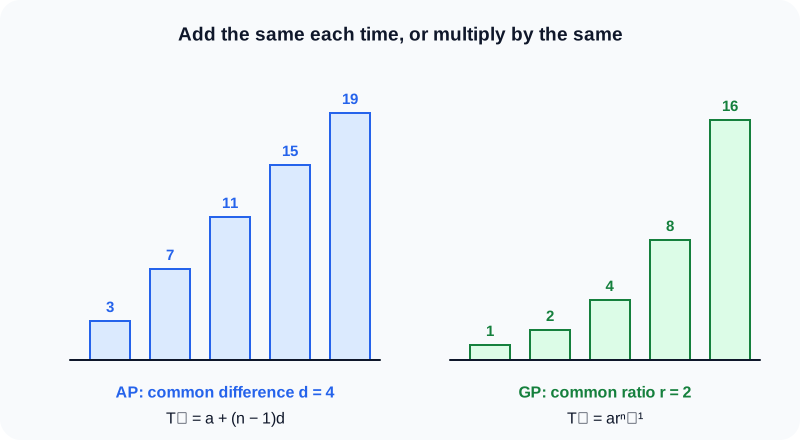
Figure 1. An AP adds the same number each time; a GP multiplies by the same number each time. WASSCE Tutor diagram.
Identifying arithmetic and geometric sequences
Quick test for AP
Subtract each term from the next. If the differences are all the same, it's an AP. The common difference is denoted .
Example: .
- All differences are . This is an AP with first term and common difference .
Quick test for GP
Divide each term by the previous. If the ratios are all the same, it's a GP. The common ratio is denoted .
Example: .
- All ratios are . This is a GP with first term and common ratio .
Combined example
Example:
- Differences: (the differences themselves form a sequence!)
- Ratios: — not constant.
This is neither AP nor GP. The differences form an AP — this is called a quadratic sequence in some contexts. WAEC focuses on plain APs and GPs.
For each sequence, identify whether it is an AP, GP, both (constant sequence), or neither, and state the relevant common difference or ratio.
(a) Differences: . AP with . (Ratios: , — not constant, so not GP.)
(b) Ratios: . GP with . (Differences not constant.)
(c) Constant sequence. Both AP () and GP ().
(d) Differences: — not constant. Ratios: — not constant. Neither AP nor GP (it's the sequence of squares).
(e) Ratios: . GP with . (Differences: — not constant.)
(f) Differences: . AP with . (Note: differences can be negative.)
(g) Ratios: . GP with .
Series — adding up the terms
Finite sum
The sum of the first terms is .
Example: For the AP , the first four terms sum to: .
Example: For the GP , the sum is: .
WAEC tests formulas for for both APs and GPs (see the next lesson).
Infinite sum (only for some GPs)
For an infinite GP, the sum may converge to a finite limit if . Otherwise it diverges to infinity.
Example: (this converges).
Example: (this diverges).
We cover infinite GP sums in the next lesson.
Notation conventions
- or — the -th term of a sequence. WAEC often uses .
- — the first term.
- — common difference (for AP).
- — common ratio (for GP).
- — sum of the first terms.
- — infinite sum (if it converges).
Examples — recognizing the type
Example 1
A bakery sells loaves on the first day, then increases by loaves each subsequent day.
This is an AP with , .
Terms:
Example 2
An investment of NLe grows by each year.
This is a GP with , .
Terms:
Example 3
The population of a village in Sierra Leone is this year. It declines by people each year.
This is an AP with , .
Terms:
Example 4
A car loses of its value each year. Initial value NLe.
This is a GP with , .
Terms:
Identify the type and parameters of each sequence.
(a) A child saves NLe each week, starting with in week . AP: total saved after weeks. Wait — the question describes the amount saved each week, not the cumulative total. Let's distinguish:
- Amount saved in week : (constant). Constant sequence.
- Cumulative savings after weeks: — AP with .
(b) A loan of NLe at simple interest. Each year, NLe is added. AP: with .
(c) A loan of NLe at compound interest, interest added once a year. GP: with .
(d) A bacteria culture doubles in size every hour, starting at bacteria. GP: with .
When the sequence is given in non-standard form
Sometimes WAEC presents a sequence by listing terms (not telling you which kind). You need to identify the type yourself.
Example: The sequence is given. Is it AP or GP?
Differences: — not constant. So not AP. Ratios: — constant. GP with .
Alternatively, the formula is .
Example: The sequence is given.
Differences: — not constant. The differences themselves form an AP. Ratios: — not constant.
This is neither AP nor GP. It's a quadratic-pattern sequence.
The connection to formulas
For sequences with a clear pattern, you can write a formula.
Example: → .
Example: → .
Example: → (GP with ).
The next lesson derives the general formulas for AP and GP.
A Sierra Leonean farmer plants rice and tracks his harvest each year. In year , he harvests kg. He invests in better fertiliser and gets more each year.
Year-by-year:
This is a GP with . After years, he harvests kg.
If instead he had a constant improvement of kg per year, the sequence would be — an AP with . After years, he'd harvest kg.
The difference between AP (linear growth) and GP (exponential growth) becomes huge over many years. WAEC tests these models in word problems all the time.
Common errors when identifying sequences:
1. Mixing up difference and ratio.
- The difference is subtract: .
- The ratio is divide: .
- Constant difference = AP. Constant ratio = GP.
2. Checking only one or two terms.
- Sometimes the pattern breaks. Check at least three consecutive differences or ratios.
3. Confusing the term number with the value.
- means the third term equals . The term number is ; the value is .
4. Forgetting that AP and GP both have a first term, but is the first term in both.
- The same letter is used. Read context to know whether it's AP or GP.
5. Not distinguishing finite from infinite sequences.
- A finite sequence stops; an infinite one continues. Both can be APs or GPs.
WASSCE examination focus
Foundational sequence questions in WAEC:
- Identify the type. Is the sequence AP or GP? (AP)
- Find or . For the sequence , find the common ratio. ()
- Identify in a word problem. A car depreciates by each year. Is this AP or GP? (GP)
- Compute next term. Find the next term in the sequence . (GP, next: )
- Recognise from a formula. Is the sequence AP or GP? (AP, since , so )
The foundational skill is recognizing the pattern and identifying the parameters. Everything else builds on this.
Practice problems
For each sequence, identify whether it is AP, GP, both, or neither. If it is AP, give the common difference. If it is GP, give the common ratio.
1.
2.
3.
4.
5.
6.
7.
8.
9. Find the next two terms of
10. Find the next two terms of
11. A small business sells units in month . Each month, sales grow by . Identify the type of sequence.
12. Aminata saves NLe in week , then NLe more each subsequent week. Identify the type.
Worked solutions
1. Differences: . AP, .
2. Ratios: . GP, .
3. Ratios: . GP, . (Differences: — not constant.)
4. Differences: . AP, .
5. Constant sequence. Both AP () and GP ().
6. Differences: — not constant. Ratios: — not constant. Neither.
7. Ratios: . GP, .
8. Differences: . AP, .
9. AP with . Next two: .
10. GP with . Next two: .
11. GP (constant percentage growth = constant ratio).
12. AP (constant addition each week).
What's next
In the next lesson we go deep on arithmetic and geometric progressions: the general formula for the -th term, the sum of the first terms, the sum to infinity of a GP, and the WAEC questions built on them.
Keep going with sequences and series
This is one of 8 lessons in Sequences and Series. Start free with the first lesson of every topic, then unlock them all, plus exam-style practice marked instantly and guided learning tools, from 25 NLe.
- Free account, no card needed
- Everything from 25 NLe
- No automatic renewal
More lessons in Sequences and Series
- Arithmetic Progressions: Finding the n-th Term🔒
- Arithmetic and geometric progressions: nth term and sums🔒
- Sum of an Arithmetic Progression🔒
- Geometric Progressions: Finding the n-th Term🔒
- Sum of a Geometric Progression🔒
- Mixed Sequence Problems and Applications🔒
- Sequences and Series: The WAEC Trap🔒