WASSCE Mathematics · Modular Arithmetic
Modular arithmetic: remainders and congruence
By the WASSCE Tutor team
Updated 12 November 2026 · 19 min read · Prepared against the WASSCE syllabus.
Imagine you look at your watch and it says 9 o'clock. Someone asks: what time will it be in 5 hours? You don't say " o'clock" — you say " o'clock." That's modular arithmetic in action. When you reach , you don't keep counting upwards forever — you wrap around to and start again.
The same idea applies to days of the week. What day is it 10 days from Tuesday? You don't say "Tuesday plus 10 days." You count by sevens — 7 days from Tuesday is Tuesday again — so 10 days from Tuesday is Tuesday plus 3 more days = Friday.
This is the heart of modular arithmetic: a system where numbers wrap around after reaching a fixed value. WAEC tests this in nearly every paper, sometimes openly ("find ") and sometimes disguised as clock, calendar, or remainder problems. This lesson opens the topic by defining the mod operation, showing how to find remainders quickly, and building the foundation for everything that follows.
Modular arithmetic (also called clock arithmetic) is arithmetic where numbers wrap around after reaching a fixed value called the modulus.
Written (read: " mod "), this means: divide by , and the result is the remainder.
The modulus is the number you wrap around at. The result is always between and , inclusive.
Examples:
- (because , remainder )
- (because , remainder )
- (because , remainder )
Learning objectives
By the end of this lesson you should be able to:
- explain modular arithmetic as arithmetic of remainders
- find quickly, including for negative
- use the division algorithm
- recognise when two numbers are congruent modulo
- connect modular arithmetic with clocks and calendars
The basic idea — remainders
When you divide one whole number by another, you get a quotient and a remainder. Modular arithmetic is about the remainder alone.
Example. Divide by .
In modular notation, this says:
We ignore the quotient () and keep only the remainder (). The result tells us: if you wrap around every 5 steps, where do you land after 17 steps? Answer: steps past the start of the latest wrap.
The division algorithm
The foundation of modular arithmetic is the division algorithm, which says:
For any whole number and any positive whole number , there are unique whole numbers (quotient) and (remainder) such that:
The remainder is what we call . The constraint is the key — the remainder is always non-negative and strictly less than the modulus.
Examples:
- , : , so .
- , : , so .
- , : , so .
- , : , so .
The last case is important: when is a multiple of , the remainder is exactly .
How to compute quickly
For most WAEC questions, the modulus is small (, , , , , , , , , ). For these, you can find the remainder in your head — or with one line of long division.
Method 1 — Long division
For :
- : goes into seven times (), with left over.
- So , and .
Method 2 — Subtract multiples of
Keep subtracting from until what remains is between and .
For :
Result: . (Same answer as long division, but slower for big numbers.)
Method 3 — Jump by multiples
Find the largest multiple of that is . Subtract.
For :
- Multiples of :
- The largest is .
- .
Result: . This is the fastest method once you know your multiplication tables well.
Find each of the following.
(a)
The largest multiple of less than or equal to is (). So .
Answer: .
(b)
Largest multiple of up to : (). So .
Answer: .
(c)
. So .
Answer: ( is a multiple of ).
(d)
Largest multiple of up to : (). So .
Answer: .
(e)
Here . So no multiple of fits inside . The remainder is just itself.
Answer: .
(f)
. So .
When is smaller than
If , then . There's no multiple of to subtract, so the remainder is itself.
When is negative — a special case
Negative numbers in modular arithmetic are uncommon at WAEC Core level, but worth understanding. The rule is: the remainder must still be in the range .
For :
- You want such that with .
- Try : . So .
- So .
Way to think about it: what number between 0 and 6 has the same wrap position as in a 7-step cycle? Going steps backwards is the same as going steps forwards (in a 7-cycle), so .
This comes up occasionally in WAEC, particularly in clock problems (" hours before o'clock").
Equivalence — when two numbers have the same remainder
Two numbers and are said to be congruent modulo if they have the same remainder when divided by . Written:
This is read: " is congruent to modulo ."
Examples:
- (both leave remainder when divided by ).
- (because ).
- (because and ).
- (because is a multiple of ).
This congruence relation is the heart of modular arithmetic. We don't always reduce to the remainder; sometimes we say "these two numbers are equivalent in this modular system," which means we can use either one in calculations.
A visual picture — the modular clock
Think of modular arithmetic as a clock with positions, numbered to .
For mod 5, the clock has positions arranged in a circle.
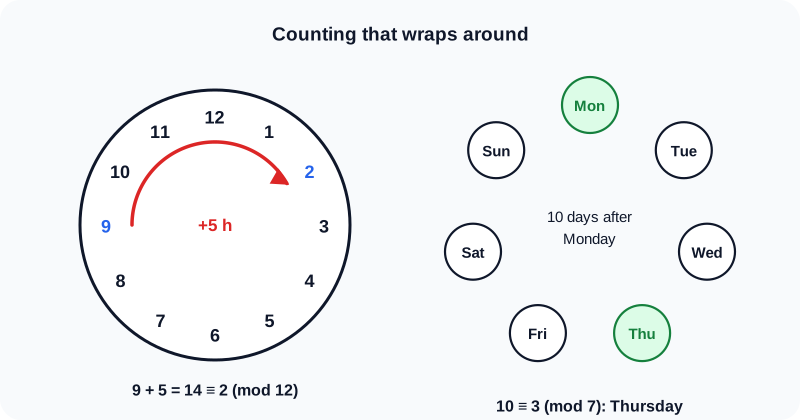
Figure 1. Clocks and calendars are everyday modular arithmetic: mod 12 for hours, mod 7 for days. WASSCE Tutor diagram.
To find , start at position and walk steps clockwise. Where you end up is the answer.
- : walk 7 steps. Pass 0, 1, 2, 3, 4, return to 0, walk to 1, then 2. End at position . So .
- : walk 11 steps. After 5 steps you're back at 0, after 10 you're back at 0 again, then 1 step to position . So .
The key insight: every time you complete a full circle, you can ignore those steps. So means you go around twice and end one step further. The 2 full circles don't change your position — only the remainder () matters.
Use the modular clock idea to find each.
(a)
A mod 7 clock has 7 positions. , so you complete 3 full circles and step 4 more. Answer: .
(b)
. So 8 full circles, then 8 more steps. Answer: .
(c)
. Seven full circles, no extra steps. Answer: .
(d)
Largest multiple of 7 less than or equal to 1000: . So . Answer: .
Real-life appearances of modular arithmetic
The 12-hour clock
A 12-hour clock is mod 12 arithmetic. Hours add modulo 12.
- If it's o'clock now, what time will it be in hours?
- . But . Answer: o'clock.
The 24-hour clock
A military or international clock is mod 24.
- It's . What time will it be in hours?
- . . Answer: (5 a.m.).
Days of the week
Days cycle every 7 days, so mod 7 arithmetic applies.
- Today is Wednesday. What day will it be in days?
- Counting Wednesday as day 0, we want . , so . Two days after Wednesday is Friday.
Days of the month / week
Less obvious examples include: days of the year (mod 365 or 366), months of the year (mod 12), positions on a circular track (mod number of seats), and even something like the position of a player rotating around a snooker table.
The next lesson goes deeper into clock and day-of-the-week problems. For now, focus on the basic remainder operation.
Find each.
(a) Today is Friday. What day will it be in days?
: largest multiple of 7 is 49 (). So . One day after Friday is Saturday.
(b) It's a.m. What time will it be in hours?
On a 12-hour clock: . . So — but we need to know if it's a.m. or p.m. hours is one full day plus hours, so the time is p.m.
On a 24-hour clock: . . So (i.e., 3 p.m.). Same answer.
(c) In a year of days, January 1 is a Monday. What day of the week is December 31?
December 31 is day 365 of the year. We want the day 364 days after January 1 (because January 1 is day 1, December 31 is day 365, so we add 364 days).
: . So 0 days past Monday — same day, Monday.
Answer: Monday. (Yes — exactly 52 weeks in 365 days plus 1 day. The 1-day shift means the next year's January 1 is a Tuesday.)
Key properties — preview
We develop these in the next lesson, but here is a quick preview of why modular arithmetic is useful:
-
Reduce before computing. Instead of computing and then taking mod, you can take each mod first, add, then mod the result. This keeps the numbers small.
-
Multiples cancel. If , then contributes nothing to a mod calculation involving multiples of .
-
Speed. For large numbers, modular reduction can replace heavy arithmetic. WAEC questions like "Find the remainder when is divided by " are solved this way.
A cassava trader in Bo Market keeps a tally of bags sold. Every bags, she ties them in a bundle and stacks them. At the end of the day, she has stacked bundles plus loose bags. Her records say she sold bags. Did she count correctly?
Let's check: Largest multiple of up to is (). So . ✓
Her records of 9 bundles + 3 loose correspond to — exactly what we got. The check works because of how modular arithmetic captures the structure of repeated grouping.
Common errors when first learning modular arithmetic:
1. Forgetting that the remainder must be less than the modulus.
- ❌ Writing or .
- ✓ (because , and is in the range ).
2. Confusing with the quotient.
- The result is the remainder, not how many times divides .
- , not (which would be the quotient).
3. Treating mod like division.
- is not the same as . It's the remainder after division.
4. Forgetting to wrap a negative number into the positive range.
- is not . It's (because ).
5. Treating as a special error.
- is a perfectly valid remainder. means is a multiple of .
WASSCE examination focus
The basic mod operation is the foundation of every WAEC question on this topic. Typical question formats:
- Find . Direct computation — examples above.
- Find the remainder when is divided by . Same as , asked in different words.
- Which of the following is the value of ? Multiple choice, single integer.
- On a 12-hour clock, what time will it be hours after o'clock? Disguised mod 12 question.
- If today is Monday, what day will it be in days? Mod 7 question.
Master the remainder operation before moving on to modular addition and multiplication. Always check that your answer is in the range .
Practice problems
1. Find .
2. Find .
3. Find .
4. Find .
5. Find .
6. Today is Sunday. What day will it be days from now?
7. It is p.m. on a 12-hour clock. What time will it be in hours?
8. Find .
9. Find .
10. Find the smallest positive value of such that .
Worked solutions
1. remainder (because , and ). So .
2. remainder (because , and ). So .
3. remainder (because ). So .
4. , so .
5. remainder (because ). So .
6. : largest multiple of up to is . So . Four days after Sunday: Monday, Tuesday, Wednesday, Thursday.
7. on a 12-hour clock. , which on a clock face is 12 o'clock. (a.m. or p.m.? hours from p.m. is p.m. — i.e., noon the next day.)
8. : , so . Answer: .
9. (adding the modulus brings us into the positive range). So . Check: . ✓
10. Largest multiple of up to is . So . Therefore , and the smallest positive is .
What's next
In the next lesson we cover addition, subtraction and multiplication in modular arithmetic, clock and calendar problems, and solving simple congruences. The key principle: you can reduce before you compute. We will see how this turns long calculations into short ones, why is easy without big multiplication, and how WAEC tests this directly.
Keep going with modular arithmetic
This is one of 7 lessons in Modular Arithmetic. Start free with the first lesson of every topic, then unlock them all, plus exam-style practice marked instantly and guided learning tools, from 25 NLe.
- Free account, no card needed
- Everything from 25 NLe
- No automatic renewal
More lessons in Modular Arithmetic
- Operations in modular arithmetic, clock and calendar problems🔒
- Addition and Subtraction in Modular Arithmetic🔒
- Multiplication and Powers in Modular Arithmetic🔒
- Solving Modular Equations🔒
- Days of the Week and Clock Problems🔒
- Modular Arithmetic: The WAEC Trap🔒