WASSCE Mathematics · Matrices and Determinants
Matrices: order, types and notation
By the WASSCE Tutor team
Updated 12 November 2026 · 12 min read · Prepared against the WASSCE syllabus.
A matrix is a rectangular array of numbers arranged in rows and columns. The matrix
has rows and columns. We call it a matrix (read "2 by 3"). Each number in the matrix is called an entry or element.
Matrices appear everywhere in advanced mathematics — solving systems of equations, transforming geometric shapes, organising data, computer graphics, statistics. For WAEC, the focus is on basic operations: addition, subtraction, scalar multiplication, multiplication, and finding determinants and inverses of matrices.
This lesson introduces matrices and their notation. The next lesson covers matrix operations, determinants, inverses and solving simultaneous equations with matrices.
Matrix: A rectangular array of numbers arranged in rows and columns, enclosed in brackets or parentheses.
Order (or dimension): The number of rows and columns. An matrix has rows and columns.
Notation: Capital letters for matrices. Elements are denoted where is the row and is the column.
Equal matrices: Two matrices are equal if they have the same order AND the same corresponding elements.
Learning objectives
By the end of this lesson you should be able to:
- describe a matrix by its rows, columns and order
- identify the element in a given row and column
- recognise row, column, square, zero, identity, diagonal and symmetric matrices
- state when two matrices are equal
Anatomy of a matrix
In the matrix
- The order is (3 rows, 3 columns).
- (row 1, column 1).
- (row 1, column 2).
- (row 2, column 3).
- (row 3, column 1).
- The element is in the -th row, -th column.
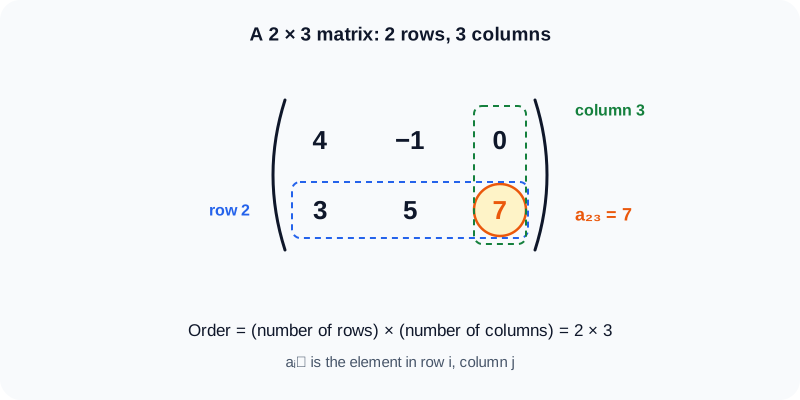
Figure 1. Rows run across, columns run down, and is the element in row , column . WASSCE Tutor diagram.
Reading matrix order
The order is always given as rows × columns (row count first).
- is .
- is (a row matrix or row vector).
- is (a column matrix or column vector).
- is .
Special types of matrices
Row matrix
A matrix with one row: .
Example: .
Column matrix
A matrix with one column: .
Example: .
Square matrix
A matrix with equal rows and columns: .
Example: ().
Zero matrix (null matrix)
All entries are zero. Denoted or .
Example: .
Identity matrix
A square matrix with s on the main diagonal and s elsewhere. Denoted .
- : .
- : .
The identity matrix plays the role of for matrix multiplication.
Diagonal matrix
A square matrix where all off-diagonal entries are zero.
Example: .
The identity matrix is a special diagonal matrix.
Triangular matrices
- Upper triangular: all entries below the main diagonal are zero. Example: .
- Lower triangular: all entries above the main diagonal are zero.
Matrix equality
Two matrices are equal if and only if:
- They have the same order.
- Every corresponding element is equal.
Example 1
Are these matrices equal?
.
Same order (), same corresponding entries. Yes, equal.
Example 2
Are these equal?
.
Different at position . Not equal.
Example 3
Are these equal?
.
Different orders ( vs ). Not equal.
Using matrix equality to solve for unknowns
If two matrices are stated to be equal, set corresponding entries equal.
Example 4
Find and if .
From position : , so . From position : , so .
Example 5
Find if .
. . .
Identify the order of each matrix.
(a) . Order: .
(b) . Order: .
(c) . Order: .
(d) . Order: .
(e) . Order: (a single scalar treated as a matrix).
For , identify each element.
(a) . (b) . (c) . (d) . (e) . (f) .
Why matrices matter
Matrices appear in many contexts.
Systems of equations
The system can be written as the matrix equation .
Data organisation
A shop's sales for products across months: organize as a matrix.
Geometric transformations
Multiplication by a matrix can rotate, scale, or reflect points in the plane. Computer graphics uses this constantly.
Networks
A matrix can represent connections in a network (graph). Entry might be if vertex connects to vertex , otherwise.
Transpose of a matrix
The transpose of , written or , swaps rows and columns. If is , then is .
.
In the transpose, . WAEC may ask basic questions about transpose, but rarely tests it deeply.
A WAEC example
Given and :
(a) What is the order of each matrix? : . : .
(b) Find . .
(c) Find the transpose of . .
(d) Are and equal? No — corresponding entries differ.
A Sierra Leonean school records exam scores for students in subjects. The data is naturally a matrix:
This matrix organises information cleanly. Row is Student 's scores; column is everyone's score in Subject (Chemistry, say).
Matrices are the natural language for tabular data, exactly as WAEC introduces them.
Common errors with matrix basics:
1. Confusing rows and columns.
- Rows go across (horizontal). Columns go down (vertical).
- Order is rows × columns.
2. Reading entries incorrectly.
- has row first, column second. is row , column .
3. Forgetting matrices with different orders aren't equal.
- A matrix and a matrix are different.
4. Treating zero matrix and identity matrix as the same.
- Zero matrix has all zeros. Identity has ones on the diagonal.
WASSCE examination focus
Foundational matrix questions in WAEC:
- Identify order. What is the order of the matrix ? (.)
- Identify an element. In matrix , what is ?
- Equality. If , find .
- Identify type. Is the matrix a zero matrix? identity? diagonal?
Vocabulary and notation are the key foundation.
Practice problems
1. State the order of each matrix. (a) (b) (c)
2. For , find .
3. Write down the identity matrix.
4. Find and if .
5. Find the transpose of .
6. Is the matrix a diagonal matrix? An identity matrix?
7. Find if .
Worked solutions
1. (a) . (b) . (c) .
2. .
3. .
4. . .
5. .
6. Diagonal matrix: yes (zeros off the diagonal). Identity: no (entries on diagonal are , not ).
7. . . .
Keep going with matrices and determinants
This is one of 6 lessons in Matrices and Determinants. Start free with the first lesson of every topic, then unlock them all, plus exam-style practice marked instantly and guided learning tools, from 25 NLe.
- Free account, no card needed
- Everything from 25 NLe
- No automatic renewal
More lessons in Matrices and Determinants
- Matrix Addition, Subtraction, and Scalar Multiplication🔒
- Matrix operations, determinants and inverses🔒
- Matrix Multiplication🔒
- Determinants and Inverse of 2x2 Matrices🔒
- Matrices: The WAEC Trap🔒