WASSCE Mathematics · Logarithms
Logarithms: meaning and the link with indices
By the WASSCE Tutor team
Updated 12 November 2026 · 15 min read · Prepared against the WASSCE syllabus.
If , then we say "the logarithm of to base is ." Logarithms are the inverse of indices — they answer the question: "to what power must I raise this base to get this number?" If indices are about computing , logarithms are about asking " to what power gives ?"
Logarithms were invented in the early s by a Scottish mathematician, John Napier, to make arithmetic easier. They turn multiplication into addition and division into subtraction — a huge advantage before calculators existed. Even today, with calculators everywhere, WAEC still tests logarithms heavily because the underlying ideas appear in algebra, calculus, exponential growth, and many real-world applications.
This lesson defines logarithms, shows their connection to indices, introduces logarithm notation, and works through fundamental conversions.
Definition of a logarithm:
This reads: " of to base equals " if and only if " to the power of equals ."
- is the base of the logarithm (must be positive and not equal to ).
- is the argument (must be positive).
- is the value of the logarithm.
Logarithm answers the question: "What power of gives ?"
Learning objectives
By the end of this lesson you should be able to:
- explain what a logarithm is
- convert between index form and logarithm form
- evaluate simple logarithms without a calculator
- recognise common logarithms (base 10)
The relationship between indices and logarithms
Logarithms and indices say the same thing in different ways:
| Index form | Log form |
|---|---|
Whenever you see a logarithm, you can rewrite it as an exponent. Whenever you see an exponent equation, you can rewrite it as a logarithm. The two forms are interchangeable.
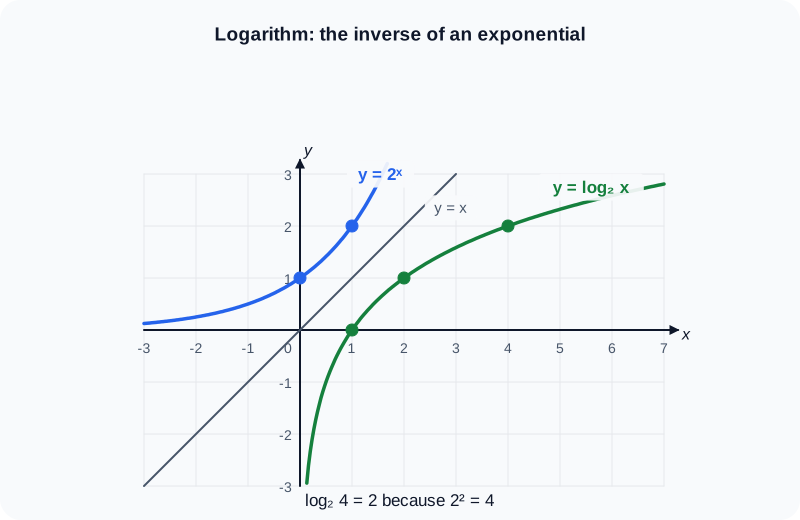
Figure 1. The logarithm undoes the exponential: the two graphs are mirror images in the line y = x. WASSCE Tutor diagram.
Reading logarithm notation
- is read "log to base of equals ."
- is read "log of to base equals " or just "log equals " (because base is the standard common log).
- is read "log of to base equals ."
- (with no subscript) is the natural log — base . WAEC focuses on common log (base ) and other integer bases.
When the base is not written, it is base in WAEC convention. So .
Converting between index and log forms
This is the foundational skill. Be able to convert in both directions.
Index → log
→ . → . → . → .
Log → index
→ . → . → . → .
Convert between forms.
(a) Express in index form. .
(b) Express in log form. .
(c) Express in log form. .
(d) Express in index form. .
(e) Express in index form. .
(f) Express in log form. .
(g) Express in index form. .
Computing simple logarithms
For simple cases, ask yourself: "What power of gives ?"
Example 1
Find .
What power of gives ? . So .
Example 2
Find .
. So .
Example 3
Find .
. So .
Example 4
Find .
. So .
Example 5
Find .
. So .
Example 6
Find .
. So .
Example 7
Find .
Think: , both are powers of . , . So , , . So .
Example 8
Find .
. So .
This is a key fact: for any base . (Because any base to the power is .)
Example 9
Find .
. So .
Another key fact: .
Compute each logarithm.
(a) . . Answer: .
(b) . . Answer: .
(c) . . Answer: .
(d) . Any base to power is . Answer: .
(e) . . . Answer: .
(f) . . Answer: .
(g) . . Answer: .
(h) . , so means , i.e. , . Answer: .
(i) . , . means , i.e. , . Answer: .
(j) . . . Answer: .
Key facts to memorise
These show up constantly. Know them by heart.
Fact 1:
Any base raised to the power is . So for any valid base .
Fact 2:
Any base raised to the power is itself. So .
Fact 3:
The log of a base to a power gives back the power.
Fact 4:
A base raised to its own log gives back the argument.
These are the inverse properties: logs and exponentials undo each other.
Domain — what can go inside a log?
The argument of a logarithm must be positive.
- is fine ().
- is undefined (you can never get by raising to a real power).
- is undefined (you can never get a negative number by raising a positive base to a real power).
Why? Because for any positive and real . So exists only for .
Also, the base must be positive and not equal to .
- is excluded because for all , so would be impossible to define uniquely.
- is excluded because then is not always defined for real .
Why logarithms exist — historical context
Before calculators, multiplying two large numbers like took ages. Logarithms made this easier because:
So you'd:
- Look up in a table (about ).
- Look up in a table (about ).
- Add: .
- Look up the antilog of — that's the product.
Much faster than direct multiplication. This is why the logarithm laws (next lesson) were transformative.
Today, calculators handle large multiplications instantly, but logarithms still matter for:
- Solving exponential equations (where the unknown is in the exponent)
- Modelling growth and decay (population, radioactive material, compound interest)
- Sound intensity (decibel scale uses logs)
- Earthquakes (Richter scale uses logs)
- pH in chemistry (uses log)
- Information theory (bits use log base )
WAEC tests them because they're foundational, not because students still do hand calculations with log tables.
Common logarithm — base
When the base is , it's called the common logarithm. The notation often omits the base:
- means .
- means .
- .
- .
The next lesson shows how common logarithms are used in calculations.
Compute each common log (base ).
(a) . . Answer: .
(b) . . Answer: .
(c) . Always . Answer: .
(d) . . Answer: .
(e) . . Answer: .
(f) . . So . Answer: .
A bank in Bo offers a savings account. Aminata deposits NLe 100 at annual interest, compounded once a year. The amount after years is .
If Aminata wants to know when her money will double (i.e., when ), she sets up: , so .
To solve this, she takes the log of both sides: , so , giving .
Using a calculator: years.
So her money doubles in about years. This kind of growth calculation — using logarithms to find an unknown time or rate — is exactly what WAEC tests with simpler numbers.
Common errors with logarithm basics:
1. Reading the log notation incorrectly.
- means log of to base , not log of to base . The number after the subscript is the base.
2. Forgetting that .
- The log of is always zero, regardless of the base.
3. Forgetting that without a subscript means base .
- in WAEC convention.
4. Trying to take the log of zero or a negative number.
- and are undefined.
5. Confusing log base of with log of raised to .
- ✓
- . (Different: it uses the power law, in the next lesson.)
6. Sign error.
- (because ). The log of a number less than is negative.
WASSCE examination focus
Foundational log questions in WAEC:
- Direct computation. Find . (Answer: )
- Different base. Find . (Answer: )
- Fraction or decimal argument. Find . (Answer: )
- Common log. Find . (Answer: )
- Convert between log and index forms. Express in log form. (Answer: )
- Conceptual. Find . (Answer: )
The key skill is converting between log and index form. Once you can do that, every log question becomes an index question in disguise.
Practice problems
1. Find .
2. Find .
3. Find .
4. Find .
5. Find .
6. Find .
7. Find .
8. Express in log form.
9. Express in index form.
10. Find .
11. Find .
12. Find .
Worked solutions
1. . Answer: .
2. . Answer: .
3. . Answer: .
4. . Answer: .
5. . Answer: .
6. . Answer: .
7. . So .
8. .
9. .
10. , . means , i.e. , so .
11. (any base to power is ).
12. (using Fact 3).
What's next
In the next lesson we cover the laws of logarithms — the rules that turn multiplication into addition, division into subtraction, and powers into multiplication. These three laws are the heart of the topic and the source of most WAEC questions.
Keep going with logarithms
This is one of 7 lessons in Logarithms. Start free with the first lesson of every topic, then unlock them all, plus exam-style practice marked instantly and guided learning tools, from 25 NLe.
- Free account, no card needed
- Everything from 25 NLe
- No automatic renewal
More lessons in Logarithms
- The Laws of Logarithms🔒
- Laws of logarithms, log equations and calculations🔒
- Common Logarithms and the Log Table🔒
- Using Logarithms for Computation🔒
- Logarithmic Equations🔒
- Logarithms: The WAEC Trap🔒