WASSCE Mathematics · Integers and Rational Numbers
Integers and rational numbers: the number systems
By the WASSCE Tutor team
Updated 12 November 2026 · 13 min read · Prepared against the WASSCE syllabus.
Numbers come in many kinds. The natural numbers count things. Integers add the negatives () and zero, giving the full number line. Rational numbers add fractions: any number you can write as where are integers and .
WAEC tests these foundational ideas — ordering numbers on the number line, comparing positives and negatives, working with fractions and decimals. This topic builds the platform for everything that follows.
This lesson introduces each number system, the number line, and basic comparisons. The next lesson covers operations on integers and rational numbers, the order of operations, and the WAEC checklist.
The main number systems:
- Natural numbers : (sometimes also ).
- Whole numbers: .
- Integers : .
- Rational numbers : any number of the form where , .
- Real numbers : all rationals plus irrationals (numbers like that can't be written as a fraction).
Each set contains the previous: .
Learning objectives
By the end of this lesson you should be able to:
- distinguish natural numbers, integers, rational and irrational numbers
- place integers and rational numbers on a number line
- order and compare integers and rational numbers
- classify numbers into the correct number systems
The number line
The number line is a visual representation of numbers. Zero is in the middle; positives extend to the right; negatives extend to the left.
... -4   -3   -2   -1    0    1    2    3    4 ...
  ←———|————|————|————|————|————|————|————|———→
Every integer corresponds to a tick mark. Every rational number has a precise location (between tick marks for non-integers). Every real number — including irrationals — has a precise location.
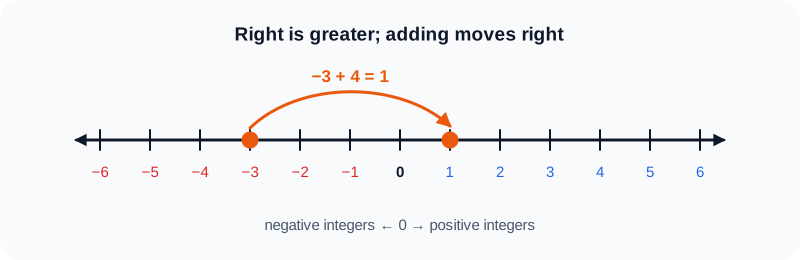
Figure 1. On the number line, numbers to the right are greater, and adding a positive number moves you right. WASSCE Tutor diagram.
Distance on the number line
- Distance between two points is the absolute difference. From to : distance is .
- Absolute value : the distance from to . So and .
Examples
- Distance from to : .
- Distance from to : .
Integers — full structure
Integers include positive, negative, and zero.
Examples: .
Properties of integers
- Closed under addition: integer + integer = integer.
- Closed under subtraction: integer - integer = integer.
- Closed under multiplication: integer × integer = integer.
- NOT closed under division: integer ÷ integer is not always an integer (, not an integer).
Ordering integers
On the number line, a number to the right is greater.
- (because is to the right of )
This matters because students sometimes think (wrong — the more negative, the smaller).
Rational numbers — fractions and integers together
A rational number is any number expressible as with integers and .
Examples
- is rational.
- is rational.
- — every integer is rational (denominator ).
- is rational.
- is rational.
- is rational (recurring decimals are rational).
What's NOT rational?
- — irrational (cannot be expressed as a fraction).
- — irrational.
- — irrational.
Irrationals have non-terminating, non-repeating decimal expansions.
Ordering rationals
On the number line, rational numbers have specific positions.
- (because and ).
- (the more positive direction).
- . Cross-multiply: and . , so .
Review the comparison methods from the Fractions topic.
Identifying types
For any given number, identify which sets it belongs to.
Examples
- : natural, whole, integer, rational, real.
- : whole, integer, rational, real (not natural in some conventions).
- : integer, rational, real.
- : rational, real.
- : real (NOT rational, NOT integer).
- : rational (), real.
- : real (NOT rational).
For each number, list all sets it belongs to (natural, whole, integer, rational, real).
(a) . Natural, whole, integer, rational, real.
(b) . Integer, rational, real.
(c) . Rational, real.
(d) . Since : natural, whole, integer, rational, real.
(e) . Real (not rational).
(f) . Whole, integer, rational, real. (Not natural in the strict convention.)
(g) . Rational (), real.
Comparing and ordering — examples
Example 1
Arrange in ascending order: .
Visualise on the number line. From left (smallest) to right (largest): .
Example 2
Arrange in ascending order: .
Convert to a common denominator or decimal. . . . .
Ascending: . So .
Example 3
Place each on the number line: .
Left to right: .
Order each set from smallest to largest.
(a) . Ascending: .
(b) . LCD : . Ascending: .
(c) . From most negative: .
(d) . Ascending: .
Special properties
Closure
A set is closed under an operation if the result is in the same set.
- Integers closed under . NOT closed under .
- Rationals closed under (except by ).
Additive identity
— adding to any number leaves it unchanged.
Multiplicative identity
— multiplying any number by leaves it unchanged.
Additive inverse
For any number , the additive inverse is (their sum is ).
Multiplicative inverse (reciprocal)
For any nonzero , the multiplicative inverse is (their product is ).
- The reciprocal of is .
- The reciprocal of is .
- The reciprocal of is .
- has no reciprocal.
Density of rationals
Between any two rational numbers, there are infinitely many other rationals.
Example: Between and , you can find .
This is in stark contrast to the integers, which are discrete — no integer lies between and .
In a Sierra Leonean market, prices range across the rationals: NLe (integer), NLe (decimal/rational), NLe (mixed fraction = ).
A temperature dropping below freezing is a negative integer: C in the highlands of Bo at night.
The altitude of a deep mine relative to sea level is also negative: m.
Understanding integers (positive and negative) lets you talk about gains and losses, profits and debts, temperatures, depths, all in a unified way.
Common errors with integers and rationals:
1. Misordering negatives.
- is LESS than , not greater. The more negative, the smaller.
2. Confusing absolute value with sign.
- (positive). NOT .
3. Treating zero as positive or negative.
- is neither positive nor negative.
4. Forgetting that integers are rational.
- Every integer can be written as , so it's a rational.
5. Forgetting irrationals exist.
- are NOT rational.
6. Reciprocal of .
- is undefined — division by is not allowed.
WASSCE examination focus
Foundational integer/rational questions in WAEC:
- Identify the type. Is an integer? a rational? (No, yes.)
- Order numbers. Arrange in ascending order.
- Distance on number line. Find the distance between and . (Answer: .)
- Identify special values. Find the additive inverse of . (Answer: .)
- Reciprocal. Find the reciprocal of . (Answer: .)
Master the vocabulary and ordering. Operations come next.
Practice problems
1. Which sets does each number belong to (natural, whole, integer, rational, real)? (a) (b) (c) (d) (e)
2. Arrange in ascending order: .
3. Arrange in ascending order: .
4. Find the distance between and on the number line.
5. Find , , .
6. Find the additive inverse of: (a) , (b) , (c) , (d) .
7. Find the reciprocal of: (a) , (b) , (c) .
8. Is rational or irrational? If rational, give the fraction.
9. Is rational? If so, write it as a fraction.
10. Find three rational numbers between and .
Worked solutions
1. (a) Natural, whole, integer, rational, real. (b) Integer, rational, real. (c) Rational, real. (d) Whole, integer, rational, real. (e) Real (not rational).
2. .
3. Convert: , , , , . Ascending: .
4. .
5. .
6. (a) . (b) . (c) . (d) .
7. (a) . (b) . (c) .
8. Rational: .
9. , so yes.
10. Many possible. For example: all lie between and .
What's next
In the next lesson we cover operations on integers and rational numbers: adding, subtracting, multiplying and dividing positive and negative numbers, and the order of operations. The sign rules need careful attention.
Keep going with integers and rational numbers
This is one of 5 lessons in Integers and Rational Numbers. Start free with the first lesson of every topic, then unlock them all, plus exam-style practice marked instantly and guided learning tools, from 25 NLe.
- Free account, no card needed
- Everything from 25 NLe
- No automatic renewal
More lessons in Integers and Rational Numbers
- Operations on integers and rational numbers🔒
- Operations on Integers🔒
- Operations on Rational Numbers🔒
- Integers and Rationals: The WAEC Trap🔒