WASSCE Government · Traditional Authority and Local Government in Sierra Leone
Paramount chiefs and chiefdom administration
By the WASSCE Tutor team
Updated 12 November 2026 · 6 min read · Prepared against the WASSCE syllabus.
In the provinces of Sierra Leone, the Paramount Chief is still one of the most important people in daily life. Chiefs help settle land disputes, keep the peace, organise community work, support tax collection and speak for their chiefdoms in Parliament. Their office is older than the state itself, and the 1991 Constitution guarantees it. This lesson explains how chiefdoms are governed today.
Learning objectives
By the end of this lesson you should be able to:
- describe the structure of chiefdom administration
- explain how a Paramount Chief is elected and removed
- state the functions of Paramount Chiefs and the Chiefdom Council
- explain the role of Paramount Chiefs in national politics
- evaluate the strengths and problems of chieftaincy today
Chiefdoms today
- Sierra Leone's provinces are divided into 190 chiefdoms (from 2017, when new chiefdoms were created; there were 149 before).
- The institution of chieftaincy is guaranteed by the 1991 Constitution.
- The Chieftaincy Act 2009 sets out how chiefs are elected, recognised and removed.
Structure of a chiefdom
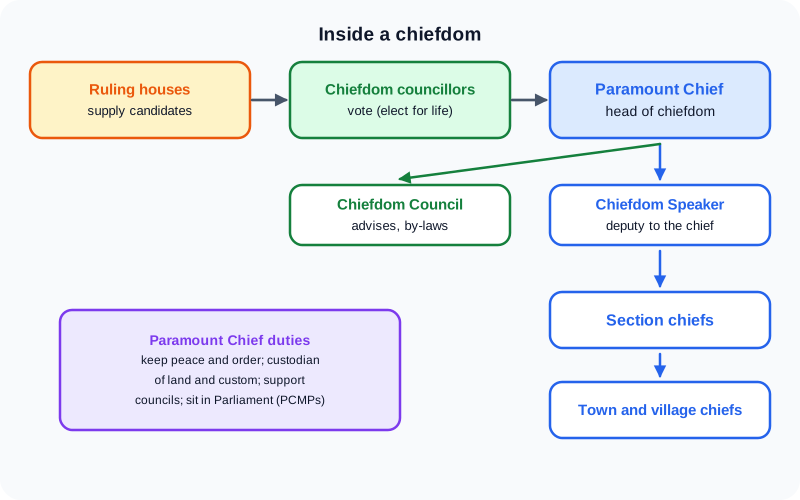
Figure 1. Inside a chiefdom. WASSCE Tutor diagram.
| Office or body | Role |
|---|---|
| Paramount Chief | Head of the chiefdom; custodian of land and custom; keeps law and order |
| Chiefdom Speaker | Deputy to the Paramount Chief; acts for the chief when absent |
| Chiefdom Council | Chiefdom councillors who advise the chief, help make chiefdom bye-laws and elect a new Paramount Chief |
| Section chiefs | Govern sections (groups of towns and villages) |
| Town and village chiefs | Govern local communities |
| Chiefdom police | Help keep order |
| Regent chief | Acts as head of the chiefdom while a Paramount Chief's office is vacant |
Election and removal of a Paramount Chief
- When the office is vacant, a regent chief acts until an election is held.
- Candidates must come from a recognised ruling house of the chiefdom, by birth or, where tradition allows, by lineage.
- The chiefdom councillors, whose names are on an approved and published list, vote to elect the chief.
- The election is supervised by the Provincial Secretary and the Electoral Commission.
- The winner is recognised by the President and holds office for life (or until removed).
- A chief may be removed for misconduct or incapacity after an inquiry, through procedures set out in the Chieftaincy Act.
Functions of Paramount Chiefs
- Maintaining law and order in the chiefdom.
- Custodian of land: approving land allocations and settling land disputes according to custom.
- Preserving custom and tradition.
- Supporting revenue collection, such as local tax, which is shared with local councils.
- Mobilising communities for development, sanitation and public health campaigns.
- Settling disputes by mediation.
- Representing the chiefdom to the government and visitors.
- Sitting in Parliament as Paramount Chief Members of Parliament (PCMPs): one for each of the 14 provincial districts.
Strengths and problems of chieftaincy
| Strengths | Problems |
|---|---|
| Rooted in tradition and respected by many people | Life tenure can lead to abuse of power |
| Closeness to the people and knowledge of local conditions | Elections limited to ruling houses and councillors, not all citizens |
| Useful in mediation, land matters and mobilisation | Disputes and litigation over who belongs to ruling houses |
| Helped communities during crises such as Ebola (2014–2016) | Political interference by governments and parties |
| Provides continuity and identity | Conflict with elected local councils over roles and revenue |
| Women face barriers to becoming chiefs in some areas |
During the Ebola epidemic of 2014–2016, Paramount Chiefs played a key role in many districts. They passed chiefdom bye-laws on safe burials, reporting of sick people and restrictions on movement, and worked with health workers to persuade communities. Their authority helped make public health measures acceptable where outside officials were distrusted.
A Paramount Chief is not elected by all adult citizens of the chiefdom. Under the Chieftaincy Act, the voters are the chiefdom councillors, and candidates must come from recognised ruling houses.
Key points
- 190 chiefdoms (since 2017); chieftaincy guaranteed by the 1991 Constitution; governed by the Chieftaincy Act 2009.
- Structure: Paramount Chief, Chiefdom Speaker, Chiefdom Council, section chiefs, town and village chiefs.
- Chiefs are elected for life by chiefdom councillors from ruling-house candidates.
- Functions: law and order, land, custom, revenue support, mobilisation, mediation, representation; 14 PCMPs in Parliament.
- Problems: life tenure, restricted franchise, disputes, political interference, conflict with councils.
WASSCE examination focus
Expect to describe the structure of chiefdom administration, to explain how Paramount Chiefs are chosen, and to state their functions and the problems of chieftaincy today. Questions often compare traditional and modern local government.
Quick check
- How many chiefdoms are there in Sierra Leone today?
- Who elects a Paramount Chief?
- What is the role of the Chiefdom Speaker?
- How many Paramount Chief Members of Parliament are there?
Answers:
- 190 (since 2017).
- The chiefdom councillors, from candidates belonging to recognised ruling houses.
- Deputy to the Paramount Chief, acting for the chief when absent.
- Fourteen, one for each provincial district.
Keep going with traditional authority and local government in sierra leone
This is one of 2 lessons in Traditional Authority and Local Government in Sierra Leone. Start free with the first lesson of every topic, then unlock them all, plus exam-style practice marked instantly and guided learning tools, from 25 NLe.
- Free account, no card needed
- Everything from 25 NLe
- No automatic renewal
More lessons in Traditional Authority and Local Government in Sierra Leone
- Local councils and decentralisation in Sierra Leone🔒
All of Traditional Authority and Local Government in Sierra Leone →