WASSCE Government · The United Nations and the Commonwealth
The United Nations: origin, aims and organs
By the WASSCE Tutor team
Updated 12 November 2026 · 7 min read · Prepared against the WASSCE syllabus.
Two world wars in thirty years killed tens of millions of people. In 1945, as the second ended, the victorious powers and their allies founded a new organisation to "save succeeding generations from the scourge of war": the United Nations. Almost every country in the world, including Sierra Leone, now belongs to it. This lesson explains the origins, aims, principles and organs of the UN, and its successes and weaknesses.
Learning objectives
By the end of this lesson you should be able to:
- explain the origin of the United Nations and its predecessor, the League of Nations
- state the aims and principles of the UN
- describe the six principal organs and their functions
- name some UN specialised agencies and what they do
- evaluate the achievements and problems of the UN
Origin
- The League of Nations (1920–1946), created after the First World War, failed to prevent the Second World War. The USA never joined, and the League had no armed force to enforce its decisions.
- During the Second World War, the Allies planned a stronger body. The UN Charter was signed by 50 states at San Francisco on 26 June 1945.
- The UN came into existence on 24 October 1945, now celebrated as United Nations Day.
- Headquarters: New York. Membership today: 193 states.
- Sierra Leone joined on 27 September 1961.
Aims of the UN
- To maintain international peace and security.
- To develop friendly relations among nations based on equal rights and self-determination.
- To achieve international cooperation in solving economic, social, cultural and humanitarian problems.
- To promote respect for human rights and fundamental freedoms for all.
- To be a centre for harmonising the actions of nations.
Principles
- Sovereign equality of all members.
- Members fulfil their Charter obligations in good faith.
- Peaceful settlement of disputes.
- No threat or use of force against the territory or independence of any state.
- Members assist the UN in actions it takes under the Charter.
- Non-interference in matters essentially within a state's domestic jurisdiction (except enforcement measures by the Security Council).
The principal organs
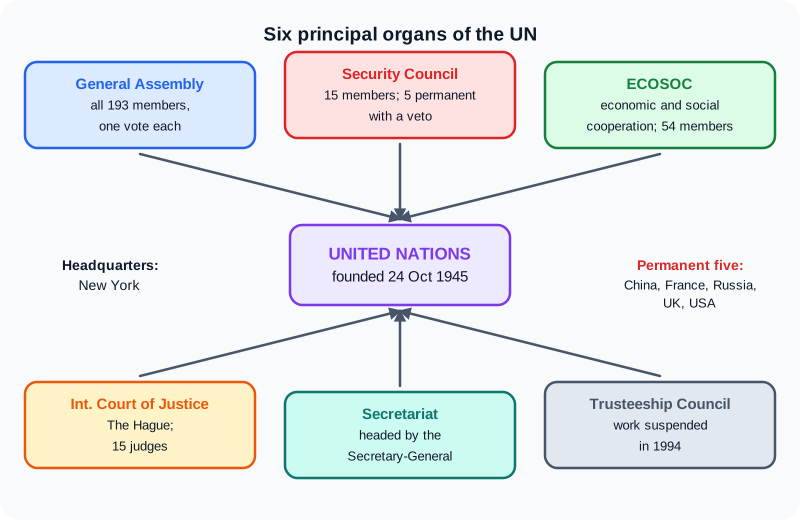
Figure 1. The six principal organs of the UN. WASSCE Tutor diagram.
| Organ | Composition | Functions |
|---|---|---|
| General Assembly | All 193 members, one vote each | Discusses any international issue; approves the budget; admits new members (on the Security Council's recommendation); elects non-permanent Security Council members; appoints the Secretary-General |
| Security Council | 15 members: 5 permanent (China, France, Russia, the UK, the USA) with a veto, and 10 non-permanent elected for two years | Main responsibility for peace and security; can impose sanctions and authorise peacekeeping and military action; its decisions bind members |
| Economic and Social Council (ECOSOC) | 54 members elected by the General Assembly | Coordinates economic, social and humanitarian work and the specialised agencies |
| International Court of Justice (ICJ) | 15 judges elected for nine years; sits at The Hague | Settles legal disputes between states; gives advisory opinions |
| Secretariat | International civil servants headed by the Secretary-General | Runs the UN day to day; the Secretary-General is chief administrative officer and can bring threats to peace to the Security Council |
| Trusteeship Council | The permanent five | Supervised trust territories until they became independent; suspended its work in 1994 |
The Secretary-General is appointed by the General Assembly on the recommendation of the Security Council, usually for five-year terms. António Guterres of Portugal has held the office since 2017.
Specialised agencies and programmes
| Agency | Work |
|---|---|
| WHO (World Health Organization) | Global health, disease control |
| UNESCO | Education, science and culture |
| FAO (Food and Agriculture Organization) | Agriculture and food security |
| ILO (International Labour Organization) | Workers' rights and labour standards |
| IMF and World Bank | Financial stability and development loans |
| UNICEF | Children's welfare |
| UNDP | Development programmes |
| WFP (World Food Programme) | Food aid |
| UNHCR | Refugees |
Achievements and problems
| Achievements | Problems |
|---|---|
| Has prevented another world war | The veto lets one permanent member block action |
| Peacekeeping missions, as in Sierra Leone | Depends on members for troops and money |
| Supported decolonisation in Africa and Asia | Big powers sometimes ignore its decisions |
| Human rights standards (UDHR, 1948) | The Security Council does not reflect today's world; Africa has no permanent seat |
| Humanitarian aid, health campaigns and refugee protection | Slow, bureaucratic decision-making |
| A forum where small states have an equal vote | Some peacekeeping failures, such as Rwanda (1994) |
Sierra Leone has played an active role in the UN. It served as a non-permanent member of the Security Council in 1970–1971 and again in 2024–2025. Through the African Union's Committee of Ten, which Sierra Leone coordinates, it has pressed for reform of the Security Council so that Africa gains permanent seats.
Only the five permanent members of the Security Council have a veto. The ten non-permanent members, and all members of the General Assembly, do not.
Key points
- The UN replaced the League of Nations; Charter signed 26 June 1945; founded 24 October 1945; HQ New York; 193 members; Sierra Leone joined 27 September 1961.
- Aims: peace and security, friendly relations, cooperation, human rights.
- Six organs: General Assembly, Security Council (P5 veto), ECOSOC, ICJ (The Hague), Secretariat, Trusteeship Council (suspended 1994).
- Agencies: WHO, UNESCO, FAO, ILO, IMF, World Bank, UNICEF, UNDP, WFP, UNHCR.
- Problems: the veto, funding, big-power politics, unrepresentative Security Council.
WASSCE examination focus
Expect to state the aims and principles of the UN, to describe its principal organs, to name specialised agencies and their functions, and to evaluate its achievements and problems. The veto and Security Council reform are common essay topics.
Quick check
- When was the United Nations founded?
- Name the five permanent members of the Security Council.
- Where does the International Court of Justice sit?
- What do the WHO and FAO do?
Answers:
- On 24 October 1945.
- China, France, Russia, the United Kingdom and the United States.
- At The Hague, in the Netherlands.
- The WHO works on global health and disease control; the FAO works on agriculture and food security.
Keep going with the united nations and the commonwealth
This is one of 2 lessons in The United Nations and the Commonwealth. Start free with the first lesson of every topic, then unlock them all, plus exam-style practice marked instantly and guided learning tools, from 25 NLe.
- Free account, no card needed
- Everything from 25 NLe
- No automatic renewal
More lessons in The United Nations and the Commonwealth
- The UN in Sierra Leone and the Commonwealth🔒