WASSCE Government · The Legislature
The legislature: types, composition and functions
By the WASSCE Tutor team
Updated 12 November 2026 · 7 min read · Prepared against the WASSCE syllabus.
Every law that governs life in Sierra Leone, from the Public Elections Act to the Finance Act that sets taxes each year, passes through one building on Tower Hill in Freetown: Parliament. The legislature is the law-making arm of government and the people's main voice in it. This lesson explains what a legislature is, the difference between one-chamber and two-chamber legislatures, its officers, and its functions.
Learning objectives
By the end of this lesson you should be able to:
- define the legislature and state other names for it
- distinguish unicameral and bicameral legislatures, with merits and demerits of each
- identify the officers of a legislature and their roles
- explain the functions of the legislature
- explain the factors that weaken legislatures
What is the legislature?
The legislature is the arm of government that makes, amends and repeals laws. It is made up of the elected (and sometimes appointed or nominated) representatives of the people.
Different countries use different names: Parliament (Sierra Leone, Ghana, Britain), National Assembly (Nigeria, The Gambia), Congress (USA) and the Legislature (Liberia).
Unicameral and bicameral legislatures
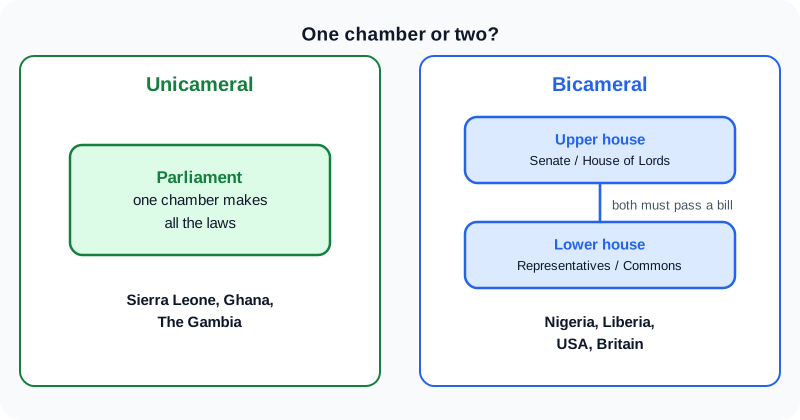
Figure 1. One chamber or two. WASSCE Tutor diagram.
| Unicameral | Bicameral | |
|---|---|---|
| Meaning | One chamber (house) | Two chambers: upper and lower |
| Examples | Sierra Leone, Ghana, The Gambia | Nigeria (Senate and House of Representatives), the USA (Senate and House), Britain (Lords and Commons) |
| Merits | Cheaper; quicker law-making; no deadlock between houses; clear responsibility | The second house revises hasty laws; represents states or special interests in federations; checks the lower house |
| Demerits | Hasty laws may pass; no second check; the ruling party can dominate | Expensive; slow; deadlock between the houses; the upper house may be undemocratic (for example, the unelected House of Lords) |
Federal states usually have bicameral legislatures, so that one house can give the states equal representation. Small unitary states such as Sierra Leone often find one chamber enough.
Officers of the legislature
| Officer | Role |
|---|---|
| Speaker | Presides over sittings, keeps order, interprets the rules (standing orders), certifies bills and represents the House |
| Deputy Speaker | Acts for the Speaker when absent |
| Clerk of Parliament | Chief administrative officer: keeps records, prepares the order paper and minutes, and advises on procedure |
| Leader of Government Business (Majority Leader) | Leads the ruling party in the House and arranges government business |
| Minority Leader (Leader of the Opposition) | Leads the largest opposition party and its criticism of government |
| Whips | Ensure party members attend and vote with their party |
| Sergeant-at-Arms | Keeps order in the chamber and has custody of the Mace, the symbol of the House's authority |
Functions of the legislature
- Law-making: passing, amending and repealing laws.
- Financial control: approving the budget and taxes (the Appropriation and Finance Acts); no public money may be spent without its authority.
- Oversight of the executive: questioning ministers, debates, motions and committee investigations.
- Approving appointments: ministers, judges, ambassadors and heads of agencies.
- Ratifying agreements: approving loans, treaties and major agreements, such as mining agreements.
- Amending the constitution by a special majority.
- Removing the President through the procedure laid down in the constitution.
- Representation: voicing the needs of constituents and districts.
- Debating public issues and educating the public on them.
- Investigating matters of public concern through committees.
How does Parliament control public money? Three stages:
- Before spending: the Minister of Finance presents the budget; Parliament debates and passes the Appropriation Act, which authorises spending.
- During the year: extra spending needs a supplementary appropriation approved by Parliament.
- After spending: the Auditor-General audits the accounts, and Parliament's Public Accounts Committee examines the report and questions officials who misused funds.
Factors that weaken legislatures
- Executive dominance: the President's party often controls Parliament, so MPs rubber-stamp government bills.
- Strict party discipline: MPs vote with their party rather than their conscience.
- Delegated legislation, which transfers detailed law-making to ministers.
- Lack of resources, research staff and expertise.
- Military coups, which dissolve legislatures entirely.
- Corruption and the low quality of some members.
Sierra Leone's Parliament is unicameral. Its ordinary members are elected for five years, and it also includes Paramount Chief Members of Parliament, one for each provincial district, who give traditional rulers a voice in law-making. Its Public Accounts Committee holds public hearings on the Auditor-General's annual report, questioning officials named for missing or unaccounted funds.
The Speaker does not lead the ruling party in the House. The Speaker is meant to be an impartial presiding officer. The person who leads the government side is the Leader of Government Business (Majority Leader).
Key points
- The legislature makes, amends and repeals laws; it may be unicameral (Sierra Leone) or bicameral (Nigeria, USA, Britain).
- Officers: Speaker, Deputy Speaker, Clerk, Majority and Minority Leaders, Whips, Sergeant-at-Arms.
- Functions: law-making, financial control, oversight, approving appointments, ratifying agreements, amending the constitution, representation.
- Weakened by executive dominance, party discipline, delegated legislation, poor resources and military rule.
WASSCE examination focus
Expect to state the functions of the legislature, to compare unicameral and bicameral legislatures with their merits and demerits, and to explain the roles of the Speaker and the Clerk. Essay questions often ask how the legislature controls the executive, or why legislatures in West Africa are weak.
Quick check
- What is a bicameral legislature? Give one example.
- State two functions of the Speaker.
- Which committee examines the Auditor-General's report?
- Give two merits of a unicameral legislature.
Answers:
- A legislature with two chambers (an upper and a lower house), for example Nigeria's National Assembly (Senate and House of Representatives), the US Congress or the British Parliament.
- Any two: presides over sittings; maintains order; interprets the standing orders; certifies bills; represents the House.
- The Public Accounts Committee.
- Any two: cheaper to run; faster law-making; no deadlock between houses; clear responsibility for laws.
Keep going with the legislature
This is one of 2 lessons in The Legislature. Start free with the first lesson of every topic, then unlock them all, plus exam-style practice marked instantly and guided learning tools, from 25 NLe.
- Free account, no card needed
- Everything from 25 NLe
- No automatic renewal
More lessons in The Legislature
- How a bill becomes law and the Parliament of Sierra Leone🔒