WASSCE Government · The Executive
The executive: types, composition and functions
By the WASSCE Tutor team
Updated 12 November 2026 · 8 min read · Prepared against the WASSCE syllabus.
When a new road is built, a hospital opens, police patrol the streets or a minister announces school fees support, you are watching the executive at work. Of the three arms of government, it is the one that turns laws and policies into action. This lesson explains what the executive is, the different kinds of executive, who belongs to it and what it does.
Learning objectives
By the end of this lesson you should be able to:
- define the executive and identify its members
- distinguish nominal and real, single and plural, and political and permanent executives
- explain the functions of the executive
- explain why the executive has grown in power in modern states
What is the executive?
The executive is the arm of government that implements (carries out) laws and policies and runs the day-to-day administration of the state. It includes the head of state or government, ministers, the civil service, the police and the armed forces.
In a narrow sense, "the executive" means the political leaders at the top: the President or Prime Minister and the ministers. In a wide sense it includes everyone who carries out government decisions, from the President down to a clerk in a district office.
Types of executive
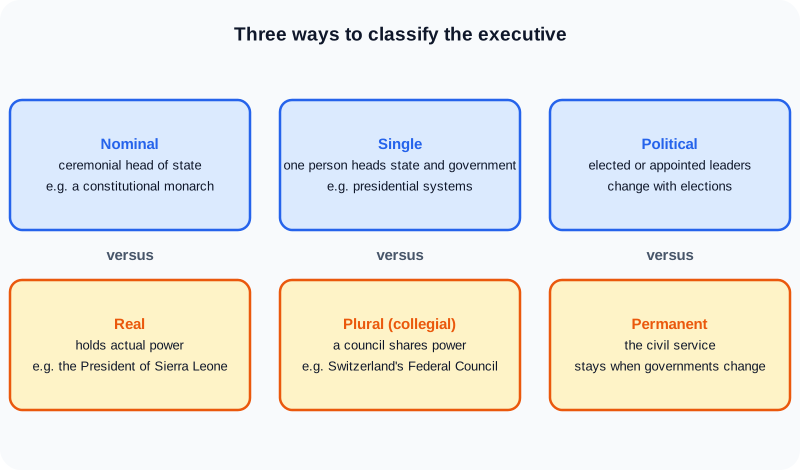
Figure 1. Three ways to classify the executive. WASSCE Tutor diagram.
| Type | Meaning | Example |
|---|---|---|
| Nominal (ceremonial) | Head of state with formal powers only; acts on advice | The British monarch; the President of Germany |
| Real (effective) | Holds and uses actual executive power | The President of Sierra Leone; the British Prime Minister |
| Single | One person is both head of state and head of government | Presidential systems: Sierra Leone, the USA |
| Dual | Head of state and head of government are different people | Parliamentary systems: Britain, India |
| Plural (collegial) | Executive power is shared by a council of equals | The Swiss Federal Council (seven members) |
| Political | Elected or appointed leaders who make policy and change with elections | President, ministers |
| Permanent | Career officials who carry out policy and stay when governments change | The civil service |
Composition of the executive
- The head of state and head of government (in Sierra Leone, both are the President).
- The Vice-President or deputy.
- Ministers, who head ministries and together form the cabinet.
- The civil service: permanent secretaries, directors and officials who run ministries, departments and agencies.
- The security forces: the police and the armed forces, under civilian command.
- Public corporations and agencies that deliver services on behalf of the state.
Functions of the executive
- Implementing laws passed by the legislature.
- Formulating policy: deciding what the government will do on education, health, roads and the economy.
- Maintaining law and order through the police and, where necessary, the armed forces.
- Defending the state against external attack; the head of state is commander-in-chief.
- Preparing the budget and presenting it to the legislature for approval.
- Conducting foreign relations: appointing ambassadors, signing treaties, joining international organisations.
- Making appointments to public offices, such as ministers, ambassadors and heads of agencies.
- Initiating legislation: most bills come from ministries.
- Delegated legislation: making rules, regulations and orders under powers given by Acts.
- Granting pardons (prerogative of mercy) to convicted offenders.
- Conferring honours and national awards.
Matching functions to examples. Classify each action:
- The President signs an agreement with a foreign government: foreign relations.
- The Minister of Finance reads the budget in Parliament: financial function (preparing the budget).
- The police deploy officers to keep order at a football match: maintaining law and order.
- A minister issues regulations under an Act to set new fees: delegated legislation.
- The President releases prisoners on Independence Day: prerogative of mercy.
Why has executive power grown?
In nearly every modern state, the executive has become the strongest arm of government. Reasons include:
- The welfare state: governments now provide education, health, water and electricity, which needs a large administration.
- Economic planning and the management of public corporations.
- Emergencies and security threats, which require quick decisions.
- Delegated legislation, which lets the executive make detailed rules.
- Control of the ruling party, which often controls the legislature too.
- Control of information and the media, and the personal popularity of leaders.
- Technical complexity of modern government, which favours experts in the civil service.
In Sierra Leone, the executive delivers flagship programmes such as Free Quality School Education, launched in 2018, through the Ministry of Basic and Senior Secondary Education. Teachers' salaries, school grants and textbook supplies are all managed by ministries and agencies of the executive, showing how far its work now reaches into daily life.
Do not confuse nominal with plural. A nominal executive is a ceremonial head of state with little real power; a plural executive is a council that shares real power. Britain has a nominal head of state (the monarch); Switzerland has a plural executive.
Key points
- The executive implements laws and policies and runs the administration.
- Types: nominal or real, single or dual, plural (collegial), political or permanent.
- It includes the head of state, ministers, civil service, police and armed forces.
- Functions: implementing laws, policy-making, law and order, defence, budget, foreign relations, appointments, delegated legislation, pardon.
- Its power has grown because of the welfare state, planning, emergencies, delegated legislation and party control.
WASSCE examination focus
Expect to define the executive, to distinguish types of executive (especially nominal and real, and political and permanent), and to state its functions. Essay questions often ask why the executive has become more powerful than the legislature, or how its power can be controlled.
Quick check
- What is a plural executive? Give one example.
- State three functions of the executive.
- Distinguish the political executive from the permanent executive.
- Give two reasons why executive power has grown.
Answers:
- An executive in which power is shared by a council of equals rather than held by one person, for example the Swiss Federal Council.
- Any three: implementing laws; making policy; maintaining law and order; defence; preparing the budget; foreign relations; making appointments; initiating bills; delegated legislation; granting pardons; conferring honours.
- The political executive is made up of elected or appointed leaders (the President and ministers) who make policy and change with elections; the permanent executive is the civil service, whose career officials carry out policy and remain when governments change.
- Any two: the welfare state; economic planning; emergencies and security threats; delegated legislation; control of the ruling party; control of information; technical complexity of government.
Keep going with the executive
This is one of 2 lessons in The Executive. Start free with the first lesson of every topic, then unlock them all, plus exam-style practice marked instantly and guided learning tools, from 25 NLe.
- Free account, no card needed
- Everything from 25 NLe
- No automatic renewal
More lessons in The Executive
- The executive in Sierra Leone and limits on executive power🔒