WASSCE Government · The 1978 and 1991 Constitutions
The 1978 one-party constitution
By the WASSCE Tutor team
Updated 12 November 2026 · 6 min read · Prepared against the WASSCE syllabus.
From 1978 to 1991, Sierra Leone had only one lawful political party: the All People's Congress (APC). Elections still took place, but voters could choose only between APC candidates, and the party chose the only presidential candidate. This lesson explains why the one-party state was created, how the 1978 Constitution worked, and what it meant for the country.
Learning objectives
By the end of this lesson you should be able to:
- define a one-party state
- explain the reasons given for the one-party state in Sierra Leone
- state the features of the 1978 Constitution
- state the merits and demerits of the one-party system
- explain how the one-party state ended
What is a one-party state?
A one-party state is one in which only one political party is allowed to exist and contest elections. It is de jure when the law or constitution makes it so, and de facto when other parties exist legally but cannot compete effectively.
Sierra Leone under the 1978 Constitution was a de jure one-party state.
Reasons given for the one-party state
The APC government argued that a one-party state would:
- End political violence between parties, which had marked the elections of 1973 and 1977.
- Promote national unity by removing parties that divided people along ethnic and regional lines.
- Save money spent on competitive elections.
- Allow faster development, with everyone working together.
- Fit African traditions of consensus under a single leader.
- Follow the example of other African states such as Tanzania and Guinea.
Critics saw a different reason: the wish of the ruling party and President Stevens to remove all opposition and stay in power.
The 1978 Constitution
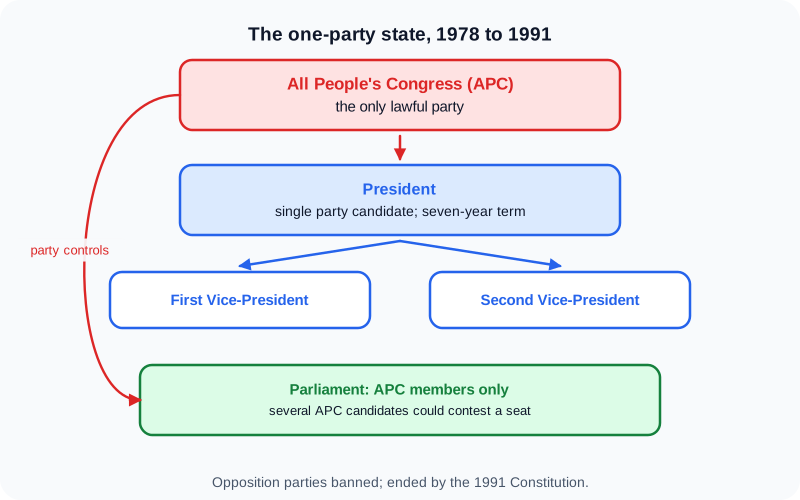
Figure 1. The one-party state, 1978 to 1991. WASSCE Tutor diagram.
The constitution was approved in a referendum in 1978, with an officially reported vote of about 97% in favour, a result widely regarded as heavily manipulated.
Features:
- The APC was the only lawful political party.
- The President was nominated as the single candidate of the party and served a seven-year term.
- A First Vice-President and a Second Vice-President assisted the President; the office of Prime Minister was abolished.
- Members of Parliament had to be APC members; several APC candidates could compete for one seat, so voters had some choice of individuals.
- Paramount Chief members remained in Parliament.
- The party's organs, such as its Central Committee, had great influence over government.
- Fundamental rights remained in the text, but freedom of association was limited by the ban on other parties.
Merits and demerits
| Claimed merits | Demerits |
|---|---|
| Reduced inter-party violence at elections | No real choice of government or president |
| Encouraged a sense of national unity | No opposition to check the government |
| Lower cost of politics | Concentration of power and personal rule |
| Allowed some choice between candidates in constituencies | Abuse of human rights; critics silenced |
| Corruption and economic mismanagement went unchecked | |
| Rigged elections and apathy |
The end of the one-party state
- 1985: Siaka Stevens retired and handed over to Major-General Joseph Saidu Momoh, the army commander, who was elected as the single candidate.
- The economy declined sharply in the 1980s: shortages, inflation and unpaid salaries.
- From 1989–1990, the end of the Cold War and pressure from citizens and donors pushed many African states back to multi-party politics.
- In 1990, President Momoh set up a Constitutional Review Commission under Dr Peter Tucker.
- In 1991, a new constitution restoring multi-party democracy was approved by referendum.
The First Vice-President under the one-party constitution was S. I. Koroma, and the Second Vice-President was C. A. Kamara-Taylor. Both were long-serving APC leaders. The arrangement shows how the APC's senior leadership and the state had become almost the same thing during the one-party period.
Elections did not stop under the one-party state. General elections were held in 1982 and 1986, but only APC candidates could stand, and there was only one presidential candidate.
Key points
- 1978 Constitution: Sierra Leone a de jure one-party state under the APC, approved by a referendum (officially about 97% yes).
- President: single party candidate, seven-year term, with First and Second Vice-Presidents; Prime Minister abolished.
- Only APC members in Parliament; several APC candidates per seat allowed.
- Demerits: no choice, no opposition, personal rule, rights abuses, corruption.
- Momoh succeeded Stevens in 1985; the Tucker Commission (1990) led to the 1991 Constitution.
WASSCE examination focus
Expect to define a one-party state, to explain why Sierra Leone adopted it in 1978, to state the features of the 1978 Constitution, and to give its merits and demerits. Questions may also ask why one-party states declined in Africa around 1990.
Quick check
- Which party was the only lawful party under the 1978 Constitution?
- How long was the President's term under the 1978 Constitution?
- State two reasons the government gave for the one-party state.
- Who succeeded Siaka Stevens as President in 1985?
Answers:
- The All People's Congress (APC).
- Seven years.
- Any two: to end political violence; to promote national unity; to save money; to speed up development; to fit African traditions of consensus; to follow other African states.
- Major-General Joseph Saidu Momoh.
Keep going with the 1978 and 1991 constitutions
This is one of 2 lessons in The 1978 and 1991 Constitutions. Start free with the first lesson of every topic, then unlock them all, plus exam-style practice marked instantly and guided learning tools, from 25 NLe.
- Free account, no card needed
- Everything from 25 NLe
- No automatic renewal
More lessons in The 1978 and 1991 Constitutions
- The 1991 Constitution and the return to multi-party democracy🔒